
Male Skin Regeneration Secrets: What Actually Helps Men’s Skin Renew and Repair
“Male skin regeneration” isn’t literal regrowth. It describes three things skin does continuously: renewing its outer layer, rebuilding its barrier after damage, and remodeling collagen in the dermis. The best-supported ways to help all three are daily broad-spectrum sunscreen (SPF 30 or higher) and a topical retinoid. Vitamin C and niacinamide have moderate support, peptides have modest support, and nothing in a jar replaces avoiding smoking and excess sun. Men also have a factor most guides skip: shaving, which limits how much irritation the skin barrier can absorb from active ingredients.
Men’s skin tends to start out thicker, oilier, and with more collagen than women’s, which is why visible aging often shows up later. Later isn’t never. Thicker skin postpones visible change without preventing it, and the changes that do arrive can look sudden.
Search for “skin regeneration”, and you’ll find plenty of promises and very little definition. This guide separates what your skin already does on its own, what slows those processes with age, and which products and habits have human evidence behind them. It also says plainly where the evidence is thin, and where it comes mostly from studies of women.
This article summarizes the published research and dermatology-organization guidance, and the sources are listed at the end. For the full step-by-step routine, see our men’s anti-aging skincare regimen.
What “skin regeneration” really means
Skin doesn’t regrow the way a lizard regrows a tail. What it does is renew and repair, through three overlapping processes:
| Process | What happens | What changes with age | What can influence it |
|---|---|---|---|
| Outer-layer renewal | Cells form in the deepest layer of the epidermis, rise, flatten, and are shed. The full cycle is commonly cited as about 28 days in young adults. | It slows. In one dataset, stratum corneum turnover on the forearm took about 20 days under age 35 and about 28 days over age 60 [6]. | Retinoids; sun protection; gentle exfoliation (evidence is mixed) |
| Barrier recovery | The outer layer rebuilds its water-holding lipids and protective structure after disruption from shaving, harsh cleansers, or strong actives. | Recovery after barrier disruption is slower in older skin [6]. | Barrier-supportive moisturizers; niacinamide; fewer irritants at once |
| Collagen remodeling | Fibroblasts in the dermis build and break down collagen. | Collagen and structural support decline with age, and UV exposure compounds the visible effects [8]. | Sun protection; retinoids (best evidence); vitamin C; in-office procedures |
Treat “28 days” as shorthand, not a personal schedule. Turnover varies by person and by body site, and the point isn’t the exact number: renewal and repair both get slower, which is why gradual build-up beats aggressive routines as you get older.
For the barrier side in depth, see our how-to repair a damaged skin barrier.
Why the wording matters
In the United States, the FDA treats a product as a drug, not a cosmetic, when it’s intended to affect the structure or function of the skin, such as removing wrinkles or increasing collagen production. Making lines less noticeable by moisturizing is a cosmetic claim (FDA). That’s why a serum can say it makes skin look smoother but shouldn’t promise to regenerate it. When you see “regeneration” on a label, treat it as a prompt to read the ingredient list, not as evidence. Prescription retinoids such as tretinoin are drugs and are prescribed as such.
How men’s skin differs, and what that means for repair
A 2018 literature review in the International Journal of Women’s Dermatology, covering studies through early 2017, found that hydration, transepidermal water loss (the amount of water escaping through the skin), sebum, microcirculation, pigmentation, and thickness were generally higher in men, while skin pH was higher in women (Rahrovan et al., 2018). Averages hide a lot of individual variation, but a few differences shape practical decisions:
| Feature | What studies generally report | Why it matters for your routine |
|---|---|---|
| Thickness | Often reported as roughly 20–25% thicker than women’s, varying by body site | Visible lines tend to appear later and can look more abrupt |
| Collagen | Higher baseline; classic measurements suggest a steadier decline in men and a sharper drop in women after menopause | Change tends to be gradual, then noticeable |
| Sebum | Higher | Shine, and larger-looking pores; lighter formulas are often easier to stick with |
| Shaving (a habit, not biology) | Frequent mechanical stress, plus the risk of razor bumps (AAD) | The main male-specific limit on how many actives your barrier can take |
A caution: most of the research enrolled women
Worth knowing before you trust any “for men” claim, including mine: a systematic review of randomized trials of topical tretinoin for photoaging noted that almost all participants were women (2022 tretinoin review). The much-cited estimate that UV causes about 80% of visible facial aging came from 298 women (Flament et al., 2013).
A large multinational survey linking smoking and alcohol to facial aging included 3,267 women (Goodman et al., 2019), and about 72% of patients in a recent microneedling review were female (2025 microneedling review). Skin biology overlaps heavily between the sexes, so these findings probably apply broadly. But the exact effect sizes and tolerability in men are less well documented than most guides imply.
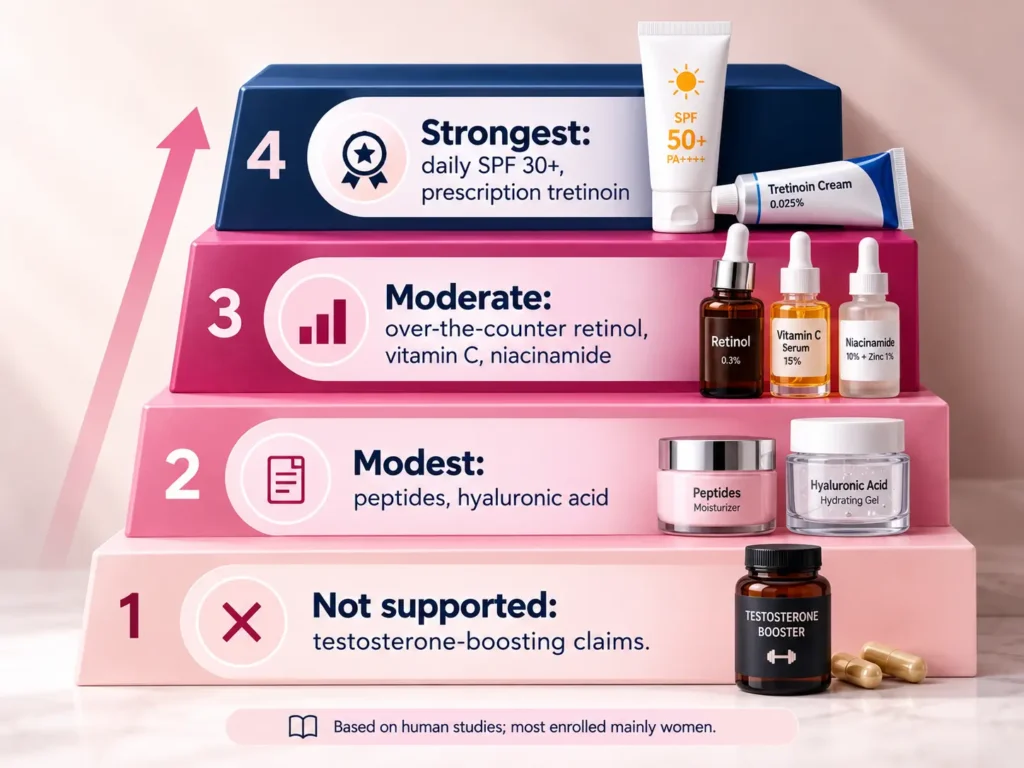
The evidence ladder: what helps, and how strongly
The ranking reflects the quality and consistency of human evidence for improving how skin looks and behaves, not how popular a product is.
| Tier | Option | What the research shows | Main limits |
|---|---|---|---|
| Strongest | Daily broad-spectrum SPF 30+ | The AAD’s core recommendation for preventing sun-driven aging [3]; UV linked to most visible facial aging signs in one study [8] | Observational data; mostly women |
| Strongest | Prescription tretinoin | A systematic review of randomized trials found improved wrinkling, mottled pigmentation, sallowness, and sun spots as early as one month, sustained to 24 months [4]. A 2024 review still calls it the gold standard [5] | Irritation; mostly women; formulations vary |
| Moderate | Over-the-counter retinol | Milder than prescription retinoids; the AAD advises starting with the mildest product [2]. Comparisons with tretinoin are mostly low quality [5] | Strengths and formulations vary by brand |
| Moderate | L-ascorbic acid (vitamin C), 10–20% | Reviews support antioxidant, photoprotective, and anti-aging effects; it’s the best-validated vitamin C form [9][10] | Unstable; small trials |
| Moderate | Niacinamide | Trials suggest it slows progression of visible aging and hyperpigmentation; well tolerated [11] | Mechanism not well understood |
| Modest | Peptides | Some in vivo studies; evidence is limited, and independent trials are scarce [12][13] | Skin penetration; small or industry-funded studies |
| Modest | Hyaluronic acid | A humectant that draws water to the surface and temporarily improves how skin looks and feels (general dermatologic understanding, not a trial claim) | Hydrates; doesn’t rebuild collagen |
| Not supported | “Testosterone-boosting,” “stem-cell,” or price-based claims | I found no clinical trial evidence for topical testosterone-boosting cosmetics in this research | n/a |
For a head-to-head on two of the moderate-tier actives, see vitamin C vs niacinamide.
Sunscreen: the step that protects everything else
The American Academy of Dermatology’s criteria are simple: broad-spectrum (covers UVA and UVB), SPF 30 or higher, and water-resistant. Apply it about 15 minutes before going out, use enough to cover all exposed skin, and reapply about every two hours outdoors and right after swimming or sweating (AAD). Every other step in your routine works better if this one is reliable, and a retinoid makes daily sun protection more important, not optional (AAD).
A few points that matter more for men:
- Thinning hair. The AAD advises putting sunscreen on the scalp or wearing a wide-brimmed hat (AAD).
- Lips. Use a lip balm with SPF 30 or higher (AAD)
- Dark spots. The AAD notes that tinted sunscreen containing iron oxide offers extra protection against dark spots (AAD)
- Format. Lotions, creams, gels, and sticks are all fine if they meet the three criteria; the best sunscreen is the one you’ll actually wear (AAD)
- . See physical vs chemical sunscreen and sunscreen ingredients for sensitive skin if shaving leaves your skin reactive.
How much of visible aging does the sun cause?
One study of 298 women in France attributed about 80% of visible facial aging signs to UV exposure(Flament et al., 2013).
Treat the number as indicative: it came from women, the authors were affiliated with a cosmetics company, and the design was observational. The direction matches why dermatology bodies put sun protection first.
Retinoids: the best-studied way to nudge renewal and collagen
Retinoids are vitamin A derivatives. They influence how epidermal cells divide and mature and how collagen is turned over, which is why they’re the most studied topical option for photoaging (2022 review; 2024 review). Prescription tretinoin is the reference standard. Retinol and related over-the-counter forms are milder and easier to tolerate, but the trial evidence behind specific over-the-counter products is thinner (2024 review).
We explain the underlying mechanism in more detail in our guide to how retinol works at the cellular level.
What to expect.
In trials, tretinoin improved wrinkling, mottled pigmentation, sallowness, and sun spots as early as one month, with benefits holding through the 24 months studied (2022 review). Timelines for over-the-counter products vary, so give a retinoid several months before judging it.
How to start retinoids, following AAD guidance:
- Choose the mildest formulation available, apply it every other night at first, and follow with a moisturizer [AAD].
- Use SPF 30 or higher every morning, and wear a hat or seek shade [AAD].
- Increase frequency only after the flaking and stinging settle.
- Don’t shop by percentage alone. Labels list retinol strength, but the number doesn’t predict irritation or results across brands; formulation and your own tolerance matter. That’s why I’ve dropped the specific starting percentage the earlier version of this article gave.
- If you have significant redness or flushing, check with a dermatologist first, since that can point to rosacea, which needs different treatment [AAD].
- Prescription tretinoin needs a dermatologist’s guidance.
Skin of color. AAD guidance notes that retinol irritation can leave dark marks in skin of color [AAD]. If you have a deeper skin tone, go slower and buffer more, and see our guide to ingredients for hyperpigmentation. For layering with other actives, see layering actives without irritation.
Retinoids and shaving. Both add stress to the barrier. Many men do better separating them: shave in the morning and use the retinoid in the evening, or skip the retinoid on the night after an especially close shave. This is practical reasoning about irritation, not a result from a trial in men. If your face stings when you apply moisturizer, you’ve stacked too much; pause the retinoid for a few days.
Vitamin C, niacinamide, peptides, and hyaluronic acid
These supporting actives each do something different, and you don’t need all four.
Vitamin C
L-ascorbic acid is the form with the most clinical support.
Reviews put useful concentrations at about 10–20%, in low-pH formulas (below roughly 3.5) that keep it stable and help it penetrate; going above 20% adds no benefit and may irritate (2017 review). A 2026 systematic review found L-ascorbic acid, often paired with vitamin E and ferulic acid, to be the most clinically validated form for photoaged and pigmented skin (2026 systematic review). Stable derivatives such as magnesium ascorbyl phosphate exist and may suit sensitive or shave-irritated skin better, though their evidence base is thinner (2017 review). A practical approach is vitamin C in the morning under sunscreen and the retinoid at night.
Niacinamide
A 2021 review concluded that topical niacinamide, alone or combined with other actives, reduced the progression of skin aging and hyperpigmentation in clinical trials and was well tolerated, while noting that how it works isn’t well understood (Boo, 2021). Because it’s generally easy on skin, it’s a reasonable first addition for men who want something beyond sunscreen and moisturizer but aren’t ready for a retinoid (that part is my judgment, not a trial finding). See our guide on ceramides vs niacinamide for the barrier.
Peptides
Peptides are short chains of amino acids. Cosmetic ones are grouped by how they’re meant to work: signal peptides (intended to prompt collagen production), carrier peptides such as copper tripeptide, and others (2017 peptide review).
Some have shown improvements in wrinkles or firmness in small studies, but reviewers repeatedly point to limited independent trials and the practical problem of getting peptides into the skin (2017 peptide review; Healio, 2026). A peptide serum is optional. It may be worth trying if you like it, but it shouldn’t stand in for sunscreen or a retinoid.
For a closer look at how peptide serums work, what the research actually shows, and how to choose one, see our detailed guide on the ultimate guide to peptide serums.
Hyaluronic acid
Hyaluronic acid is a humectant: it holds water at the skin’s surface. That can temporarily soften the look of lines caused by dehydration, but it doesn’t treat aging itself. It works best under a moisturizer that seals it in.
Shaving: the male-specific variable most guides skip
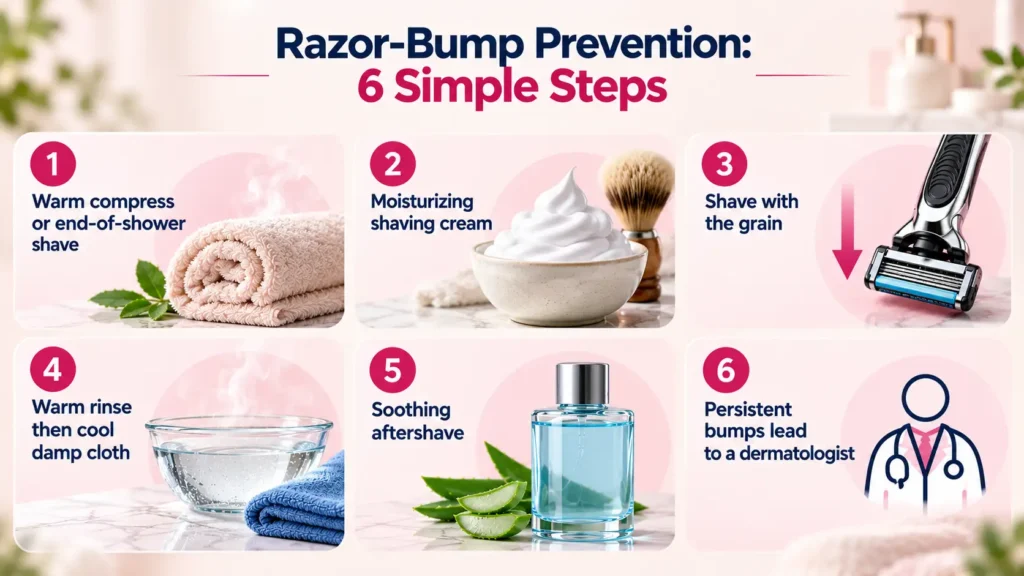
Shaving is the routine factor that women’s skincare research rarely accounts for.
Razor bumps, medically called pseudofolliculitis barbae, happen when shaved hairs curl back into the skin, and the AAD warns that untreated bumps can leave deep grooves and raised scars (AAD razor-bump tips; AAD guidance for darker skin tones).
Dermatologists recommend:
- Prepare the hair. Shave at the end of a shower, or hold a warm, damp washcloth on the area first, so hairs soften and are less likely to curve into the skin (AAD).
- Use a moisturizing shaving cream. Never dry shave (AAD; AAD, darker skin tones).
- Shave with the grain. Shaving against it irritates the skin (AAD).
- Finish gently. Rinse with warm water, lay a cool, damp washcloth on the skin, and apply a soothing aftershave formulated to reduce razor-bump risk (AAD).
- Know the frequency advice. For men with darker skin tones who get bumps, the AAD’s protocol includes shaving daily or at least every two to three days, and stopping shaving altogether removes the cause (AAD; AAD, darker skin tones).
- Don’t tough it out. If bumps persist after changing your habits, see a board-certified dermatologist (AAD).
How this interacts with actives: retinoids and acids both raise irritation, so the timing advice in the retinoid section applies. I couldn’t find trial evidence on whether chemical exfoliation prevents shaving-related ingrown hairs. If you try one, keep it gentle, don’t use it right before shaving, and don’t stack it on a retinoid night.
For guidance on choosing an exfoliant, using it at the right frequency, and avoiding over-exfoliation, see our complete guide to face exfoliation.
Matching your routine to your decade and skin type
This section is editorial guidance built on the evidence above and the general principle of introducing actives gradually; it isn’t drawn from trials by age group.
For a practical routine tailored to men’s anti-aging skincare, see our complete guide to men’s anti-aging skincare.
| Stage | Priorities | Why |
|---|---|---|
| 20s and 30s | Daily SPF, gentle cleanser, moisturizer; consider an antioxidant and a low-strength retinoid | Preventing damage costs less than correcting it. See our guide to anti-aging products for your 20s. |
| 40s | Make a retinoid consistent; add a barrier-supportive moisturizer; vitamin C or niacinamide if you like | Renewal and barrier recovery are slowing, so build up gradually |
| 50 and over | Keep SPF and a retinoid at a gentle pace; prioritize barrier care; have any new or changing spot examined |
Recovery from irritation takes longer (J Cosmet Sci review) |
| Your pattern | Starting point |
|---|---|
| Oily or acne-prone | Gel or foaming cleanser, lightweight non-comedogenic moisturizer, niacinamide; retinoids are often tolerated. See our guide to cleansers for oily skin |
| Dry or mature | Ceramide-containing moisturizer with hyaluronic acid underneath; introduce a retinoid slowly |
| Sensitive or shaving-irritated | Fragrance-free products, one new active at a time, a vitamin C derivative if L-ascorbic acid stings |
| Combination | For a step-by-step routine tailored to combination skin, see our complete guide to the best skincare routine for combination skin. |
Habits that change how skin ages
- Smoking.
- In a study of twins, the twin who smoked, or who had smoked longer, tended to look older, with differences showing after about five extra years of smoking (twin study).
- Alcohol. In a large survey of women, more than eight drinks a week was associated with more upper-face lines, under-eye puffiness, midface volume loss, and visible blood vessels (Goodman et al., 2019). That’s an association from self-reported data, not proof of cause.
- Sleep and diet. Seven or more hours of sleep is standard adult guidance, and a varied diet supports general health. I didn’t find strong human trial evidence in this research that any single food or supplement reverses visible skin aging, so I wouldn’t build a routine around one.
- Stress. Chronic stress can influence how your skin responds to existing conditions. Learn how stress can trigger or worsen common skin problems—and what you can do about it in our guide to stress and pre-existing skin conditions.
When peels, microneedling, and lasers make sense
In-office procedures can change surface and collagen faster than topicals, but they cost more and carry more risk, and candidacy depends on your skin tone and history. A dermatologist is the right person to decide; this is where their judgment should replace mine.
- Chemical peels are used for photoaging, pigmentary disorders, and scarring, with depth ranging from light to deep (2018 peel review).
- Microneedling. A 2025 systematic review of 21 studies and 723 patients (72% female, average age 48) found high satisfaction and few adverse events, but outcome measures and treatment schedules varied widely (2025 microneedling review).
- Lasers cover a wide range of devices and downtime. The right one depends on your concern and skin tone.
Before booking anything, ask about expected downtime, how many sessions you’ll need, how your skin tone affects the risk of pigment change, and how the treatment fits with your retinoid and other actives.
Four myths worth dropping
- “Skincare is just for women.” Sun damage, barrier health, and renewal apply to everyone. Men’s differences are reasons to adjust a routine, not to skip one.
- “A routine will make it obvious.” Sunscreen, moisturizer, and a retinoid show up as even, healthy-looking skin, not as visible product.
- “Natural or testosterone-boosting skincare works better.”
I found no clinical evidence for topical testosterone-boosting products, and a cosmetic can’t legally claim to change how the body functions (FDA). “Natural” doesn’t make a product gentler or more effective; formulation does.
- “More expensive means more effective.” Price isn’t evidence. Look at the active ingredient, its concentration where disclosed, and the formulation. The evidence ladder above is a better filter than price.
FAQs: Male Skin Regeneration Secrets
How long does it take male skin to renew itself?
The full epidermal cycle is commonly cited as about 28 days in young adults and gets longer with age. In one dataset, forearm stratum corneum turnover rose from about 20 days under age 35 to about 28 days over age 60 (J Cosmet Sci review). Visible results take longer than one cycle: in trials, tretinoin improved signs of photoaging as early as one month, with benefits holding through 24 months (2022 review). Judge a new active at about three months, not three weeks.
Can you reverse sun damage on your face?
Partly. Prescription tretinoin improved wrinkling, mottled pigmentation, sallowness, and sun spots in randomized trials (2022 review); vitamin C and niacinamide have moderate support (vitamin C review; Boo, 2021); and procedures can add more (peel review). None erases damage completely. Sunscreen doesn’t regenerate skin on its own, but it prevents ongoing UV damage while repair happens (AAD).
Is retinol or tretinoin better for men?
Tretinoin has the strongest evidence and needs a prescription, and it’s more irritating (2022 review; 2024 review). Retinol is milder, sold over the counter, and the AAD suggests starting with the mildest product (AAD). Most men can reasonably start with retinol and ask a dermatologist about tretinoin if progress stalls after several months. Remember that most of the trials involved women.
Do men need different skincare than women?
Not a separate product category. Average differences in sebum, thickness, and shaving habits can change which textures and routines work (Rahrovan et al., 2018), but choose by skin type, concerns, and tolerance. The evidence base is thinner for men than for women.
Should men exfoliate to speed up skin renewal?
Exfoliation can remove excess dead skin cells from the surface, but there’s no strong evidence that it meaningfully speeds up the skin’s natural regeneration process. For men, shaving already provides some physical exfoliation, so adding frequent exfoliation may increase dryness, redness, or irritation rather than improve results. If you want to exfoliate, start with once a week, avoid exfoliating immediately before shaving or on retinoid nights, and reduce or stop if your skin becomes irritated or stings.
Want to exfoliate without damaging your skin barrier? Our complete guide to face exfoliation explains how often to exfoliate, which methods work best, and how to fit exfoliation safely into your skincare routine.
What’s the best routine for men over 40?
The evidence-backed foundation is simple: use broad-spectrum SPF 30 or higher every day, introduce a retinoid gradually, and apply a barrier-supportive moisturizer to maintain hydration. Vitamin C, niacinamide, and peptides can be useful additions, but they’re optional rather than essential.
For the complete morning and evening routine—including product order, active ingredients, and tips for introducing anti-aging products without unnecessary irritation- explore our step-by-step men’s anti-aging skincare regimen.
The bottom line: Male Skin Regeneration Secrets
If you change one thing, make it daily sunscreen. Add a retinoid second, slowly, and fix your shaving technique third, because irritation undoes the gains from everything else. Vitamin C and niacinamide are reasonable additions once those basics hold; peptides are optional. Give any change about three months before judging it, and see a dermatologist if irritation doesn’t settle, razor bumps persist, or a spot changes, bleeds, or doesn’t heal. The evidence for men specifically is thinner than the evidence for women, so treat every number here as a starting point and let your skin’s response guide you.
References
- Rahrovan S, Fanian F, Mehryan P, Humbert P, Firooz A. Male versus female skin: what dermatologists and cosmeticians should know. Int J Womens Dermatol. 2018;4(3):122–130. doi:10.1016/j.ijwd.2018.03.002
- American Academy of Dermatology. Retinoid or retinol? aad.org/public/everyday-care/skin-care-secrets/anti-aging/retinoid-retinol/
- American Academy of Dermatology. How to apply sunscreen (aad.org/public/everyday-care/sun-protection/shade-clothing-sunscreen/how-to-apply-sunscreen) and Sunscreen FAQs (aad.org/sun-protection/sunscreen-faqs).
- Topical tretinoin for treating photoaging: a systematic review of randomized controlled trials. Int J Womens Dermatol. 2022;8(1):e003. PubMed 35620028.
- Comparing tretinoin to other topical therapies in the treatment of skin photoaging: a systematic review. Am J Clin Dermatol. 2024;25(6):873–890. doi:10.1007/s40257-024-00893-w
- Aging skin barrier (review). J Cosmet Sci. 2024;75(5). library.scconline.org/v075n05. Add the author list.
- U.S. Food and Drug Administration. Wrinkle treatments and other anti-aging products. fda.gov/cosmetics/products/wrinkle-treatments-and-other-anti-aging-products
- Flament F, Bazin R, Laquieze S, Rubert V, Simonpietri E, Piot B. Effect of the sun on visible clinical signs of aging in Caucasian skin. Clin Cosmet Investig Dermatol. 2013;6:221–232.
- Topical vitamin C and the skin: mechanisms of action and clinical applications. J Clin Aesthet Dermatol. 2017;10(7):14–17. PMC5605218. Add the author names.
- Clinical applications of vitamin C in dermatology: a systematic review. J Clin Aesthet Dermatol. 2026;19(7):10–15.
- Boo YC. Mechanistic basis and clinical evidence for the applications of nicotinamide (niacinamide) to control skin aging and pigmentation. Antioxidants. 2021;10(8):1315. doi:10.3390/antiox10081315
- Topical peptide treatments with effective anti-aging results. Cosmetics. 2017;4(2):16. Add the author names.
- The peptide prescription: decoding the evidence, from topicals to longevity. Healio, July 9, 2026.
- American Academy of Dermatology. 6 razor bump prevention tips from dermatologists. aad.org/public/everyday-care/skin-care-basics/hair/razor-bump-prevention
- American Academy of Dermatology. Razor bump remedies for men with darker skin tones. aad.org/public/everyday-care/skin-care-basics/hair/razor-bump-remedies
- Twin-pair study of smoking and facial aging. Plast Reconstr Surg. 2013 (Guyuron and colleagues). Confirm full citation details.
- Goodman GJ, et al. Impact of smoking and alcohol use on facial aging in women: results of a large multinational, multiracial, cross-sectional survey. J Clin Aesthet Dermatol. 2019;12(8). PMC6715121. Confirm the full author list.
- Foppiani JA, Fanning JE, Beltran K, et al. Microneedling for facial rejuvenation: a systematic review. Aesthetic Plast Surg. 2025;49(17):4949–4960.
- Chemical peels: a review of current practice. Australas J Dermatol. 2018;59(3):171–181. PubMed 29064096.

About Subhan Usafzai
Evidence-Based Skincare Educator & Formulation Specialist
I'm Subhan Usafzai (Fazli Subhan), an Evidence-Based Skincare Educator and Formulation Specialist. My background includes first-hand experience as a technician and research support in skin departments across tertiary military hospitals since 2006, and since 2008 I've focused on researching and translating clinical and formulation science into practical, evidence-based guidance. My formal training includes Coursera's Introduction to Cosmetic and Skincare Science and the four-course Introduction to Cosmetic Science and Ingredients specialization (Cosmetic Formulation Science, Cosmetic Product Development, and Quality Control and Regulatory in Cosmetic Science), authorized by Olay. Every article I write is checked against current research and reviewed by our medical team before publishing.
✅ Medically reviewed by Dr. Muhammad Khurram Ahmad, MD, Board-Certified Dermatologist · 📅 Last updated: October 2026
Medical Disclaimer
For Educational Purposes Only: This article is written by Subhan Usafzai, an Evidence-Based Skincare Educator and Formulation Specialist, for educational and informational purposes only. The information draws on scientific research, peer-reviewed studies, and dermatological literature available as of October 2026.
Not Medical Advice: This content does not constitute medical advice, diagnosis, or treatment. It is not a substitute for consultation with a qualified healthcare professional or dermatologist.
Individual Results May Vary: Skin conditions and responses to skincare products vary according to individual characteristics, skin type, hormonal factors, and environmental exposure.
Consult Your Healthcare Provider: Seek professional guidance before changing your skincare regimen, particularly during pregnancy or breastfeeding, or if you have a diagnosed skin condition, take medication, have sensitive skin, or receive dermatological treatment.
Product Safety: Consider patch testing new products. Discontinue use if irritation or an adverse reaction occurs, and seek medical advice when needed.
Affiliate Disclosure
Amazon Associates Disclosure: As an Amazon Associate I earn from qualifying purchases.
Editorial Independence: Affiliate relationships do not determine our product reviews or recommendations. We aim to provide balanced, research-informed information to help readers make informed skincare choices.
Supporting Glow Guide Hub: Qualifying purchases through affiliate links may earn us a commission at no additional cost to you.