

Complete Men’s Anti-Aging Skincare Regimen: What Actually Works
Most men don’t need a ten-step routine. They need three habits done consistently: daily sunscreen, a retinoid at night, and a moisturizer that keeps the skin barrier comfortable. Everything else on the shelf is a bonus.
This guide shows you what to use morning and night, how to start retinol without wrecking your skin, how routines change from your 20s to your 40s, and which popular “anti-aging” claims the research doesn’t back up.
Short answer: Wear a broad-spectrum SPF 30+ every day. Use a retinoid 2–3 nights a week (or bakuchiol if retinol irritates you). Moisturize daily. Treat vitamin C, peptides, and in-office treatments as optional extras, not foundations.
In this guide, we cover:
- Why men’s skin ages the way it does
- The routine at a glance
- Morning and night steps
- Shaving and anti-aging
- Routines by age
- Skin cycling
- How long results take
- Diet, sleep and lifestyle
- Professional treatments
- Safety and when to see a dermatologist
- FAQ
Why men’s skin ages the way it does
What’s different about male skin
Dermatology research going back decades suggests male skin is generally thicker and denser in collagen than female skin, which is one reason visible wrinkling tends to appear later in men. Male skin also produces more sebum after puberty. That head start fades, though: thickness declines gradually with age, and collagen loss is a normal part of getting older for everyone.
You may have read that falling testosterone is the main reason men’s skin ages. That idea gets repeated a lot, but I couldn’t find solid evidence that it’s a primary driver of wrinkles, so I’m not building a routine around it.
The factor you can control most: sun exposure
According to the American Academy of Dermatology, UVA rays contribute to premature skin aging, including wrinkles and age spots, while UVB rays cause sunburn. Together, they drive most visible photoaging. That’s why sunscreen sits at the top of this routine rather than any serum.
Survey data suggest men use sunscreen less consistently than women. A national analysis of U.S. adults found that men had a lower prevalence of sunscreen use than women in every survey period from 2010 to 2020, and Harvard Health summarized a Journal of the American Academy of Dermatology analysis in which fewer than 15% of men, versus 30% of women, regularly used sunscreen on both the face and other exposed skin.
Since UV damage accumulates over years, skipping sunscreen may offset some of the advantage of thicker, collagen-dense skin. That last point is a reasonable inference, not something these studies measured directly.
The routine at a glance
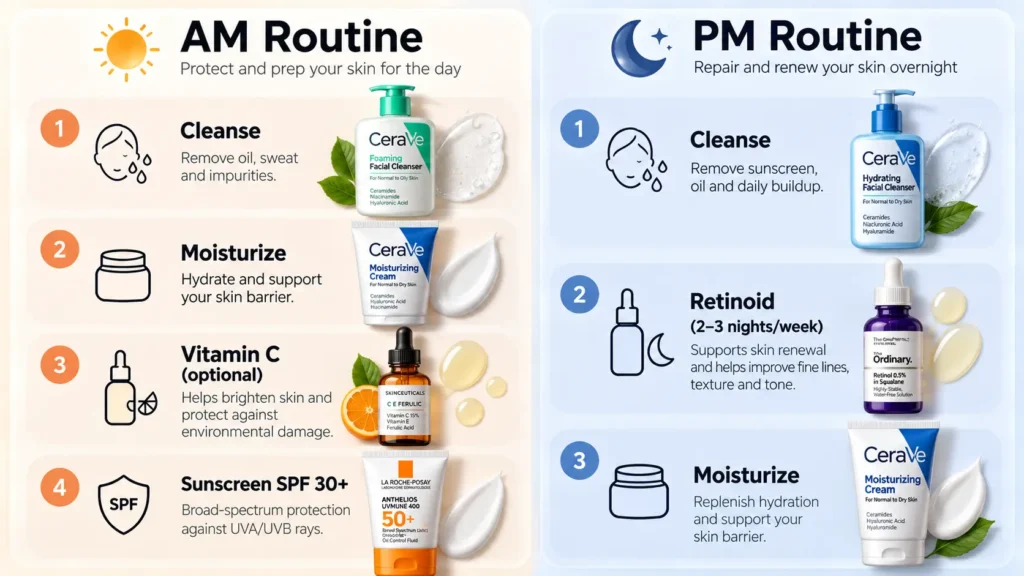
| Step | What to use | Priority | |
|---|---|---|---|
| AM | 1. Cleanse | Gentle, non-stripping cleanser (or just water if skin is dry) | Essential |
| 2. Moisturize | Ceramides, glycerin, or hyaluronic acid | Essential | |
| 3. Vitamin C | Stable vitamin C serum | Optional | |
| 4. Sunscreen | Broad-spectrum SPF 30+ | Most important | |
| PM | 1. Cleanse | Same gentle cleanser | Essential |
| 2. Retinoid | Retinol, adapalene or prescription tretinoin, 2–3 nights/week | Highest-impact active | |
| 3. Moisturize | Barrier-supporting cream | Essential |
Morning routine
Cleanser and moisturizer
Use a gentle cleanser that leaves skin comfortable rather than tight. Follow with a moisturizer containing humectants such as glycerin or hyaluronic acid, plus ceramides, which are fats that help the skin barrier hold water. Moisturizer doesn’t reverse wrinkles. It makes skin look smoother and helps you tolerate retinoids.
Vitamin C
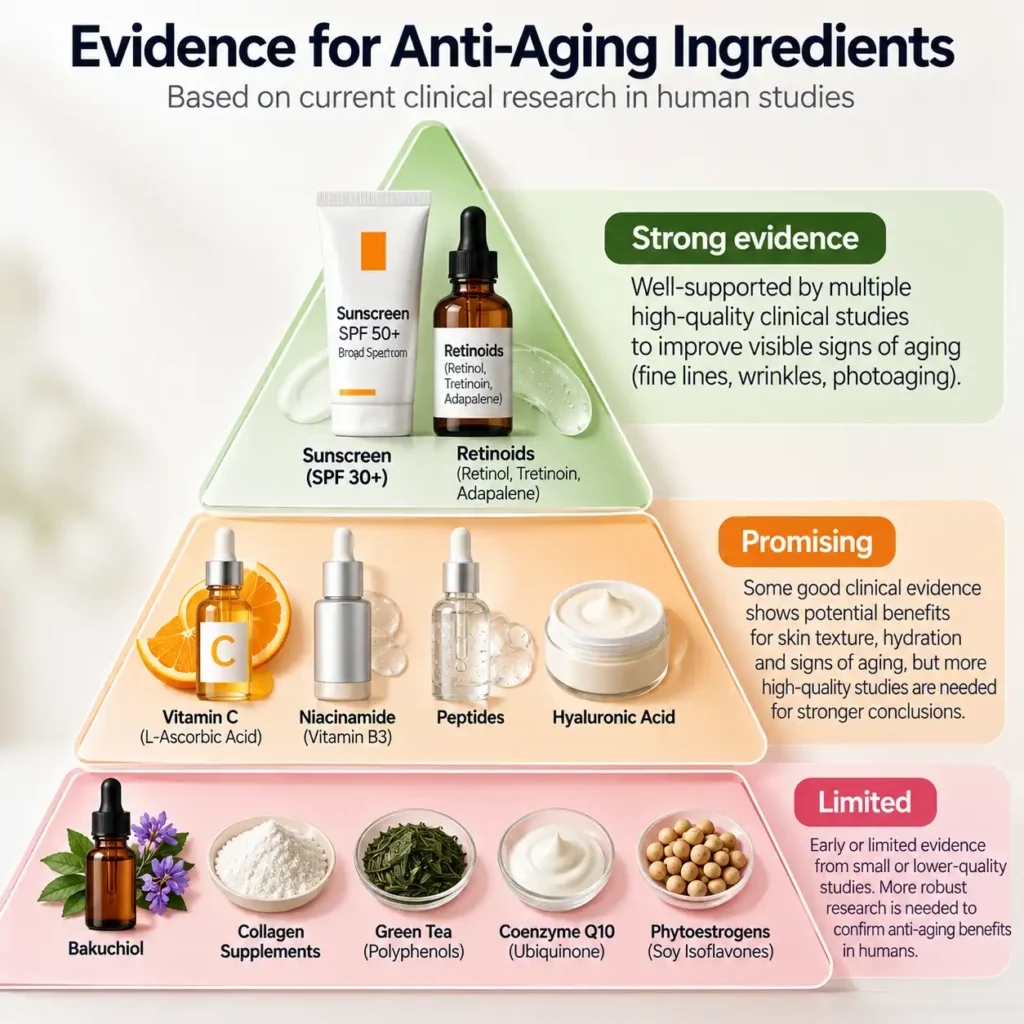
Topical vitamin C is an antioxidant involved in collagen formation in skin, and a 2017 review in Nutrients discusses its potential role in skin aging while noting that delivery into the skin remains challenging. Human evidence is limited: the Linus Pauling Institute at Oregon State University reports only a few human studies on photoprotection from topical vitamin C, and one found no significant benefit. So treat it as a supplement to sunscreen, never a replacement. Vitamin C also degrades with exposure to air, heat and light, so look for opaque or airless packaging and don’t use a serum that has turned dark orange or brown. For more, see how vitamin C and sunscreen work together or vitamin C vs. niacinamide.
Sunscreen: what SPF 30 does and doesn’t mean
According to the American Academy of Dermatology, SPF 30 blocks about 97% of UVB rays, and higher numbers block slightly more, but no sunscreen blocks everything. The AAD advises a broad-spectrum, water-resistant sunscreen of SPF 30 or higher, reapplied about every two hours outdoors and after swimming or sweating. A higher SPF does not let you stay out longer between applications; as the FDA explains, SPF reflects the amount of solar energy needed to burn, not a length of time. In practice, the sunscreen you’ll actually wear daily beats the “best” one you leave in a drawer. Not sure which type to pick? Compare physical and chemical sunscreens.
Hats, shade and UPF clothing add protection. They supplement sunscreen; they aren’t a replacement.
Night routine
Retinol: how to start without irritation
Retinoids are a family of vitamin A derivatives. The strongest evidence belongs to prescription tretinoin: a systematic review and meta-analysis of randomized trials concluded that topical tretinoin is a safe and effective treatment for fine and coarse facial wrinkles caused by sun damage.
Evidence for over-the-counter retinol is thinner. A review in Advances in Therapy found a lack of well-designed clinical trials supporting the claimed anti-aging efficacy of the most common cosmetic retinoids, while describing tretinoin as the most well-established.
In practice, retinol is a reasonable, gentler starting point, and you can move to a prescription retinoid if you want stronger results. Both can cause irritation, dryness, redness and flaking, especially when you jump in too fast.
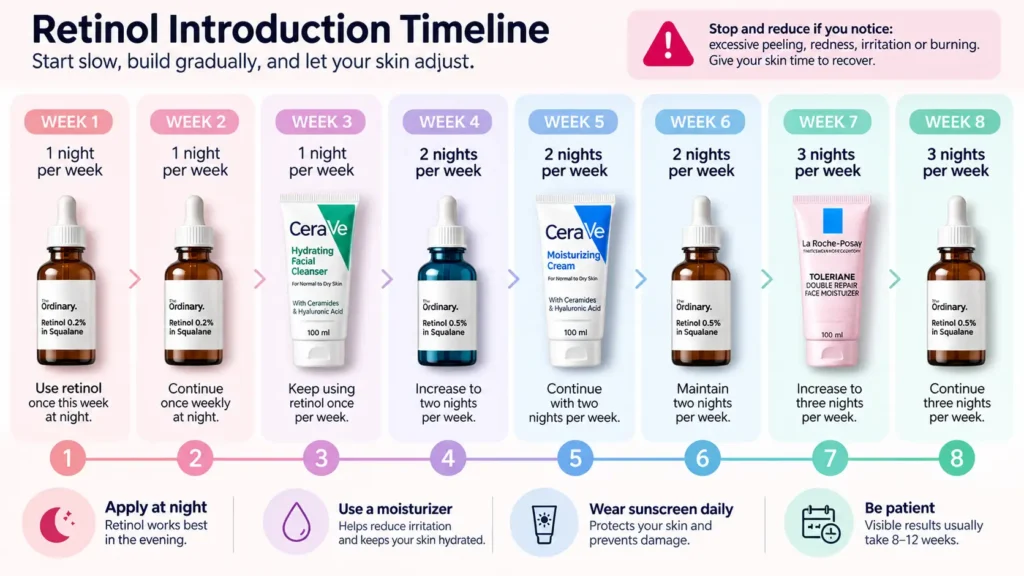
A gentle ramp-up:
| Weeks | Frequency | Notes |
|---|---|---|
| 1–2 | 1 night/week | Pea-sized amount for the whole face, over dry skin |
| 3–4 | 2 nights/week (non-consecutive) | Moisturize after, or sandwich: moisturizer → retinol → moisturizer |
| 5–8 | 3 nights/week if comfortable | Stay here; more isn’t always better |
Slow down or pause if you notice persistent burning, peeling that doesn’t settle within a week, or a rash. Use sunscreen every morning, since retinoids can increase sun sensitivity. Avoid retinoids during pregnancy, and ask a doctor if there’s any chance a partner’s or your own situation calls for caution. Don’t use them on sunburned or freshly shaved, broken skin. For the science, see how retinol works at the cellular level, and for combining products, layering actives without irritation.
Bakuchiol: when it makes sense
Bakuchiol is a plant-derived ingredient marketed as a retinol alternative. In one 12-week randomized trial of 44 people published in the British Journal of Dermatology, 0.5% bakuchiol applied twice daily and 0.5% retinol applied once daily both reduced wrinkle area and pigmentation by similar amounts, and the retinol group reported more scaling and stinging.
That’s encouraging, but it’s a small, short study, so bakuchiol is a reasonable option for people who can’t tolerate retinol, not proven to be equal in every way. It’s not a replacement for prescription tretinoin if your dermatologist has recommended it.
Barrier-supporting moisturizers
Look for ceramides, glycerin, hyaluronic acid, panthenol, and niacinamide. If retinoid use leaves skin raw, see how to repair a damaged skin barrier.
Shaving and anti-aging
Daily shaving is a mild form of mechanical exfoliation, and razors can cause irritation, ingrown hairs and razor bumps. Practical rules: shave with a sharp blade, use a lubricating shaving gel, and avoid applying a retinoid right before shaving. Schedule retinoid nights for the days you aren’t shaving, or apply it after the skin has settled. Finish with a fragrance-free moisturizer.
Routines by age
| Age | Focus | Keep it simple |
|---|---|---|
| 20s | Prevention | Cleanser, moisturizer, daily SPF 30+. Add a retinoid once your base routine is steady. See wrinkle prevention in your 20s. |
| 30s | Early lines, uneven tone | Add a retinoid (2–3 nights/week) and vitamin C. |
| 40s+ | Visible lines, dryness, sun damage | Consider prescription tretinoin from a dermatologist, a richer moisturizer, annual skin check. |
Skin cycling: a simple weekly schedule
Skin cycling is a popular way to space out actives. A commonly described four-night version:
- Night 1: gentle exfoliation (see our full guide for a more detailed overview 👉 face exfoliation)
- Night 2: retinoid
- Nights 3–4: recovery with moisturizer only
Repeat. It’s a convenient structure, not a clinically validated protocol, so adjust it to your skin. If your skin stings, skip the exfoliation night. Avoid exfoliating and using a retinoid on the same night.
How long results take
Don’t expect overnight change. Retinoid benefits for texture and fine lines typically build over several months, and some dermatologists suggest a trial of three to six months before judging results. Sunscreen results are invisible by design: it prevents new damage. If you’re seeing nothing after 3–6 months of consistent use, that’s a good time to ask a dermatologist about prescription options.
Diet, sleep and lifestyle: what’s supported and what’s hype
Reasonably supported: not smoking, protecting yourself from the sun, sleeping enough, and eating a varied diet rich in fruit, vegetables and fish are all good for general health, and skin benefits from the same habits. Chronic stress and poor sleep can worsen skin concerns; see how stress affects skin.
Mixed or weak evidence:
- Collagen supplements. A 2023 meta-analysis of 26 trials (1,721 participants) found improvements in skin hydration and elasticity. But a 2025 meta-analysis of 23 trials found that the benefit disappeared when it looked only at independently funded or higher-quality studies, a finding industry groups dispute.
The honest summary: possibly a small benefit, not proven, and nothing that replaces sunscreen or a retinoid. Eating collagen-rich foods doesn’t mean your skin makes more collagen.
- “Detoxing” skin with lemon water or teas. Your liver and kidneys handle detoxification, and I found no evidence that these drinks change skin.
- Specific “anti-aging foods.” Fruit, vegetables and fish are healthy choices, but no single food has been shown to reverse wrinkles.
Professional treatments
Treatments such as LED light therapy and microneedling are marketed for collagen stimulation. Evidence varies by device and protocol; results are generally modest, and outcomes depend heavily on who performs them. If you’re interested, see a board-certified dermatologist or a licensed professional first.
Don’t combine retinoids with treatments like microneedling or lasers without clinical guidance. Prescription tretinoin remains the most established medical option for photoaging, supported by randomized-trial evidence.
Safety, side effects and when to see a dermatologist
- Patch test any new product on a small area (such as the inner forearm) for a few days.
- Irritation vs. allergy: irritation is usually burning, dryness or redness where you applied the product and fades after stopping. An allergic reaction may cause itchy bumps, swelling or a spreading rash. Stop the product and get medical advice if you suspect an allergy.
- See a dermatologist if you have a mole that is changing in size, shape or color, a sore that won’t heal, persistent rash, or irritation that doesn’t improve after you stop a product.
- A cosmetic routine is not a treatment for skin disease and can’t diagnose anything.
FAQ: Best Men’s Anti-Aging Skincare Regimen
When should men start an anti-aging skincare routine?
There is no fixed age to start. Daily broad-spectrum sunscreen is worth using from an early age, while a retinoid can be considered in your mid-20s or 30s once you have a consistent cleanser, moisturizer, and SPF routine.
How often should men use retinol?
If you are new to retinol, start with once a week and gradually increase to two or three nights a week as your skin tolerates it. Some people may find that using it a few nights per week is enough long-term.
Is bakuchiol as effective as retinol?
Evidence is limited, but one small 12-week clinical trial found similar improvements in some measures of photoaging, with less reported irritation. Bakuchiol may be an alternative for people who do not tolerate retinol well, but it has not been studied as extensively.
What is the most important anti-aging skincare product for men?
Sunscreen is the foundation of an anti-aging routine. Choose a broad-spectrum SPF 30 or higher and apply it every day. Reapply when you spend extended time outdoors, especially after sweating or swimming.
Do collagen supplements improve skin?
The evidence is mixed. Some clinical trials have reported modest improvements in skin hydration or elasticity, but a 2025 analysis found that these benefits were not maintained in higher-quality or independently funded studies. Collagen supplements should therefore not be considered a proven anti-aging treatment.
How long does retinol take to show results?
Retinoids work gradually. Early changes may take several weeks, while more noticeable improvements in fine lines and skin texture generally require consistent use for around three to six months. Avoid judging the results after only a few weeks.
The bottom line: Best Men’s Anti-Aging Skincare Regimen
If you only change three things, make them these: sunscreen every morning, a retinoid a few nights a week, and a moisturizer that keeps your barrier comfortable. Add vitamin C or bakuchiol if they suit you, and treat supplements and professional treatments as optional extras with more uncertain evidence. If your skin is irritated, slow down; if you’re unsure, a dermatologist can tailor this to you. For the broader picture, see the complete anti-aging skincare routine.
This article is educational and is not medical advice. Individual skin differs; consult a qualified clinician for personal concerns.
References
- American Academy of Dermatology. Sunscreen/SPF guidance. aad.org/news/aad-survey-shows-americans-need-sunscreen-education
- Dhaliwal S, et al. Prospective, randomized, double-blind assessment of topical bakuchiol and retinol for facial photoageing. Br J Dermatol. 2019;180(2):289-296. PMID 29947134
- Effects of Oral Collagen for Skin Anti-Aging: A Systematic Review and Meta-Analysis. Nutrients. 2023. PMID 37432180
- Myung & Park. Effects of Collagen Supplements on Skin Aging: A Systematic Review and Meta-Analysis of RCTs. Am J Med. 2025;138(9):1264-1277 (confirm PMID before publishing)
- To add after verification: AAD retinoid guidance; a peer-reviewed review on topical retinoids and photoaging; Shuster 1975 and Rahrovan 2018 on sex differences in skin.

About Subhan Usafzai
Evidence-Based Skincare Educator & Formulation Specialist
I'm Subhan Usafzai (Fazli Subhan), an Evidence-Based Skincare Educator and Formulation Specialist. My background includes first-hand experience as a technician and research support in skin departments across tertiary military hospitals since 2006, and since 2008 I've focused on researching and translating clinical and formulation science into practical, evidence-based guidance. My formal training includes Coursera's Introduction to Cosmetic and Skincare Science and the four-course Introduction to Cosmetic Science and Ingredients specialization (Cosmetic Formulation Science, Cosmetic Product Development, and Quality Control and Regulatory in Cosmetic Science), authorized by Olay. Every article I write is checked against current research and reviewed by our medical team before publishing.
✅ Medically reviewed by Dr. Muhammad Khurram Ahmad, MD, Board-Certified Dermatologist · 📅 Last updated: October 2026
Medical Disclaimer
For Educational Purposes Only: This article is written by Subhan Usafzai, an Evidence-Based Skincare Educator and Formulation Specialist, for educational and informational purposes only. The information draws on scientific research, peer-reviewed studies, and dermatological literature available as of October 2026.
Not Medical Advice: This content does not constitute medical advice, diagnosis, or treatment. It is not a substitute for consultation with a qualified healthcare professional or dermatologist.
Individual Results May Vary: Skin conditions and responses to skincare products vary according to individual characteristics, skin type, hormonal factors, and environmental exposure.
Consult Your Healthcare Provider: Seek professional guidance before changing your skincare regimen, particularly during pregnancy or breastfeeding, or if you have a diagnosed skin condition, take medication, have sensitive skin, or receive dermatological treatment.
Product Safety: Consider patch testing new products. Discontinue use if irritation or an adverse reaction occurs, and seek medical advice when needed.
Affiliate Disclosure
Amazon Associates Disclosure: As an Amazon Associate I earn from qualifying purchases.
Editorial Independence: Affiliate relationships do not determine our product reviews or recommendations. We aim to provide balanced, research-informed information to help readers make informed skincare choices.
Supporting Glow Guide Hub: Qualifying purchases through affiliate links may earn us a commission at no additional cost to you.