
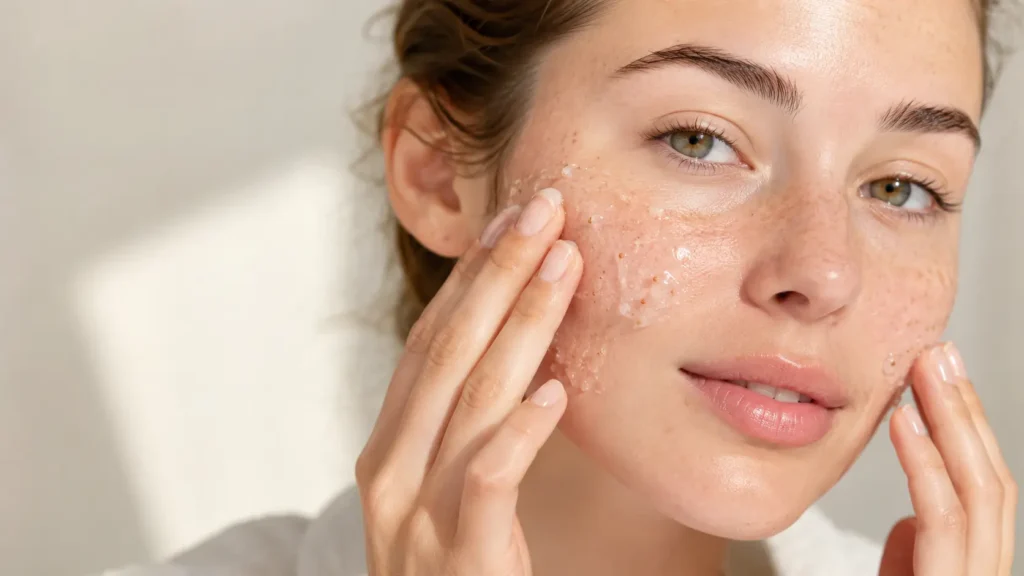
The Ultimate Guide to Face Exfoliation: Research-Based Guide in 2026
Your skin sheds up to 40,000 dead skin cells every single hour.
Yet most people either scrub them off far too aggressively—or never remove them properly at all.
The result?
Dullness, clogged pores, irritation, and skincare products that never get the chance to perform at their best. I’ve formulated with exfoliating acids that would shock most DIY scrub fans, and one lesson stands out every time: there is no universal “best” exfoliation method.
What transforms oily, acne-prone skin can easily damage a dry or sensitive skin barrier.
Here’s what that number means in practice: shedding isn’t optional, and scrubbing harder doesn’t make it happen any faster or more safely. It’s a steady biological cycle running underneath your skincare routine, whether you exfoliate or not — one that slows measurably as you age. That’s not a guess; it’s documented in peer-reviewed research on skin aging published through the National Institutes of Health.
Understanding how this natural renewal process changes over time is the key to choosing an exfoliation method that works with your skin—not against it.
That’s exactly why this guide exists. You’ll learn the real difference between physical and chemical exfoliation, how AHAs, BHAs, PHAs, and enzyme exfoliants actually work, how often each skin type should exfoliate, and the most common mistakes that silently damage your skin. If you’re looking for one evidence-based resource to help you exfoliate safely and effectively, this is the only guide you’ll need in 2026.
What Is Face Exfoliation and Why Does It Matter?
Exfoliation is the process of removing dead skin cells from the outermost layer of your skin — the stratum corneum. It sounds almost too basic to matter, but that top layer is doing far more work than most people give it credit for, and when dead cells pile up faster than they naturally shed, everything downstream of your skincare routine gets a little less effective.
Your moisturizer sits on the surface of dead skin instead of soaking in. Your sunscreen applies unevenly over rough patches. Even makeup starts to cling in places it shouldn’t.
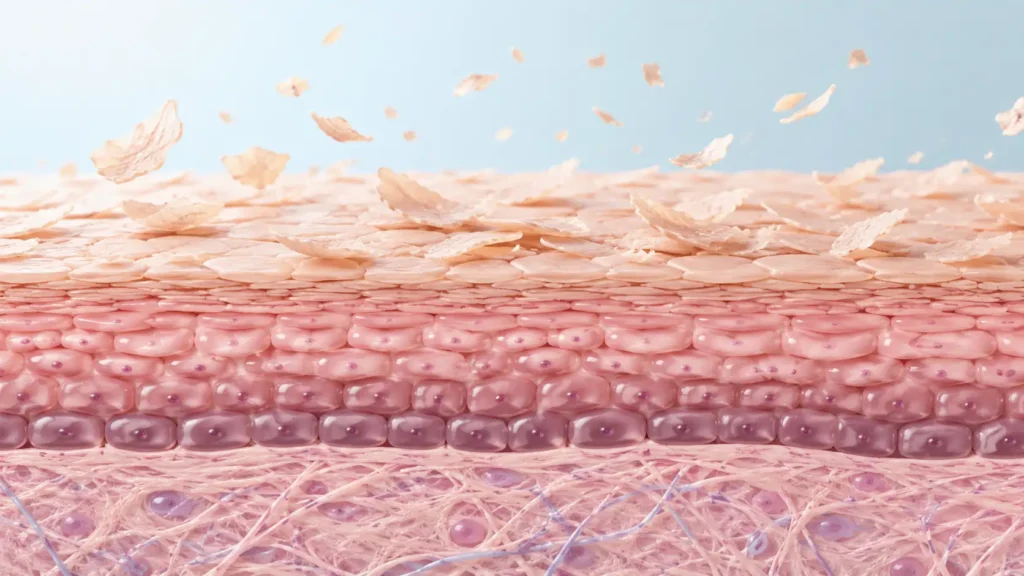
What happens to skin cells if you never exfoliate?
Nothing catastrophic, honestly — your skin sheds dead cells on its own; it doesn’t need you to survive. But without any help, that turnover can look dull, feel rough underhand, and your serums may sit on top of built-up dead cells instead of absorbing the way they’re formulated to.
Over time, clogged pores and uneven texture tend to become more noticeable, especially as natural cell turnover slows with age, which is a well-documented part of the skin-aging process rather than a marketing talking point.
A few things worth knowing before you touch a single acid or scrub:
- The basics. Exfoliation removes dead skin cells on the skin’s surface, encouraging a smoother texture and better light reflection — which is a big part of what people mean when they describe skin as having a “glow.”
- Turnover slows with age. Epidermal cell turnover decreases as we get older, which is one reason mature skin can look duller or take longer to recover from irritation or sun exposure. This is documented in NIH-published research on cellular senescence and skin aging.
- It’s not universally necessary. The American Academy of Dermatology (AAD) is fairly blunt about this: exfoliation “is not for everyone,” and if it’s done incorrectly, it can do more harm than good.
- Timing matters. Skip exfoliating over sunburned skin, open cuts, or active irritation — the AAD specifically flags these as situations where exfoliation should be paused entirely, not pushed through.
Dermatologist Rebecca Clare Tung, MD, FAAD, associate professor of dermatology at Loyola University Medical Center, put it plainly in an AAD-distributed statement: “For some people, exfoliation can actually make their skin worse — with increased redness or acne breakouts. If you choose to exfoliate, it’s important to do so safely so that it does not damage your skin”.
That quote reframed exfoliation for me, and I think about it more than I probably should while formulating or writing about actives. It’s not a mandatory daily ritual, and it’s definitely not a competition to see who can tolerate the harshest acid. It’s a tool. Like any tool, it’s only genuinely useful when it’s matched to the right job — the right skin, the right concentration, the right frequency.
Physical vs. Chemical Exfoliation: Which Is Right for You?
The beauty aisle throws “physical” and “chemical” at you like they’re a permanent rivalry — team scrub versus team acid, pick a side. They’re not actually rivals. They’re just two different mechanisms for accomplishing the same basic biological job: getting dead cells off your face.
Physical exfoliation removes dead skin cells through friction — scrubs, brushes, konjac sponges, even a warm washcloth technically counts. Chemical exfoliation, on the other hand, uses acids or enzymes to dissolve the “glue” (specialized proteins called desmosomes) holding dead cells to the layer beneath them, so those cells release on their own without any manual scrubbing at all. One is mechanical. The other is molecular. Neither is inherently superior — they’re just built for different jobs and different skin.
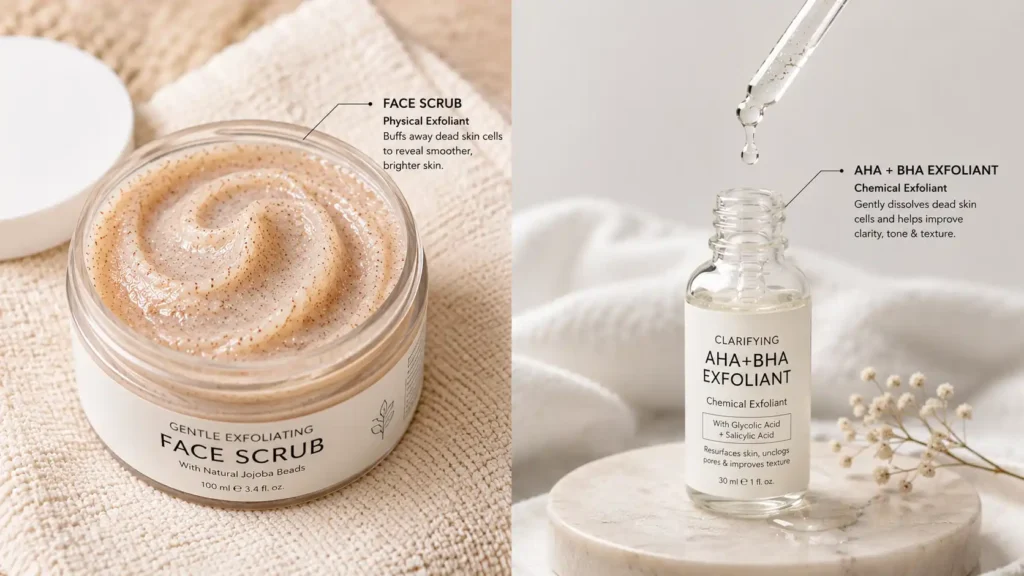
Is physical exfoliation bad for your skin?
Physical exfoliants work through direct friction, so scrubs with rough, unevenly shaped granules (think crushed walnut shells or fruit pits) can create micro-tears in the skin’s surface that you won’t necessarily see immediately but will absolutely feel later as irritation or sensitivity.
That’s a real, physical risk, not a scare tactic dreamed up by chemical-exfoliant brands. The safer physical options use smooth, uniform particles and gentle pressure applied for a short window of time — think seconds, not minutes of vigorous circular scrubbing.
Chemical exfoliation tends to be gentler on skin overall, mostly because there’s no manual manipulation involved, which matters quite a bit if you’re prone to inflammation, redness, or active breakouts. AHA and BHA acids work at a cellular level, loosening the bonds between dead cells rather than physically abrading them off the surface — a more even, more predictable process by nature.
A few distinctions worth sitting with before you choose:
- Physical exfoliants — scrubs, brushes, sponges, at-home microdermabrasion tools. Effective when used correctly, but heavily technique-dependent; too much pressure or oversized particles can damage the skin barrier fast.
- Chemical exfoliants — acids and enzymes that dissolve intercellular bonds chemically. Generally more even in application and gentler for reactive or acne-prone skin, since there’s no friction involved at all.
- Professional options exist too, including in-office chemical peels and clinical-grade microdermabrasion, which deliver deeper results than at-home versions but come with real downtime and should be discussed directly with a board-certified dermatologist before you book anything.
- Combining both is possible, and plenty of people do it well — pairing a gentle chemical exfoliant a few times a week with an occasional soft physical step. But doing both aggressively in the same routine on the same days is a fast and reliable way to compromise your skin barrier.
I’ll admit a small professional bias here, because it’s honest to say so: as someone with a formulation background, I lean toward chemical almost every time I’m asked which method to start with. It’s just easier to control the dose, the pH, and the depth of exfoliation with a well-formulated acid than with a handful of scrubs you apply by feel.
But that’s a personal and professional preference, not a universal rule — plenty of people do perfectly well in the long term with a gentle, well-made physical exfoliant used once or twice a week, particularly if their skin is thicker, oilier, and more resilient to begin with.
Prefer to make your own physical exfoliant at home? Our DIY exfoliating scrubs guide walks through safe, dermatologist-informed recipes by skin type.
AHAs, BHAs, PHAs & Enzymes Explained (Ingredient Breakdown)
This is the part where ingredient lists start to read like alphabet soup, and where a lot of people just give up and buy whatever’s trending on their For You page.
Let’s slow down and untangle it properly, because the differences here actually matter for your results.
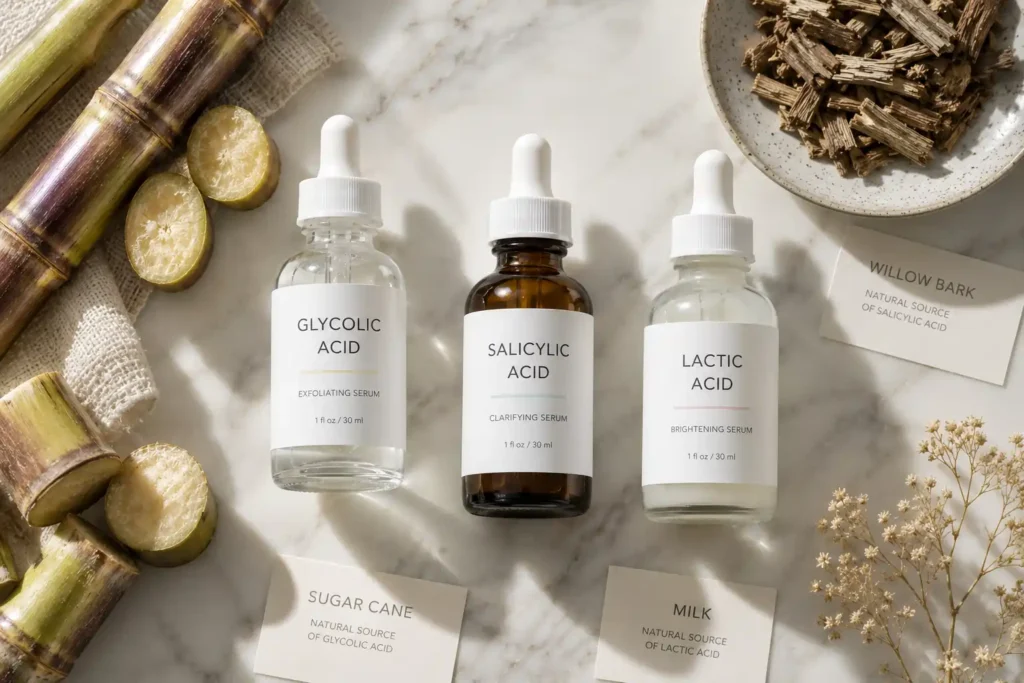
What’s the difference between glycolic acid and salicylic acid?
Glycolic acid is an AHA — water-soluble, meaning it works mostly on the skin’s surface, and it’s especially good for improving overall tone and surface texture. Salicylic acid is a BHA — oil-soluble, so it can actually travel into the pore itself, which makes it the go-to choice for anyone managing acne, blackheads, or generally oily, congested skin.
That solubility difference is basically the whole story. AHAs sit closer to the surface and smooth things out broadly, working on tone and texture across the face. BHAs travel into oil-filled pores and clear congestion from the inside, which is exactly why dermatology guidelines keep coming back to salicylic acid specifically for acne rather than recommending AHAs as a first-line acne treatment.
Here’s a quick breakdown of the main exfoliating acid families, since seeing them side by side tends to make the differences click faster than reading about them in isolation:
| Ingredient type | Examples | Solubility | Best suited for |
|---|---|---|---|
| AHA (Alpha Hydroxy Acid) | Glycolic acid, lactic acid, mandelic acid | Water-soluble | Uneven tone, surface texture, mild sun damage |
| BHA (Beta Hydroxy Acid) | Salicylic acid | Oil-soluble | Acne, clogged pores, oily/combination skin |
| PHA (Polyhydroxy Acid) | Gluconolactone, lactobionic acid | Water-soluble, larger molecule | Sensitive, reactive, rosacea-prone skin |
| Enzymes | Papain (papaya), bromelain (pineapple) | N/A — protein-dissolving | Very gentle, low-irritation exfoliation |
The clinical evidence for chemical exfoliation isn’t just marketing copy dressed up in lab coats, either. A study published evaluated superficial chemical peels for active acne vulgaris and found them to be both effective and reasonably safe when properly formulated and applied under appropriate guidance.
And the AAD’s own clinical guidelines for acne management list salicylic acid alongside topical retinoids and benzoyl peroxide as a recognized, evidence-supported topical therapy — not a fringe home remedy floating around wellness forums, but a legitimate option with real research behind it.
PHAs deserve a slightly longer mention here, because they’re criminally underrated in most mainstream skincare content. The molecules are physically larger than AHA molecules, so they penetrate the skin more slowly and cause noticeably less irritation — which makes them the smarter starting point if you’ve reacted badly to glycolic or salicylic acid in the past, or if you’re simply nervous about introducing your first acid and don’t want to gamble on a stronger option right away.
Enzymes sit in a similar gentle category; they work by breaking down surface proteins rather than acid bonds, which is part of why papaya- and pineapple-derived exfoliants have such a long history in gentler, more traditional skincare formulations.
How to Exfoliate by Skin Type
There’s no universal answer here, and any guide that hands you a single “exfoliate three times a week, no exceptions” rule for every skin type is skipping a step that actually matters — and, honestly, the step that causes the most damage when ignored.
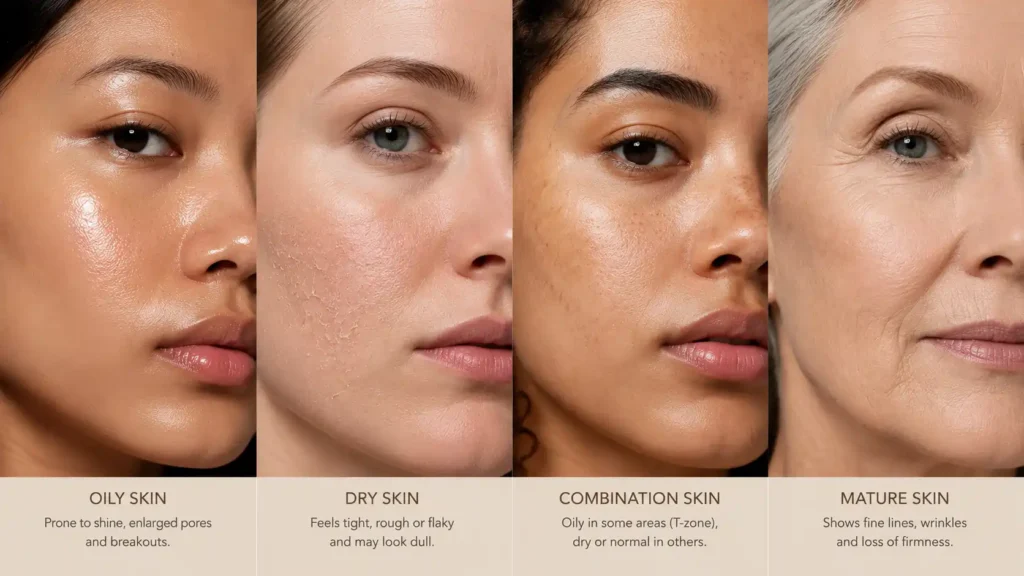
How often should you exfoliate oily skin vs. dry skin?
Oily, thicker skin generally tolerates more frequent or stronger exfoliation, sometimes several times a week without much complaint. Dry, sensitive, or acne-prone skin usually does better with a noticeably milder approach — something like a soft washcloth paired with a low-strength chemical exfoliant — since mechanical scrubbing tends to be too irritating for that skin type and can worsen dryness rather than resolve it.
| Skin type | Recommended approach | Frequency guidance |
|---|---|---|
| Oily/thick skin | Stronger chemical exfoliants or gentle mechanical exfoliation | Several times weekly, as tolerated |
| Dry/sensitive skin | Mild chemical exfoliant or washcloth only | 1–2 times weekly |
| Acne-prone skin | Salicylic acid (BHA), no aggressive scrubbing | 2–3 times weekly, per AAD guidance |
| Combination skin | Zone-specific — BHA on the T-zone, gentler AHA/PHA elsewhere | Adjust by area |
| Mature skin | Low-concentration lactic acid or PHA; avoid harsh physical scrubs | 1–2 times weekly |
| Darker skin tones | Caution with strong chemical or mechanical exfoliation, especially with post-inflammatory dark spots | Start conservatively, patch test |
The AAD is specific about one more group worth calling out on its own: people with darker skin tones, or anyone with a history of dark spots forming after burns, bug bites, or acne breakouts, should avoid strong chemical or mechanical exfoliation altogether, since aggressive exfoliation can worsen post-inflammatory hyperpigmentation rather than fade it.
That’s a genuinely important distinction, and it’s one that a lot of generic “one-size-fits-all” skincare content glosses over entirely.
If you’re not sure which category you fall into — and a lot of people genuinely aren’t; skin doesn’t always announce itself clearly, especially if you’ve got combination skin that shifts with the seasons — that’s exactly the kind of question worth bringing to a board-certified dermatologist rather than guessing from a five-star product review written by someone with completely different skin than yours.
How to Exfoliate Your Face the Right Way (Step-by-Step)
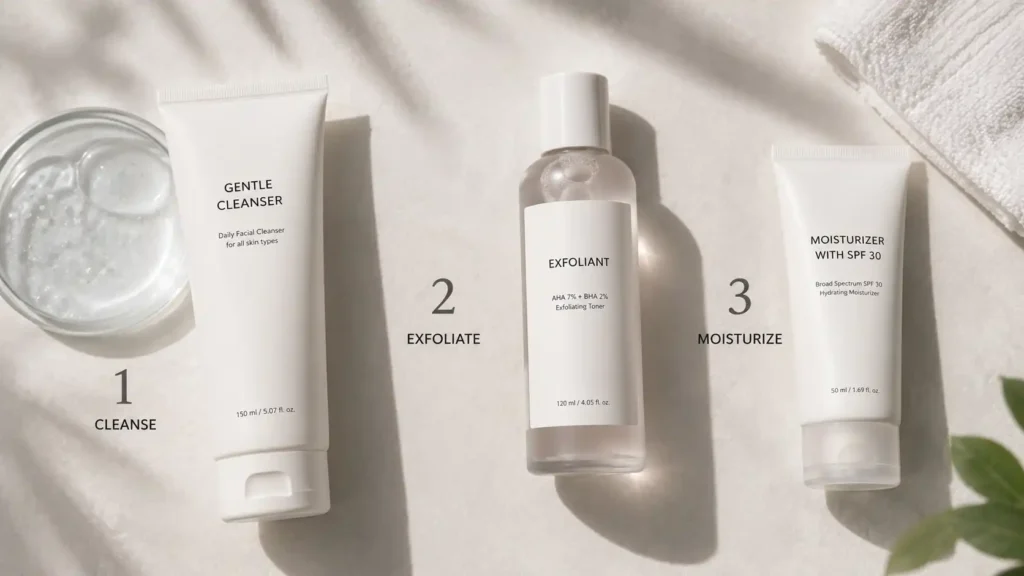
Should you exfoliate before or after cleansing?
After. Cleanse first to remove surface oil, makeup, and general debris, then apply your exfoliant to clean skin so the active ingredient — whether that’s an acid, an enzyme, or a gentle scrub — can actually reach the dead cells it’s meant to work on, instead of getting diluted or blocked by leftover product residue sitting on top of your face.
Here’s the sequence that tends to keep skin cooperative rather than combative, in the order it should actually happen:
- Cleanse first. A gentle, non-stripping cleanser clears the surface so your exfoliant works directly on skin, not on leftover sunscreen or makeup.
- Patch test anything new. Apply a small amount to your inner forearm or behind your ear and wait roughly 24 hours before using it on your face — this single, unglamorous step prevents most bad reactions before they ever reach your cheeks.
- Apply gently. For physical exfoliants, use a light circular motion for roughly 30 seconds, no more — set a timer if you have to. For chemical exfoliants, follow the product’s stated contact time exactly rather than guessing.
- Rinse with lukewarm water. Hot water strips the barrier further and can undo some of the benefit you were just trying to create; skip it, even in winter.
- Moisturize immediately after. Freshly exfoliated skin loses moisture faster than usual, so this step genuinely isn’t optional, even if your skin runs oily.
- Follow with SPF the next morning — always, no exceptions. Exfoliated skin, particularly after AHA or BHA use, is measurably more vulnerable to UV damage than skin that hasn’t been recently exfoliated.
One thing that trips people up constantly, myself included at one point: layering exfoliants with retinoids or benzoyl peroxide on the same night. The AAD notes that using exfoliating products alongside prescription retinoids or benzoyl peroxide can worsen dryness or even trigger new breakouts, which is exactly why most dermatologists recommend alternating nights between actives rather than stacking them all at once in a single routine.
It feels inefficient to space things out like that, I know — but the skin doesn’t care about your schedule; it cares about not being overwhelmed.
If your skin runs sensitive or reactive, our guide to organic sunscreens for sensitive skin can help you pick a formula that won’t sting freshly exfoliated skin.
Common Face Exfoliation Mistakes to Avoid
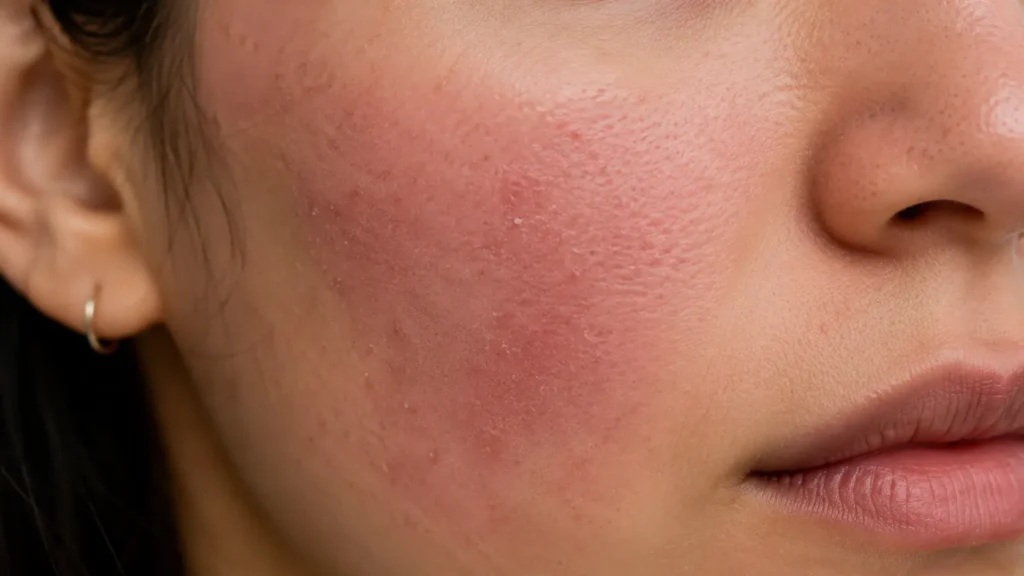
Can you over-exfoliate your skin?
Yes, easily, and it’s probably the single most common exfoliation mistake people make without realizing it’s even happening. Signs include redness, stinging, visible peeling, and — counterintuitively — more breakouts, not fewer, because a compromised skin barrier can’t defend itself against bacteria and irritants as well as healthy, intact skin can.
A short list of habits genuinely worth dropping, some of which took me longer to unlearn than I’d like to admit:
- Exfoliating daily “just to be safe.” More isn’t better here, full stop. Most skin types do best with a few sessions a week, not seven.
- Using scrubs with jagged or oversized particles. If you can feel sharp edges between your fingers before you even apply it, your face is going to feel them too, just less immediately.
- Skipping sunscreen the day after chemical exfoliation. This is exactly when skin is at its most reactive to UV exposure, not the day to “forget” SPF.
- Stacking multiple actives in one routine — a glycolic toner, a salicylic serum, and a physical scrub all in the same week is a recipe for barrier damage, not faster results, no matter how good it sounds in theory.
- Exfoliating over sunburn, cuts, or active irritation. Wait it out. Your skin will tell you clearly enough when it’s actually ready again.
Here’s a mistake I see often: one client layered a glycolic toner under a salicylic acid spot treatment before a late-night out, not realizing she was effectively double-exfoliating. Her skin stayed irritated for nearly a week. It’s a simple oversight with a clear lesson: check the ingredient list of your full routine with the same care you’d give any single product, especially before combining actives.
Already dealing with stinging, tightness, or redness from over-exfoliating? Our guide to repairing a damaged skin barrier walks through the recovery process step by step.
Best Exfoliation Practices for Specific Skin Concerns
What’s the best exfoliation routine for acne scars?
Consistency with a mild AHA, like lactic acid, tends to work better than higher intensity for fading post-acne marks over time, since gradual surface renewal supports a more even tone without provoking the fresh inflammation that could worsen scarring.
Different concerns genuinely call for different exfoliation strategies, and treating them all identically is one of the more common ways people stall their own progress:
- Hyperpigmentation — gentle AHA or PHA combinations, applied consistently rather than aggressively, tend to support gradual, more even brightening without the rebound irritation that harsher approaches can trigger.
- Active acne and clogged pores — salicylic acid remains the dermatology-recognized standard here, given its proven ability to penetrate oil-filled pores directly rather than just working on the surface (JAAD Guidelines).
- Rosacea or generally reactive skin — enzyme exfoliants or PHAs only, used sparingly, with a strong parallel emphasis on barrier-supportive, ceramide-rich moisturizers alongside them.
- Anti-aging goals — glycolic acid, ideally balanced with ceramide-rich moisturizers to offset the natural moisture loss that comes with more frequent acid use over time.
Pairing exfoliation with anti-aging goals? Our guide to sun protection and anti-aging covers why SPF is the step that actually protects those results.
Final Thoughts on Face Exfoliation
Here’s what I keep coming back to, after all the ingredient research and all the dermatology guidelines and, honestly, a fair bit of my own trial and error along the way: exfoliation works best as restraint, not aggression. The skin you’re trying to reveal underneath isn’t hiding from a lack of scrubbing.
It’s usually just waiting — for consistency, for the right ingredient matched to your specific skin type, and for a little patience while natural cell turnover does what it’s biologically built to do on its own timeline, not yours.
If you take one thing from this guide, let it be this: start gentler than you think you need to, watch how your skin actually responds over a couple of weeks rather than a couple of days, and adjust from there based on what you observe, not what a five-star review promised you.
And if your skin is doing something you genuinely can’t explain — persistent redness, unexpected breakouts, dark spots that won’t fade no matter what you try — that’s a conversation for a board-certified dermatologist, not another product review or forum thread. Your skin will tell you what it needs, honestly, if you give it the chance. It’s mostly just a matter of learning to listen before reaching for the next scrub.
FAQs: The Ultimate Guide to Face Exfoliation
What is the best exfoliation for your face?
There’s no single “best” — it depends on your skin type. Oily or acne-prone skin generally responds well to salicylic acid (a BHA), while dry or sensitive skin does better with a mild lactic acid or PHA, applied a couple of times a week rather than daily (as an AAD).
What is the most effective exfoliator for the face?
Chemical exfoliants — particularly AHAs and BHAs — are considered the most consistently effective and even-acting option by dermatologists, since they work without the friction and micro-tear risk that comes with physical scrubs.
Should I exfoliate my face if I have rosacea?
Very cautiously, if at all. Rosacea-prone skin tends to react badly to both physical scrubs and stronger acids, so a gentle enzyme exfoliant or low-strength PHA, used infrequently, is the safer starting point — ideally under a dermatologist’s guidance.
Which exfoliator is best for blackheads?
Salicylic acid (BHA) is the standard recommendation because it’s oil-soluble and can penetrate clogged pores, dissolving the buildup that forms blackheads (JAAD Guidelines).
What is the best face exfoliator for older skin?
Low-concentration lactic acid is generally favored for mature skin, since it exfoliates gently while also drawing in moisture — useful given that skin tends to become thinner and slower to renew with age (NIH/PMC).
What is the best exfoliator for hyperpigmentation?
Gentle, consistent use of AHAs like glycolic or lactic acid tends to support gradual, even fading of dark spots. Those with darker skin tones should start conservatively, as overly aggressive exfoliation can worsen post-inflammatory hyperpigmentation (PIH).

About Subhan Usafzai
Evidence-Based Skincare Educator & Formulation Specialist
I'm Subhan Usafzai (Fazli Subhan), an Evidence-Based Skincare Educator and Formulation Specialist. My background includes first-hand experience as a technician and research support in skin departments across tertiary military hospitals since 2006, and since 2008 I've focused on researching and translating clinical and formulation science into practical, evidence-based guidance. My formal training includes Coursera's Introduction to Cosmetic and Skincare Science and the four-course Introduction to Cosmetic Science and Ingredients specialization (Cosmetic Formulation Science, Cosmetic Product Development, and Quality Control and Regulatory in Cosmetic Science), authorized by Olay. Every article I write is checked against current research and reviewed by our medical team before publishing.
✅ Medically reviewed by Dr. Muhammad Khurram Ahmad, MD, Board-Certified Dermatologist · 📅 Last updated: July 2026
📋 Medical Disclaimer
For Educational Purposes Only: This article is written by Subhan Usafzai, an Evidence-Based Skincare Educator and Formulation Specialist, and is intended for informational and educational purposes only. The content provided is based on scientific research, peer-reviewed studies, and dermatological literature available as of July 2026.
Not Medical Advice: The information in this article does not constitute medical advice, diagnosis, or treatment recommendations. It should not be used as a substitute for professional medical consultation, diagnosis, or treatment from a board-certified dermatologist or qualified healthcare provider.
Individual Results May Vary: Skin conditions, including hyperpigmentation, melasma, and UV-induced pigmentation, vary significantly between individuals based on genetics, skin type, hormonal factors, and environmental exposure.
Consult Your Healthcare Provider: Before starting any new skincare regimen, especially if you are pregnant, breastfeeding, have diagnosed skin conditions, are taking medications, have sensitive skin, or are undergoing dermatological treatments.
Product Safety: Always perform a patch test before using new skincare products. Discontinue use and consult a healthcare professional if you experience irritation or adverse reactions.