
Layering skincare actives is one of the most powerful tools in modern dermatology. But it’s also one of the easiest ways to wreck your skin barrier overnight.
In fact, a 2023 survey by the International Dermal Institute found that over 62% of skincare users reported self-induced irritation from combining ingredients incorrectly — and that number is only climbing as multi-step routines become more popular.
Here’s the good news: in 2026, we know exactly how to do this right.
Whether you’re stacking retinol and peptides, experimenting with niacinamide and vitamin C, or trying to work AHAs and BHAs into the same routine, there’s a science to layering actives that protects your skin barrier while maximizing results. I’ve broken it all down, step by step, backed by board-certified dermatologists and the latest research.
This guide covers everything from understanding pH compatibility and skin barrier function, to building a morning vs. night active routine that actually works — without the redness, peeling, or regret. And if your skin barrier is already showing signs of damage, read more about how to repair a damaged skin barrier before diving into any active routine.
Let’s get into it.
What Are Skincare Actives and Why Does Layering Matter in 2026?
Not every ingredient inside your serum is doing the same kind of work. Some sit at the surface, some shuttle moisture into cells, and some — the ones this entire guide is built around — actually change what’s happening inside your skin tissue at a cellular level. Understanding that distinction is the foundation of everything else here.
Defining “Actives” — and Why not All Skincare Ingredients are created equal
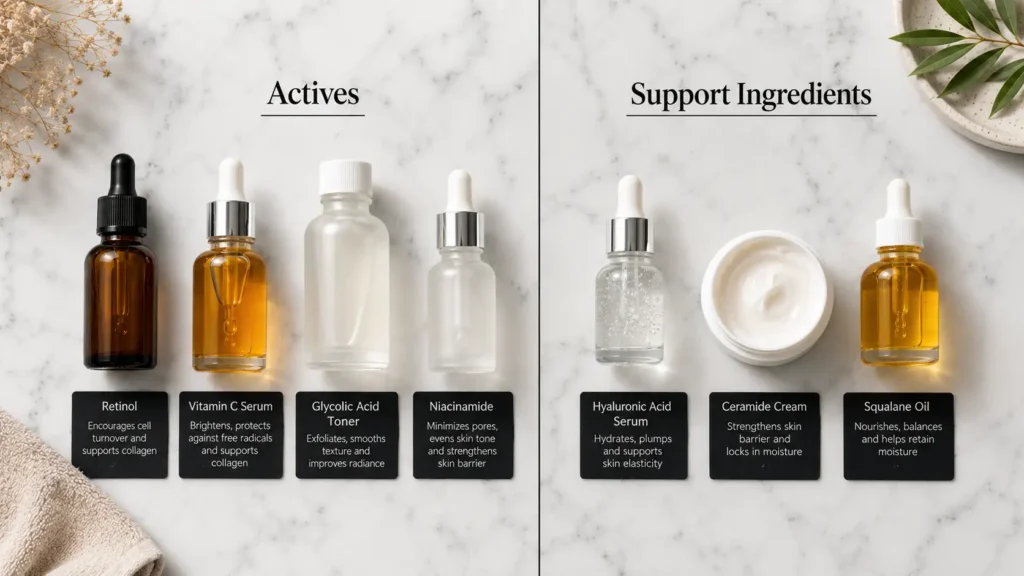
An active ingredient is one that produces a measurable, physiological change inside the skin — not just on its surface. That’s a meaningful distinction and worth holding onto. Humectants like hyaluronic acid attract water to skin cells. Emollients like squalane form a protective, softening film. Both matter for skin health, but neither structurally alters anything at the tissue level.
Actives do. They penetrate deeply enough to interact directly with skin cells — stimulating collagen synthesis, interrupting melanin production pathways, dissolving bonds between dead skin cells, or accelerating the rate at which cells turn over.
The American Academy of Dermatology classifies active ingredients as compounds clinically demonstrated to alter the structure or function of skin, which is also why they’re more tightly regulated than standard moisturizers, and why combining them carelessly carries real, documented consequences.
The list of common actives includes retinoids (retinol, retinal, tretinoin), alpha-hydroxy acids (glycolic, lactic, mandelic), beta-hydroxy acids (salicylic acid), vitamin C (L-ascorbic acid and its derivatives), niacinamide, azelaic acid, benzoyl peroxide, peptides, and tranexamic acid.
Supporting ingredients — ceramides, glycerin, panthenol, squalane — don’t require the same careful handling. They can be layered freely. Actives, by definition, cannot.
The rise of multi-active routines and why more isn’t always more
Multi-step, multi-active routines exploded through the early 2020s. Social media made ingredient education genuinely accessible — knowing what glycolic acid does became common knowledge.
But knowing what an ingredient does is a completely different thing from knowing whether it belongs in the same session as your retinol. The gap between those two pieces of knowledge is where most skin damage happens.
The result has been a widespread practice dermatologists have started calling “skincare cocktailing” — stacking three, four, sometimes five actives into a single application, with the conviction that more potency equals faster results. It doesn’t.
Board-certified dermatologist Dr. Shereene Idriss, one of the most cited clinical voices in modern skincare education, has stated publicly that “layering multiple actives without understanding compatibility is one of the top causes of self-inflicted skin damage” she sees in practice.
The mechanism is straightforward: incompatible actives don’t compound benefits. They compound irritation, barrier disruption, and — paradoxically — slower progress on the exact concerns you were trying to address. More is rarely better. More is usually just more.
What happens to your skin barrier when actives are layered incorrectly
Your skin barrier — specifically the stratum corneum, the outermost layer of the epidermis — is a lipid matrix that functions as the body’s primary defense against moisture loss, environmental damage, and irritant penetration. When actives are layered incorrectly, this structure absorbs the damage first, with consequences that are both specific and cumulative.
A peer-reviewed study on skin barrier function and topical product interactions explains that repeated disruption of the stratum corneum increases transepidermal water loss (TEWL) and triggers a sustained inflammatory cascade.
The operative word is repeated. One poorly layered session won’t destroy your barrier. But chronic misuse creates a progressive deficit, which is why people suddenly find that “everything is irritating my skin” after months of an aggressive multi-active routine. It’s not a mysterious new sensitivity. It’s compounding damage, finally crossing the threshold where it becomes impossible to ignore.
The Golden Rules of Layering Skincare Actives Without Irritation
Layering actives isn’t a guessing game when you understand the underlying rules. These aren’t aesthetic preferences or brand recommendations — they’re principles grounded in formulation chemistry and dermatology research. Get them right, and most compatibility problems resolve on their own.
Rule #1 — Apply products from thinnest to thickest consistency
This rule is molecular, not stylistic. Thinner, water-based formulas contain smaller molecules that absorb quickly and completely into the skin. Apply a heavy cream before a watery vitamin C serum, and you’ve physically blocked the serum’s path. It won’t penetrate effectively. You’ve just wasted both products on each other rather than on your skin.
The correct sequence: toner or essence → watery treatment serums → thicker treatment serums → facial oil (if used) → moisturizer → SPF (morning only). This isn’t rigid ritual — it’s the application order that gives each product an unobstructed absorption window.
Healthline’s dermatologist-reviewed guide on skincare layering identifies texture-ordering as the foundational rule most routinely violated by people who are otherwise careful about ingredient selection.
Rule #2 — Understand pH levels before you stack anything
pH compatibility is the single most overlooked factor in active layering — and the one responsible for the most silent product failures. The short version: AHAs and BHAs function optimally at pH 3–4. Vitamin C (L-ascorbic acid) requires a pH below 3.5 to stay stable and effective. Niacinamide is most active at pH 5–7.
Apply a higher-pH product directly over a low-pH active before the acid has finished working, and you’ve neutralized it. No visible damage, no stinging — just a product that’s been chemically deactivated before it could do anything useful.
Paula’s Choice’s research team has addressed the pH layering debate directly, noting that well-formulated products maintain their pH range even when layered immediately over products with a different pH — meaning a mandatory wait between steps is generally not required.
For most people, the more practical fix is separating pH-incompatible actives into morning and evening routines entirely — no timing math required.
Rule #3 — The “buffer time” method: wait between actives
Related to pH, but distinct from it. Even compatible actives need proper absorption time before you layer something on top. The general working standard is 20–30 minutes after any acid or vitamin C serum before the next product step.
For retinol specifically, the sandwich method is the most widely recommended introduction strategy among dermatologists: apply a light moisturizer first, then retinol, then another thin layer of moisturizer on top.
This buffers the rate of retinol absorption — reducing the acute irritation response that typically characterizes the first weeks of use without eliminating the ingredient’s long-term efficacy. Think of it as a calibrated starting point, not a permanent feature of the routine. Most people phase it out gradually as their skin adapts over 6–8 weeks.
Rule #4 — Never skip patch testing when introducing a new active
You know this. You probably still skip it. According to the AAD’s guide on how to test skincare products, dermatologists recommend applying a quarter-sized amount of any new product to the underside of your arm or the bend of your elbow, twice daily for 7–10 days, before introducing it to your face.
If no redness, itching, or swelling appears after that window, the product is generally safe to use — and that simple step is the most reliable way to catch a contact reaction before it becomes a full facial problem.
When adding a new active into an existing multi-step routine, interaction effects between the new ingredient and what’s already in your routine matter as much as the new ingredient alone. That makes patch testing more essential in a complex routine, not less.
Are you over-exfoliating without realizing it? Signs to watch for
Over-exfoliation announces itself subtly before it announces itself obviously. The early signals tend to get misread: skin that feels tight immediately after applying a moisturizer that used to feel comfortable; a shiny, unusually “polished” quality to the complexion — often mistaken for a glow, but actually the visual marker of a thinned stratum corneum; sudden stinging from products you’ve used for months without any reaction; breakouts appearing in locations where you don’t typically break out.
Any two of these together, in the context of a multi-active routine, is your skin asking you to pull back. The appropriate response is not pushing through. It’s stopping.
The Active Ingredients Compatibility Chart — What to Pair and What to Avoid
This is where most layering decisions — and most layering mistakes — actually happen in practice. Some combinations are genuinely synergistic. Some need timing care. And some are reliably counterproductive regardless of how high-quality the individual products are.
To know more about where people go wrong and how to course-correct, read our detailed guide on skincare mistakes and how to fix them.
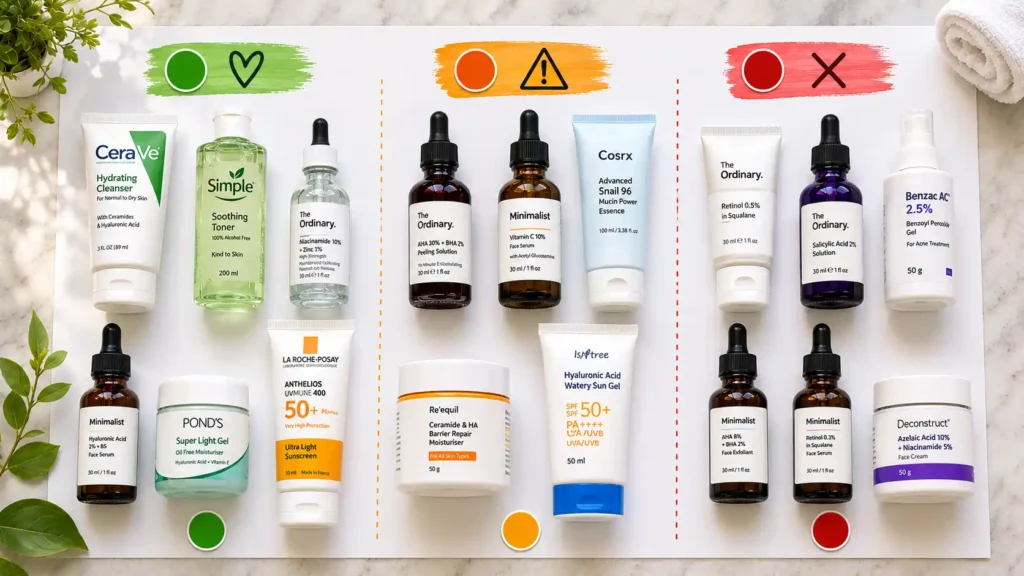
The “green light” combinations — actives that work beautifully together
Some pairings don’t just coexist — they actively complement each other through non-competing mechanisms, producing combined results that are meaningfully better than either ingredient alone.
According to dermatologist-reviewed guidance, including the Healthline skincare layering resource, these are the combinations that consistently perform without conflict:
| Pairing | Why It Works | Best Routine Slot |
|---|---|---|
| Vitamin C + Broad-Spectrum SPF | Vitamin C neutralizes free radicals that SPF filters can’t block; SPF protects vitamin C from UV-driven oxidation | Morning |
| Niacinamide + Hyaluronic Acid | Both barrier-supportive, with no competing mechanisms and no pH conflict | Morning or Night |
| Retinol + Peptides (applied in sequence) | Peptides stimulate collagen via distinct cellular pathways — no competition with retinoid activity | Night |
| AHA + Hyaluronic Acid (after acid fully absorbs) | HA replenishes hydration post-exfoliation without interfering with the acid’s action | Night |
| Azelaic Acid + Niacinamide | Both anti-inflammatory and pigment-targeting through genuinely complementary mechanisms | Morning or Night |
The “proceed with caution” combinations — use them, but carefully
Niacinamide + Vitamin C. This pairing has attracted debate for years. The theoretical concern is that, combined at elevated temperatures or high concentrations, they form a compound called niacin that can cause skin flushing.
Dr. Michelle Wong of Lab Muffin Beauty Science addresses this directly in her Vitamin C skincare guide, stating that it is a myth you cannot use niacinamide with ascorbic acid, and that any niacin formation from the interaction is most likely only relevant when the two are stored together in the same product over a long period — not when layered on skin during a routine.
That said, if you’re using high-percentage L-ascorbic acid (15–20%) alongside high-concentration niacinamide (10%+), it’s sensible to split them into separate AM and PM routines.
Retinol + Niacinamide. Not a problematic pairing — but sequencing matters. Niacinamide applied after retinol has fully absorbed actively supports barrier recovery through anti-inflammatory action and ceramide stimulation. Issues arise only when they’re applied simultaneously in the same step without adequate absorption time between them.
BHA + AHA in the same session. Some specifically formulated multi-acid products are designed for simultaneous use at calibrated concentrations. But layering a standalone glycolic acid toner immediately followed by a full-strength salicylic acid serum is generally a case of over-exfoliation. Alternate rather than stack.
The “red light” combinations — ingredients that should never share a routine step
Retinol + AHAs or BHAs (same session): Both categories are exfoliating through different mechanisms. Combined in one application, the barrier disruption risk compounds — along with heightened redness and significantly increased photosensitivity. The AAD’s retinoid guidance specifically flags combining vitamin A derivatives with chemical exfoliants without dermatologist oversight.
Retinol + Vitamin C (same step): L-ascorbic acid requires a low-pH environment to remain stable and biologically active. Retinol is chemically destabilized by that same low-pH environment. Both are also susceptible to oxidative degradation, and direct layering compromises the stability of each. Morning vitamin C, evening retinol — this separation reflects documented formulation chemistry, not just convention.
Benzoyl Peroxide + Retinol: Benzoyl peroxide and retinol are both acne-fighting actives, but they shouldn’t be used together in the same session. As Dermstore’s guide on skincare products you should never mix explains, retinol stimulates cell production and leaves skin extra sensitive, while benzoyl peroxide works by drying the skin — the combination causes double the irritation. Use them on alternate days rather than in the same routine.
Multiple exfoliating acids at high concentration in the same session. Glycolic acid at 10% plus lactic acid at 10% in the same application is not additive brightening — it’s additive exfoliation that doubles the risk of barrier disruption without doubling the results.
What happens when you mix retinol and acids? A dermatologist explains
Board-certified dermatologist Dr. Joshua Zeichner, MD (Director of Cosmetic and Clinical Research in Dermatology, Icahn School of Medicine at Mount Sinai, New York) has publicly addressed this specific combination, explaining that layering retinoids with chemical exfoliants in the same session effectively doubles the exfoliation load — creating a barrier vulnerability that standard overnight moisturizers can’t fully reverse by morning.
The downstream consequence isn’t confined to that evening: photosensitivity is meaningfully elevated the following day, so your UV protection needs to be more rigorous — not just standard — the morning after using either active category. The overlap between retinoids and exfoliating acids is one of the most consequential layering errors in contemporary skincare routines, and it’s also one of the most common.
How to Build Your Morning Active Routine Without Irritation
Morning skincare has one non-negotiable anchor: sunscreen. Everything else in the AM routine exists in service of that foundation — either amplifying its protective effect or maintaining skin resilience throughout the day. That purpose shapes every active choice in this slot.
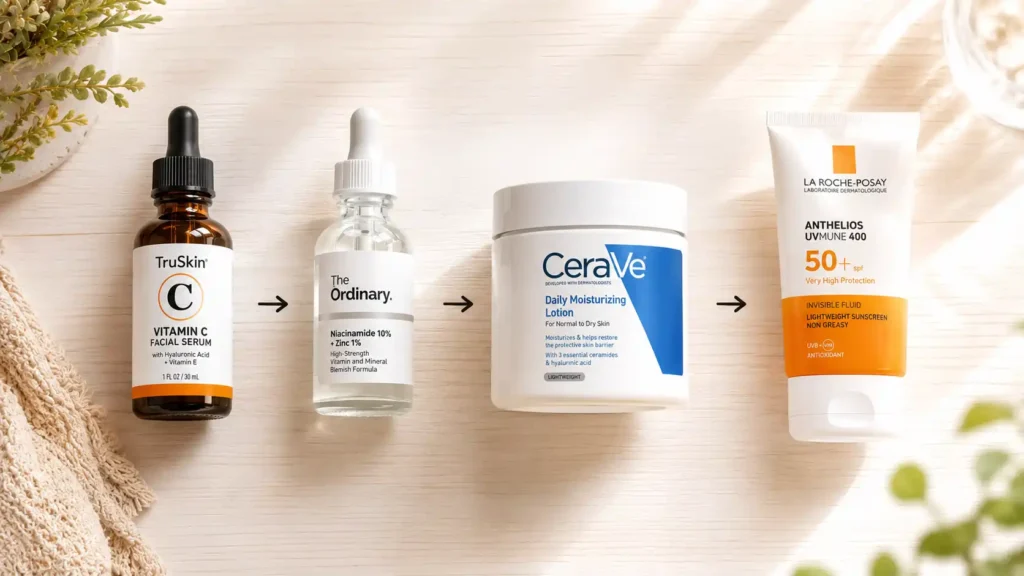
The ideal AM active lineup — step by step
Strong exfoliating acids and high-concentration retinoids belong at night, full stop. They increase photosensitivity — meaning UV exposure after applying them amplifies irritation and accelerates the very damage you’re trying to repair. Morning is for protection and brightening.
Here’s a functional, dermatologist-aligned AM sequence:
- Gentle, pH-balanced cleanser — fragrance-free, non-stripping, nothing that leaves skin feeling tight
- Vitamin C serum — apply to clean, slightly dry skin; allow 2 full minutes to absorb before the next product
- Niacinamide serum (if included in AM rotation) — apply after vitamin C has fully absorbed into the skin
- Lightweight moisturizer — ceramides, peptides, or a simple barrier formula that layers cleanly under SPF
- Broad-spectrum SPF 30+ — the final step before makeup, applied generously and evenly
That’s the sequence. Five steps, two actives maximum, and nothing that undermines your sunscreen. Resist the urge to add an exfoliating acid “just in the morning sometimes” — it’s not worth the photosensitivity cost.
Which vitamin C derivative is least irritating for sensitive skin in 2026?
L-ascorbic acid is the most extensively researched form of vitamin C in topical skincare and has the strongest clinical evidence base. But the pH it requires to function (below 3.5) makes it the most acutely irritating option for sensitive and reactive skin types. If it’s always stung or oxidized too quickly in your routine, that’s not your skin being difficult — that’s formulation chemistry.
A 2023 review of the clinical efficacy of topical vitamin C and its derivatives, available via Semantic Scholar, examined multiple vitamin C derivatives, including sodium ascorbyl phosphate, ascorbyl glucoside, and 3-O-ethyl ascorbic acid, for stability and antioxidant activity.
Sodium ascorbyl phosphate showed greater stability than L-ascorbic acid due to its phosphate group, which protects the enediol structure from oxidation, and demonstrated efficacy.
3-O-ethyl ascorbic acid is gaining clinical traction as a stable, less pH-dependent alternative — as confirmed in a PubMed-indexed characterisation study — with good skin bioavailability as a vitamin C delivery form.
Ascorbyl glucoside is gentler still — though it requires enzymatic conversion inside the skin before becoming biologically active. These aren’t inferior substitutes. They’re better-matched options for skin types that the purest, most potent form simply doesn’t suit.
Why niacinamide has become the MVP of the 2026 morning routine
Niacinamide — vitamin B3 — earns its current status not through trend but through genuine versatility. What makes it genuinely exceptional in a morning routine is the breadth of benefit it delivers without requiring any special handling protocols.
At concentrations between 2% and 10%, niacinamide strengthens the skin barrier by actively stimulating ceramide production, regulates sebum in oily and combination skin types, fades hyperpigmentation by inhibiting melanosome transfer between skin cells, and reduces redness and reactivity through real anti-inflammatory action — not just surface soothing.
Critically: it’s compatible with nearly all other morning actives when applied in the correct sequence. No strict pH window to manage. No photosensitivity increase. No documented conflicts with SPF. For anyone structuring a morning active routine, niacinamide is the rare ingredient that fits into almost every scenario without complicating the ones around it.
For a deeper look at how niacinamide stacks up against ceramides specifically for barrier repair, this breakdown is worth the read.
How to apply SPF after actives without pilling or breaking down your serums
Pilling — when products ball up on skin during application — is a timing and formulation compatibility issue before it’s anything else. Actives need full absorption before SPF is applied on top. The AAD’s sunscreen application guidelines recommend applying sunscreen as the final skincare step before makeup, after all prior products have settled.
Practically: 60–90 seconds minimum per product layer before adding the next one. On the formulation side, mineral sunscreens (zinc oxide, titanium dioxide) sit on the skin rather than being absorbed, which increases the risk of pilling when layered over thick or slow-absorbing serums.
Chemical sunscreens absorb more cleanly and tend to layer more smoothly over active serums, though they’re not suitable for all skin types. If your SPF is consistently pilling, try a lighter-textured sunscreen formula before reconsidering your actives.
How to Build Your Nighttime Active Routine Without Irritation
Your skin’s repair mechanisms run hardest while you sleep. Cell turnover accelerates, collagen synthesis increases, and the barrier actively rebuilds its lipid matrix during nighttime hours. That’s physiology — not marketing. Which is exactly why the most potent actives belong in the PM, and why structuring them carefully matters more here than anywhere else in the routine.
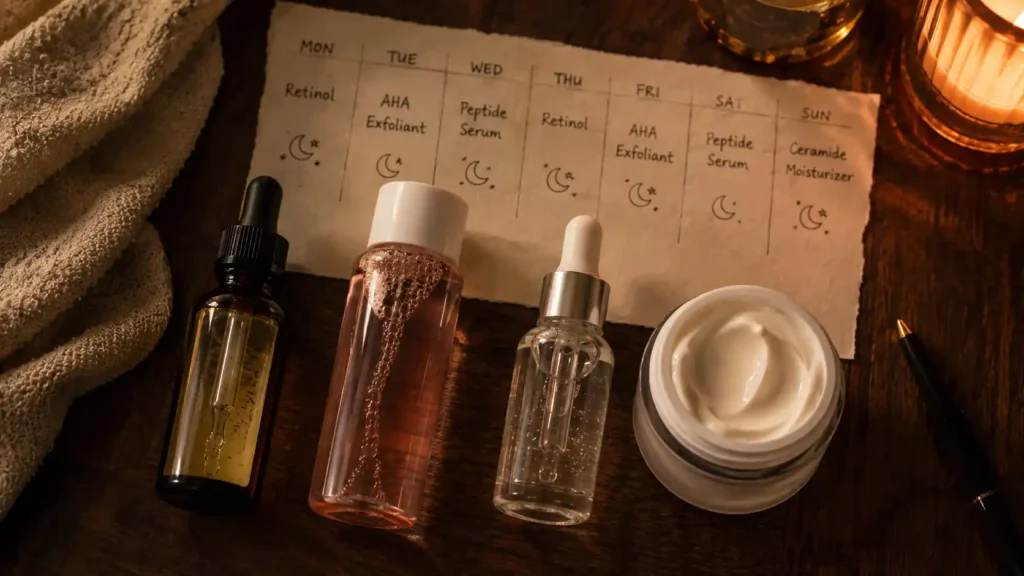
The ideal PM active lineup — step-by-step for beginners and advanced users
The governing principle of a functional nighttime active routine is rotation, not stacking. You don’t need retinol and an exfoliating acid every single night. You need them on strategic, non-overlapping nights — so your skin gets targeted treatment on some nights and genuine recovery time on others.
Before building your PM active routine, make sure you’re applying products in the correct sequence — this complete guide on the right nighttime skincare routine order explains exactly how to layer your skincare for the best results and minimal irritation.
Retinol nights (3–4x per week):
- Double cleanse (oil cleanser → gentle water-based cleanser)
- Light moisturizer as buffer (beginners; phase out as skin adapts)
- Retinol → wait 20–30 minutes
- Ceramide-rich moisturizer
Acid nights (1–2x per week):
- Gentle cleanser
- AHA or BHA — not both in the same session
- Wait 20 minutes
- Niacinamide or peptide serum
- Barrier-repair moisturizer
Rest nights (remaining nights):
- Gentle cleanser
- Hydrating serum (hyaluronic acid, panthenol)
- Rich barrier-supportive moisturizer — zero actives
Results consolidate during recovery phases as much as they build during active treatment nights. Rest nights aren’t wasted nights.
How to introduce retinol without the “retinol uglies” — the slow method
The retinol adaptation period — the flaking, dryness, and reactive sensitivity that tends to arrive in the first weeks — is real, documented, and largely preventable with a properly staged introduction.
The AAD’s retinoid guidance recommends starting with the lowest available OTC formulation and applying it every other night initially, gradually increasing frequency only once the skin has stopped reacting.
A common approach: once per week for the first two weeks, twice weekly in weeks three and four, then three times per week — but only when skin has genuinely stopped reacting at each frequency, not on a predetermined schedule.
The most common beginner mistake is accelerating this timeline the moment skin seems fine. Skin needs approximately 6–8 weeks to upregulate the cellular mechanisms required for regular retinoid exposure. Push the schedule before that adaptation is complete, and you’re not accelerating results — you’re inflaming skin that hasn’t finished adjusting. Slow is fast here.
The “retinol sandwich” method — does it actually work in 2026?
Yes — with an important nuance that’s worth understanding properly. The sandwich method (moisturizer applied before retinol → retinol → moisturizer applied after) works by slowing the rate of retinol penetration, reducing peak concentration delivered at any single moment.
For beginners, this meaningfully reduces acute irritation without eliminating retinol’s long-term efficacy. Research published in the Journal of Drugs in Dermatology has supported moisturizer-based buffering approaches for retinoid initiation, particularly in patients with dry or reactive baseline skin.
The nuance: as your skin adapts over months, sustained use of the sandwich method can limit delivery enough to gradually slow results. Most dermatologists recommend phasing it out progressively — dropping the pre-retinol moisturizer layer first, then the post-application buffer — as tolerance builds. It’s a calibrated starting point, not a permanent feature of the routine.
AHA vs. BHA nights — how to rotate exfoliating acids without overdoing it
AHAs — glycolic acid, lactic acid, mandelic acid — are water-soluble, working primarily at the skin’s surface by dissolving the bonds between dead cells to improve texture, brightness, and overall tone. BHAs — primarily salicylic acid — are oil-soluble, meaning they penetrate pore linings and are more specifically effective for congested, acne-prone, or oily skin. Same broad category of exfoliant; genuinely different mechanisms and target zones.
Most people don’t need both in a weekly rotation unless they’re targeting both surface texture and pore congestion simultaneously. If you use both: non-consecutive nights only.
A practical example: AHA on Monday and Thursday; BHA on Wednesday; retinol on Tuesday and Friday; barrier-focused rest on Saturday and Sunday. Maximum safe usage frequency: AHAs 2–3x per week; BHAs 2–3x per week. Never combine both at meaningful concentrations in the same session.
Can you use peptides with retinol at night? What the research says
Peptides — signaling molecules that stimulate collagen and elastin synthesis — are genuinely excellent companions to retinol, applied after retinol has fully absorbed. A 2022 research review on peptides in topical skincare indexed on PubMed confirmed that peptides operate through distinct cellular pathways from retinoids — no competitive interaction between the two, no pH conflict, no efficacy reduction.
The one specific exception worth knowing: copper peptides. There is evidence that copper’s oxidative properties may interfere with retinol stability through a mechanism similar to the benzoyl peroxide issue. Most formulation chemists, including myself, recommend using copper peptides on non-retinol nights as a sensible precaution.
Standard peptide complexes — MATRIXYL 3000, palmitoyl tripeptide-1, various oligopeptide variants — carry no such concern and layer cleanly with retinol once it has absorbed fully.
Skin Barrier Repair — What to Do When You’ve Already Irritated Your Skin
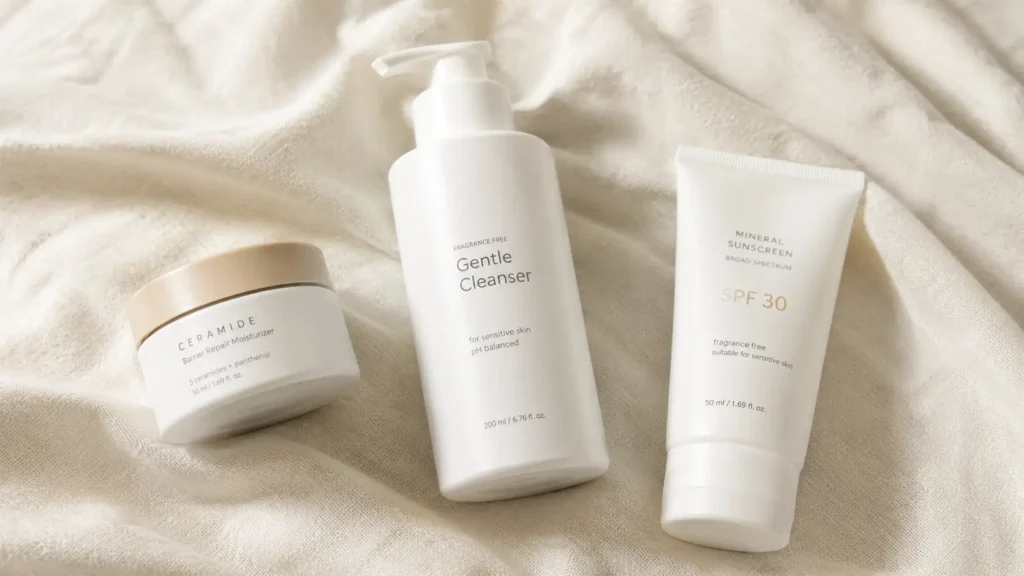
Sometimes the guide gets read after the damage is already done. That’s genuinely fine — skin barrier recovery is well-understood in dermatology, and with the right protocol, most compromised barriers recover completely within two to four weeks.
Here’s what the evidence actually recommends.
How to tell if your skin barrier is damaged (and not just “purging”)
These two conditions are genuinely different, and the distinction matters because the correct responses are essentially opposite.
Purging happens when retinoids or exfoliants accelerate cell turnover, pushing existing comedones to the surface faster than they would naturally cycle out. It stays concentrated in areas where you typically break out, usually resolves within four to six weeks, and, critically, it doesn’t involve stinging or burning sensations from products that previously felt comfortable on your skin.
Barrier damage presents differently entirely. Skin feels tight immediately after moisturizing — not just before it. Products you’ve used for months suddenly sting on application. The complexion takes on an unusual shininess or tautness, often misread as a glow but actually a visual marker of a thinned stratum corneum with inadequate lipid reserves.
Breakouts appear in locations where they don’t normally form. These are structural distress signals. Continuing to use actives through them doesn’t build tolerance — it extends and deepens the damage.
The 7–14 day “skin reset” protocol recommended by dermatologists
Stop all actives completely. Not reduce — stop, entirely, for a full 7–14 days. Every time you reintroduce even a “gentle” active before the barrier has fully recovered, you reset the recovery window from the start.
During the reset, the protocol is deliberately minimal: a fragrance-free, pH-balanced, non-stripping cleanser — Vanicream Gentle Facial Cleanser and CeraVe Hydrating Cleanser are both widely recommended by dermatologists for compromised skin situations, and CeraVe’s published ingredient rationale is available at; a ceramide-rich moisturizer applied morning and night; and SPF every single morning regardless of weather. Nothing else. No treatment serums, no “just a touch” of niacinamide. The biology needs uninterrupted time to work. Give it that.
The ingredient MVPs for rebuilding your skin barrier fast
Once the reset period is complete and acute inflammation has settled, these are the ingredients with the strongest evidence for active barrier reconstruction — the ones worth prioritizing in your moisturizer and supporting products:
- Ceramides (1, 3, 6-II): The structural lipid building blocks of the stratum corneum — non-negotiable in any genuine barrier repair formula
- Cholesterol: Works synergistically with ceramides to restore the skin’s natural physiological lipid ratio; most effective when all three lipid classes are present together
- Fatty acids (linoleic acid, palmitic acid): The third essential component of the skin’s natural moisture factor system; ceramides alone don’t rebuild the barrier without adequate fatty acid support
- Panthenol (Provitamin B5): Deeply hydrating, documented anti-inflammatory, and well-tolerated by even the most reactive skin
- Madecassoside / Centella Asiatica: Anti-inflammatory plant-derived compound with strong evidence in dermatology research for barrier support and skin healing
- Niacinamide at 5%+: Once skin has stabilized from the reset, niacinamide actively increases ceramide synthesis — making it one of the most valuable long-term barrier maintenance actives once the acute phase is over.
If you’re weighing up which one to reach for first, our detailed breakdown of ceramide vs. niacinamide for skin barrier repair walks you through exactly how they differ and when to use each.
When to see a dermatologist vs. treating irritation at home
Most cases of self-induced layering irritation resolve fully with the reset protocol above — no professional intervention required. But there are clear thresholds where that changes.
See a board-certified dermatologist: if the reaction involves oozing, significant swelling, or crusting, that suggests allergic contact dermatitis requiring prescription treatment; if persistent redness extends well beyond your active application areas, which may indicate a rosacea flare or perioral dermatitis; or if symptoms don’t meaningfully improve after two full weeks of strict barrier reset.
The AAD’s contact dermatitis resource outlines the distinction between irritant and allergic contact dermatitis — an important clinical distinction because treatment approaches for the two conditions differ significantly.
Layering Actives for Specific Skin Concerns in 2026
The foundational layering rules apply universally. But the specific combination of actives that makes most sense — and how aggressively you can layer them — shifts meaningfully depending on what you’re actually trying to address.
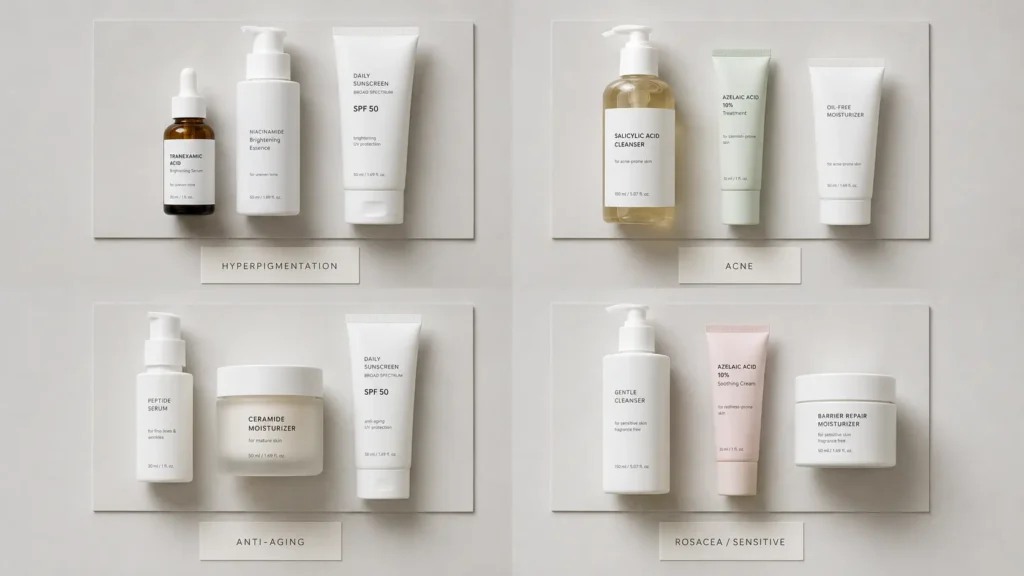
Best active layering routine for hyperpigmentation and dark spots
Hyperpigmentation — whether from UV damage, post-inflammatory marks from acne, or melasma — responds best to a multi-target approach that simultaneously interrupts melanin production at multiple points in the synthesis pathway.
For a full breakdown of the evidence-backed ingredients involved, this guide covers the key mechanisms.
Morning: Vitamin C serum (form appropriate to your skin type) → niacinamide → lightweight moisturizer → broad-spectrum SPF. The SPF step here is not optional — UV exposure actively reverses hyperpigmentation treatment, making any brightening routine functionally pointless without consistent sun protection.
Tranexamic acid is attracting significant clinical interest for melasma and post-inflammatory hyperpigmentation — a study indexed in PubMed documented melanin inhibition via a pathway distinct from vitamin C, making it a valuable, non-redundant addition to a brightening protocol rather than a replacement for existing actives.
Best active routine for acne-prone and oily skin
The instinct for acne-prone skin is to use every available anti-acne active, simultaneously and aggressively. This reliably backfires. Over-treating triggers a compensatory surge in sebum; a barrier damaged by aggressive layering allows bacteria and irritants to penetrate more easily, not less. Restraint, honestly, gets better results faster.
For a full routine built around that principle, this guide to oily skin care covers the ingredient logic and layering order in detail.
Morning: Niacinamide (sebum regulation, anti-inflammation) → lightweight non-comedogenic moisturizer → SPF
Evening: BHA (salicylic acid 1–2%) on 2–3 non-consecutive nights per week; retinol on 2 separate nights; never combined in the same session. Benzoyl peroxide, if used, is most appropriate as a targeted spot treatment applied after moisturizer — isolated to active breakout zones, never combined with retinol on the same night, and never spread across the whole face routinely.
How to layer actives for anti-aging without wrecking sensitive skin
Anti-aging actives — retinoids and exfoliating acids especially — sit at the high-irritation end of the active spectrum, which creates a real challenge for sensitive skin types trying to address fine lines and loss of firmness. The answer isn’t abandoning the most clinically supported ingredients. It’s a slower introduction schedule and a more strategic rotation.
Retinol remains the gold standard. For sensitive skin, retinal (retinaldehyde) is worth considering as an alternative starting point — it converts to retinoic acid in fewer enzymatic steps, and some users find the acute adaptation period less intense.
Bakuchiol, a plant-derived compound, has attracted legitimate clinical attention; a 2018 double-blind study published in the British Journal of Dermatology found bakuchiol comparable to 0.5% retinol in reducing fine lines and pigmentation, with significantly less reported photosensitivity and dryness — making it a meaningful option for those who genuinely cannot tolerate standard retinoids in any form.
Peptides (MATRIXYL complexes, argireline, palmitoyl oligopeptides) add collagen-stimulating benefit through non-exfoliating, non-barrier-disrupting mechanisms, making them ideal companions to retinol on alternating nights.
Can you layer actives if you have rosacea or reactive skin?
Yes — but the selection criteria are substantially stricter, and the introduction timeline is more cautious than for most other skin types. Many standard actives reliably trigger rosacea flares: high-strength glycolic acid, alcohol-forward toners, synthetic fragrance in serums, and high-percentage retinol are among the most documented.
The National Rosacea Society advises consulting a dermatologist before introducing any active ingredients and recommends introducing new products one at a time, with an extended observation period between additions — not the standard two-week trial window, but often four to six weeks.
Actives with the most favorable tolerability profile for rosacea-prone skin: azelaic acid (genuinely anti-inflammatory as well as brightening — one of the very few actives that can address rosacea symptoms while treating hyperpigmentation simultaneously, as real-world results consistently show); niacinamide at mid-range concentrations (5–10%); and low-concentration lactic acid as the gentler AHA alternative when exfoliation is necessary, as it’s considerably less likely to provoke a flare than glycolic acid at equivalent concentrations.
2026 Skincare Innovations — New Active Delivery Technologies That Reduce Irritation
One of the genuinely exciting developments of 2026 is that the question of how to get actives into skin without triggering irritation is increasingly being solved at the formulation level — not just through routine design and scheduling.
Encapsulated actives — how smart delivery systems are changing the game
Microencapsulation wraps active molecules — retinol and vitamin C most commonly — in a protective shell that gradually breaks down upon contact with skin, rather than releasing the entire dose immediately. The result is time-released delivery: therapeutic efficacy maintained, but peak concentration at any single moment significantly reduced.
This is precisely why encapsulated retinol formats are now the standard recommendation for beginners and for anyone who has previously reacted to conventional retinol formulas.
A 2023 study on encapsulation technology in cosmetic formulations, published in Pharmaceutics and indexed in PubMed, confirmed that encapsulated active ingredients exhibit extended-release profiles and significantly reduced irritation markers compared with equivalent unencapsulated formulations.
If retinol has historically been too reactive for your skin, specifically seeking an encapsulated retinol formula in 2026 is a substantive upgrade — not marketing language in a different font.
Microbiome-conscious formulations and their role in reducing active-induced irritation
The skin microbiome — the ecosystem of bacteria, fungi, and microorganisms colonizing the skin’s surface — plays a more meaningful role in barrier resilience than conventional skincare messaging has historically acknowledged. When strong exfoliating acids shift surface pH and alter lipid composition, they not only affect the physical barrier structure. They alter the microbial environment in ways that can amplify subsequent sensitivity responses.
A 2022 review published in the International Journal of Molecular Sciences and indexed on PubMed outlined the relationship between microbiome disruption and barrier impairment in the context of topical skincare application.
The practical formulation response has been the development of microbiome-conscious active products — incorporating prebiotics (substrates that feed beneficial skin bacteria) or postbiotics (fermented byproducts that support barrier integrity) alongside the active ingredient itself.
The consumer benefit: active delivery without the collateral microbial disruption typically associated with aggressive acid use.
For a deeper look at how the skin microbiome works and how to protect it within your routine, this guide covers the full picture.
Hybrid moisturizer-serums with built-in actives — less layering, same results?
The full multi-step routine has genuine merit for those who manage it well. But for people with reactive skin — or anyone who struggles with the timing, sequencing, and compatibility management a full active routine requires — the growing category of active moisturizers offers a legitimate alternative worth taking seriously.
The principle is sound: an encapsulated retinol delivered inside a ceramide-rich moisturizer base is an inherently buffered delivery system. The barrier lipids slow penetration in real time, without requiring a separate sandwich-method step or manual buffer application.
Similarly, AHA-barrier hybrid formulas — lactic acid combined with ceramides and fatty acids — exfoliate while actively replenishing the lipid matrix that exfoliation alone depletes.
For minimalists, for reactive skin types, and for anyone who has experienced the compounding irritation of too many separately applied products in sequence, these formulas represent formulation science doing what this entire guide has been describing manually. They’re not shortcuts. They’re the intelligent application of chemistry to a well-documented problem.
Conclusion: How to Layer Skincare Actives Without Irritation
Layering actives doesn’t have to be a guessing game — and it definitely shouldn’t come with a side of burning, peeling skin.
The key takeaway from everything we’ve covered? Start slow, understand your ingredients, and respect your skin barrier above all else. Whether you’re building a routine for anti-aging, acne, hyperpigmentation, or simply trying to get the most out of your serums, the foundation is always the same: know what you’re mixing, know your pH, and give your skin time to adapt.
In 2026, the tools and research available to us are better than ever. From encapsulated retinol that self-regulates delivery to microbiome-friendly formulas designed to actively protect your barrier while treating your skin concerns — there’s genuinely no reason to suffer irritation in the name of glowing skin.
Your action step: Start with one active at a time. Patch test. Introduce a second active only once your skin has tolerated the first for two full weeks. Build the routine slowly, and you’ll get there — with a healthy, thriving barrier to show for it.
Still unsure where to start?
Explore the full ingredient breakdown at GlowGuideHub’s Skincare Ingredients That Actually Work in 2026 — it’s the perfect companion resource to this guide.

About Subhan Usafzai
Evidence-Based Skincare Educator & Formulation Specialist
I'm Subhan Usafzai (Fazli Subhan), an Evidence-Based Skincare Educator and Formulation Specialist. My background includes first-hand experience as a technician and research support in skin departments across tertiary military hospitals since 2006, and since 2008 I've focused on researching and translating clinical and formulation science into practical, evidence-based guidance. My formal training includes Coursera's Introduction to Cosmetic and Skincare Science and the four-course Introduction to Cosmetic Science and Ingredients specialization (Cosmetic Formulation Science, Cosmetic Product Development, and Quality Control and Regulatory in Cosmetic Science), authorized by Olay. Every article I write is checked against current research and reviewed by our medical team before publishing.
✅ Medically reviewed by Dr. Muhammad Khurram Ahmad, MD, Board-Certified Dermatologist · 📅 Last updated: May 2026
Medical Disclaimer
For Educational Purposes Only: This article is written by Subhan Usafzai, an Evidence-Based Skincare Educator and Formulation Specialist, for educational and informational purposes only. The information draws on scientific research, peer-reviewed studies, and dermatological literature available as of May 2026.
Not Medical Advice: This content does not constitute medical advice, diagnosis, or treatment. It is not a substitute for consultation with a qualified healthcare professional or dermatologist.
Individual Results May Vary: Skin conditions and responses to skincare products vary according to individual characteristics, skin type, hormonal factors, and environmental exposure.
Consult Your Healthcare Provider: Seek professional guidance before changing your skincare regimen, particularly during pregnancy or breastfeeding, or if you have a diagnosed skin condition, take medication, have sensitive skin, or receive dermatological treatment.
Product Safety: Consider patch testing new products. Discontinue use if irritation or an adverse reaction occurs, and seek medical advice when needed.
Affiliate Disclosure
Amazon Associates Disclosure: As an Amazon Associate I earn from qualifying purchases.
Editorial Independence: Affiliate relationships do not determine our product reviews or recommendations. We aim to provide balanced, research-informed information to help readers make informed skincare choices.
Supporting Glow Guide Hub: Qualifying purchases through affiliate links may earn us a commission at no additional cost to you.