
Ceramide vs Niacinamide for Skin Barrier in 2026: Which Works Best?
“Healthy skin starts with a strong barrier.” Dermatologists say the stratum corneum acts like a brick wall, protecting your skin from moisture loss, irritants, and environmental damage.
Yet millions of people unknowingly damage their skin barrier every day — through over-exfoliation, harsh cleansers, retinoids, and environmental stressors.
So what actually repairs it?
Two ingredients dominate modern dermatology discussions:
-
Ceramides
-
Niacinamide
Both are scientifically proven to support skin barrier repair, but they work in completely different ways.
That raises an important skincare question:
Ceramide vs niacinamide for skin barrier — which one works better?
In this evidence-based guide, we’ll break down:
-
How each ingredient repairs the skin barrier
-
Which one do dermatologists recommend most
-
Whether you should use ceramides, niacinamide, or both together
Let’s get into it!
What Is the Skin Barrier and Why Does It Get Damaged?
What Exactly is the Skin Barrier, and What Does it Do?
The skin barrier, or stratum corneum, is the outermost layer of the skin made of tightly packed skin cells (corneocytes) held together by lipids like ceramides, cholesterol, and fatty acids. Often described as a “brick-and-mortar” structure, the bricks are your corneocytes (flattened, dead skin cells); the mortar holding everything together is a precise mixture of ceramides, cholesterol, and free fatty acids packed into lamellar bodies between those cells.
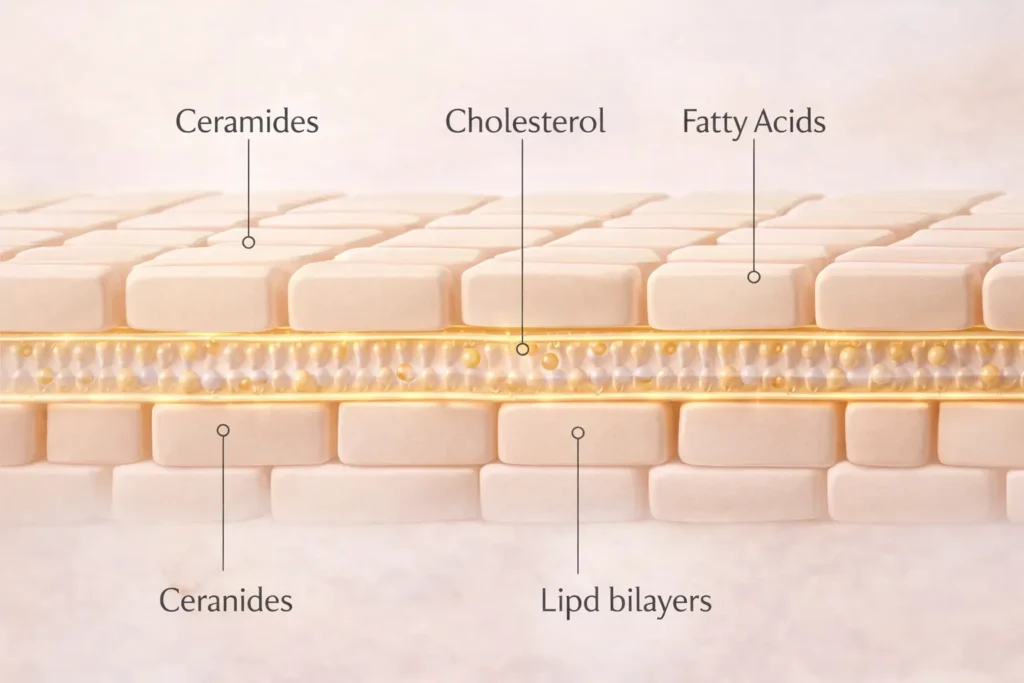
This lipid-rich mortar does two critical jobs simultaneously. It keeps water in — preventing what scientists call transepidermal water loss, or TEWL — and it keeps irritants, bacteria, and allergens out.
When that mortar crumbles, both functions fail at once. You lose hydration faster than you can replace it, and suddenly everything — fragrance, pollution, even your own products — starts getting through when it shouldn’t.
Studies provide that ceramides make up roughly 50% of the stratum corneum’s lipid content by mass. That’s not a minor player — that’s the foundation.
What are the Most Common Causes of a Damaged Skin Barrier?
The list is longer than most people realize. Over-exfoliation is probably the most common culprit (guilty, as previously established), but harsh sulfate cleansers, retinoid overuse, UV exposure, dry winter air, and even hot showers all chip away at your lipid matrix over time.
Age plays a role too — ceramide production measurably declines starting in your 30s, which is part of why mature skin tends toward dryness and sensitivity even without any exfoliation mistakes.
Skin conditions like eczema (atopic dermatitis), rosacea, and psoriasis also involve inherent barrier dysfunction.
How Do You Know if Your Skin Barrier is Compromised?
There’s actually a simple at-home indicator that dermatologists sometimes call the “lactic acid sting test.” Apply a product containing lactic acid to your face. If it stings or burns — even mildly — your barrier is compromised. Healthy skin barely registers it.
Other signs: tightness after cleansing, flaking at the temples and around the nose, sudden intolerance to products you’ve used for months, and redness that seems to appear without reason. If four or more of those sound familiar? Your barrier needs attention before anything else.
What Are Ceramides? The Structural Backbone of Skin Barrier Repair
What are Ceramides and How do They Work in the Skin?
Ceramides are sphingolipids — a class of lipid molecules — and they’re not just in the skin barrier; they essentially are the skin barrier, at least architecturally. There are at least 12 identified ceramide subtypes in human skin, but the ones you’ll see on skincare labels most often are Ceramide NP (the most abundant, key to moisture retention), Ceramide AP (supports deeper hydration), and Ceramide EOP (critical for restoring the overall lipid matrix integrity).
When you apply topical ceramides, you’re delivering pre-formed lipid molecules directly into the extracellular space between corneocytes. This is important — it bypasses the enzymatic processes your skin would normally use to synthesize ceramides, which means the structural reinforcement is nearly immediate. Studies show measurable TEWL reduction within 24–72 hours of consistent application.
For formulation nerds: the optimal ratio for complete barrier restoration is roughly 3:1:1 of ceramides, cholesterol, and fatty acids at pH 4.5–6.0. Products that include all three — like CeraVe Moisturizing Cream with its patented MVE technology — tend to outperform ceramide-only formulas for this reason.
How do Topical Ceramides Repair a Damaged Skin Barrier?
Think of it this way. If your barrier is a wall, ceramides are the bricks and mortar arriving on a delivery truck, ready to be placed. They don’t need to be manufactured on-site. They show up, slot in, and start doing structural work immediately.
This makes ceramides uniquely suited for acute barrier damage — the kind where your skin is actively stinging, flaking, and rejecting products. The creative-proteomics ceramide research review describes how ceramide NP and EOP subtypes work together to reinforce lamellar structure, which is the organized lipid bilayer arrangement that makes the barrier actually function as a physical seal.
Which Skin Types Benefit Most from Ceramides?
Dry skin. Sensitive skin. Mature skin. Eczema-prone skin. Post-procedure skin (post-peel, post-laser, post-retinoid purging). These are the skin types that respond most dramatically and most quickly to topical ceramide application.
Here’s the part that surprises many people: oily skin with a compromised barrier also benefits enormously from ceramides. In fact, oily skin that’s been over-stripped by harsh cleansers or acne treatments often shows the highest TEWL of any skin type. Ceramides won’t make your skin oilier — the lipid matrix they support is fundamentally different from sebum.
What Is Niacinamide? The Regulatory Powerhouse for Barrier Health
What is Niacinamide and How Does it Strengthen the Skin Barrier?
Niacinamide is the amide form of Vitamin B3, and it works through a completely different mechanism than ceramides. Where ceramides are structural, niacinamide is regulatory — it gets inside the cell and changes what the cell does.
Specifically, niacinamide is converted in skin cells to NAD⁺ and NADH, coenzymes that drive the metabolic machinery responsible for ceramide and lipid synthesis. In practical terms, it tells your keratinocytes to make more of their own barrier lipids.
It also inhibits pro-inflammatory cytokines — IL-6 and TNF-α — which is why it’s so effective for inflamed, reactive, and rosacea-prone skin. Sebum regulation, brightening, pore minimization — these are side benefits; barrier support is the core function.
| Timeline | Measured Effect |
|---|---|
| Days 1–5 | 12% reduction in erythema |
| Week 2 | 23% decrease in TEWL; measurable ceramide increase |
| Week 4 | 47% lactic acid sting reduction; 31% filaggrin expression increase |
| Week 8 | Durable barrier normalization; sustained ceramide elevation |
That “durable” part matters. Niacinamide’s effects are transcriptional — they take longer to appear, but they stick in a way that purely topical ceramides don’t always maintain.
How Fast does Niacinamide Repair the Skin Barrier?
Slower than ceramides for acute structural damage. Faster than ceramides for inflammatory-driven barrier breakdown. The “better” ingredient genuinely depends on your bottleneck — and most people have both problems simultaneously, which is exactly why the combination is so powerful.
As Dr. Elena Ruiz, Lead Investigator at the Skin Barrier Research Consortium, puts it: “Niacinamide doesn’t just patch the barrier — it reprograms keratinocyte behavior toward homeostasis.” That reprogramming takes weeks, not days. Plan accordingly.
What Concentration of Niacinamide is Best for Barrier Repair?
Start at 4–5% if your barrier is actively compromised. The 10% formulas — like The Ordinary’s Niacinamide 10% + Zinc — are excellent for oil control and pore work once your skin has stabilized, but they can paradoxically sting or irritate acutely damaged skin. Ironic, isn’t it? The higher concentration can temporarily worsen the sensitivity you’re trying to fix.
For sensitive and eczema-prone skin, Paula’s Choice recommends beginning at 2% and increasing gradually. That’s conservative, but it’s the approach that avoids setbacks.
Ceramide vs Niacinamide for Skin Barrier — Head-to-Head Comparison
Which Ingredient Works Faster for Barrier Repair — Ceramide or Niacinamide?
Here’s the honest answer: ceramides work faster structurally; niacinamide works more durably biologically.
Ceramides deliver an immediate reduction in TEWL (24–72 hours). Niacinamide begins measurable barrier improvement around Week 2. If you have to choose one to start tonight because your skin is in acute distress, start with ceramides. But “start with ceramides” doesn’t mean “use only ceramides,” and we’ll get to why.
Is Ceramide or Niacinamide Better for Dry and Dehydrated Skin?
For dry skin that’s flaking, tight, and craving moisture — ceramides first, every time. You can’t expect niacinamide to trigger internal ceramide synthesis when the barrier is so disrupted that the keratinocytes themselves are stressed. You need structural stabilization before the regulatory signals can even land properly.
Is Ceramide or Niacinamide Better for Sensitive and Reactive Skin?
Genuinely inflamed skin — red, hot, reacting to everything — responds better to niacinamide first, because you need to calm the cytokine storm before rebuilding the lipid structure.
For structurally compromised but non-inflamed sensitive skin? Ceramides first.
Is Ceramide or Niacinamide Better for Acne-Prone and Oily Skin?
Niacinamide, and it’s not particularly close. It regulates sebum without disrupting the lipid matrix, reduces the inflammation that drives breakouts, and — critically — it’s non-comedogenic. The catch: most acne-prone skin is also structurally compromised from harsh treatments (benzoyl peroxide, salicylic acid, retinoids). So a lightweight, non-comedogenic ceramide moisturizer belongs in the routine too. Niacinamide serum first, then ceramide moisturizer.
Can You Use Ceramide and Niacinamide Together — and is it Safe?
Not just safe — ideal. Kinship’s skincare research explains that ceramides provide immediate structural reinforcement, while niacinamide simultaneously promotes the skin’s own ceramide synthesis — creating what amounts to a dual-channel repair system.
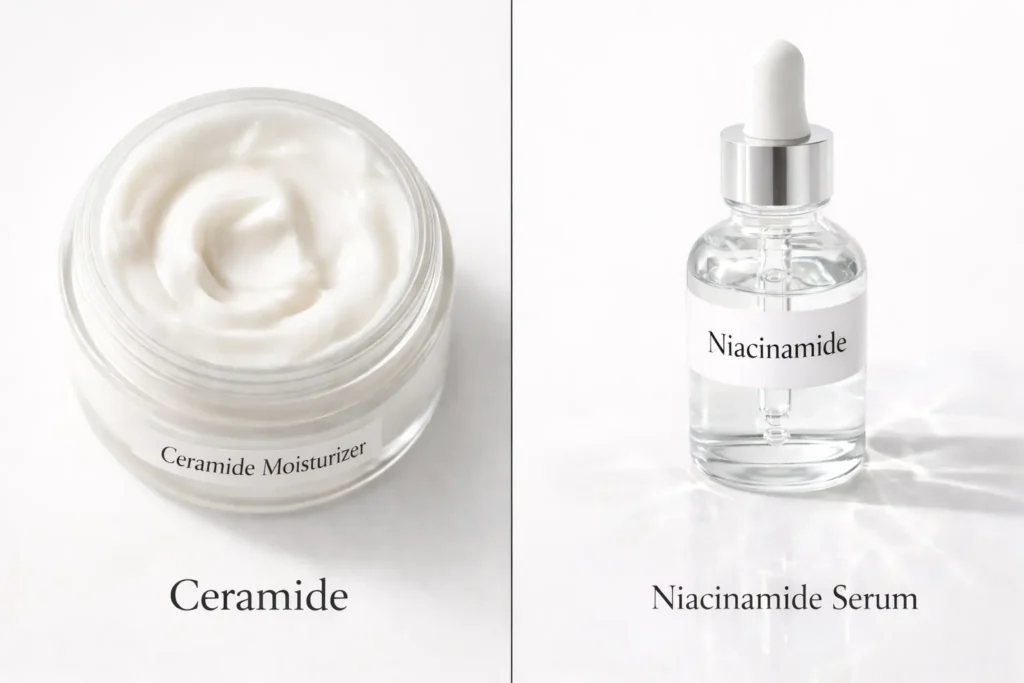
The application order matters. Niacinamide is water-soluble and penetrates the epidermis most effectively when applied first, on clean skin. Your ceramide moisturizer goes on top, sealing in the niacinamide while actively replenishing the lipid matrix. It’s the one-two punch your barrier actually needs.
The Science-Backed Case for Using Both Together
What Does Clinical Research Say About Using Ceramide and Niacinamide Together?
Metware Bio’s lipidomic analysis of combination therapy is particularly compelling. Using tape-strip lipidomics — which samples lipid composition from actual stratum corneum layers — researchers tracked shifts in NP/NS and EOS/EOP ceramide subclasses when both ingredients were used together versus alone. The combination produced faster TEWL normalization and more complete recovery of ceramide subtypes than either ingredient alone.
Think about what that means in practical terms. Niacinamide signals your skin to produce more ceramides internally. Topical ceramides are simultaneously filling the structural gaps that already exist. These aren’t overlapping functions — they’re complementary ones operating in parallel.
What Does a Dermatologist-Recommended Ceramide + Niacinamide Protocol Look Like?
Based on the clinical timeline evidence, here’s the three-phase approach that dermatologists consistently recommend for acute-to-moderate barrier damage:
Phase 1 — Stabilize (Days 1–7) Ceramide-dominant moisturizer applied 3–4× daily. Strip all actives from your routine. No exfoliants, no retinoids, no vitamin C. Lukewarm water only. The goal here is structural first aid — stopping the bleeding, so to speak.
Phase 2 — Activate (Days 8–21) Introduce niacinamide at 4–5% once daily (PM application). Monitor for stinging — mild tingling is acceptable; burning is not. Add a simple hydrating toner if needed (e.g., a hyaluronic acid- or panthenol-based one).
Phase 3 — Maintain (Week 5 onward) Niacinamide AM and PM. Ceramide moisturizer AM and PM or as needed. Reintroduce gentle actives one at a time, with at least 2 weeks between additions. Your barrier should now be self-sustaining.
How to Repair a Damaged Skin Barrier — Full Step-by-Step Routine
What Should Your Morning Routine Look Like when Repairing the Skin Barrier?
Keep it ruthlessly simple. Your skin doesn’t need 7 products right now — it needs 4 good ones, consistently applied.
- Gentle cleanser — sulfate-free, non-foaming, fragrance-free (Vanicream Gentle Face Wash or La Roche-Posay Toleriane Hydrating Gentle Cleanser)
- Hydrating toner — hyaluronic acid or panthenol-based, no alcohol or fragrance
- Niacinamide serum — 4–5% during Phase 2 onward
- Ceramide moisturizer — with cholesterol and free fatty acids (CeraVe Moisturizing Cream remains the gold standard)
- Mineral SPF 30+ — zinc oxide or titanium dioxide, no alcohol, no chemical filters initially
If you’re new to barrier repair, here’s a complete, step-by-step guide to repairing a damaged skin barrier, explaining each phase in detail.
What Should Your Evening Routine Look Like for Barrier Recovery?
Same principle — simplified. Single cleanse only (double cleansing overcleansing strips more lipids when your barrier is already depleted). Niacinamide serum, then your ceramide moisturizer. On particularly rough nights, you can swap to a barrier repair ointment — Aquaphor or pure petrolatum as the final layer, applied over your moisturizer. Dermatologists call this “slugging,” and the occlusive layer dramatically reduces overnight TEWL.
What Ingredients Should you Absolutely Avoid When Repairing your Skin Barrier?
The avoid list is as important as the use list, maybe more so:
- Alcohol-denat — immediately disrupts lipid integrity
- Synthetic fragrance/parfum — the single most common skin sensitizer
- AHAs and BHAs — glycolic, lactic, salicylic acid all increase TEWL temporarily
- Retinoids — even gentle ones accelerate cell turnover before the barrier can rebuild
- High-dose vitamin C — pH below 3.5 can irritate a compromised barrier
- SLS/SLES cleansers — strips every natural lipid your skin has left
- Hot water — literally dissolves the lipid mortar between your skin cells
The AAD’s guidance on barrier restoration specifically calls out fragrance and alcohol as the two most frequently overlooked culprits in delayed barrier recovery.
How long does it take to repair a Damaged Skin Barrier?
| Damage Level | Expected Recovery Time |
|---|---|
| Mild (temporary irritation, minor sensitivity) | 2–4 weeks |
| Moderate (flaking, stinging, product intolerance) | 4–8 weeks |
| Severe (eczema flare, steroid withdrawal, post-peel) | 8–12 weeks |
The clinical metric that matters most is TEWL normalization — you’re aiming for below 20 g/m²/h. Most people without a TEWL meter just track the sting test and product tolerance as proxies.
Best Serums and Moisturizers for Skin Barrier Repair in 2026
Which is the best ceramide moisturizer for skin barrier repair?
CeraVe Moisturizing Cream remains the benchmark — ceramides 1, 3, and 6-II in the MVE delivery system, paired with hyaluronic acid and cholesterol. It’s unglamorous, it comes in a tub, and it works better than most products that cost three times as much.
For compromised skin that’s also inflamed, La Roche-Posay Toleriane Double Repair Face Moisturizer combines ceramides and niacinamide in a single, fragrance-free formula — effectively delivering both phases of the protocol in one product. SkinBravo’s 2025 barrier repair cream roundup lists it as a top pick specifically for combination barrier + inflammation scenarios.
For very sensitive, eczema-prone skin where even inactive ingredients can trigger reactions: Vanicream Moisturizing Skin Cream — no dye, no fragrance, no preservative concerns.
Which is the best niacinamide serum for barrier repair in 2026?
- Good Molecules Discoloration Correcting Serum — 5% niacinamide, well-tolerated on compromised skin
- The Inkey List Niacinamide Serum — affordable, clean formula, good for barrier repair + early hyperpigmentation
- Paula’s Choice 10% Niacinamide Booster — for stabilized skin (too strong for actively damaged barriers)
- Neutriherbs Niacinamide Serum with Hyaluronic Acid — budget-friendly combination formula
One word of caution: if a serum tingles even slightly when your barrier is damaged, that’s your skin telling you the concentration is too high right now. Dilute it by mixing with your moisturizer, or wait until Phase 2 of your recovery.
Ceramide vs Niacinamide for Specific Skin Conditions
Which ingredient is better for eczema and atopic dermatitis?
Ceramides are first-line for eczema, full stop. Atopic dermatitis skin consistently and significantly shows lower ceramide levels than healthy skin — it’s a defining feature of the condition, not just a side effect. AAD treatment guidelines specifically recommend ceramide-dominant emollients as the foundation of eczema management.
Niacinamide works beautifully alongside ceramide therapy for eczema — reducing inflammatory cytokine activity that drives flares and supporting the body’s long-term ceramide synthesis. But it’s the co-pilot here, not the captain.
Which ingredient is better for rosacea-prone and reactive skin?
For rosacea, niacinamide leads. The microvascular instability and chronic low-grade inflammation that define rosacea respond well to niacinamide’s cytokine-suppressing effects — and the 12% erythema reduction within 5 days (from the British Journal of Dermatology trial) is genuinely meaningful for people dealing with persistent flushing.
Ceramides then maintain and protect the structural integrity of a barrier that rosacea chronically weakens. Again, this is a both/and situation for most people.
Which works better for acne-prone skin with a damaged barrier?
This one’s nuanced. Niacinamide is the obvious hero for acne-prone skin — sebum regulation, anti-inflammatory, non-comedogenic. But here’s the thing most acne routines miss entirely: the harsh treatments that fight acne (benzoyl peroxide, retinoids, strong exfoliants) also destroy the skin barrier, which then increases sensitivity, redness, and — ironically — breakouts from stressed skin.
A lightweight, non-comedogenic ceramide moisturizer isn’t optional in an acne routine. It’s structural maintenance that makes everything else work better.
Can ceramide or niacinamide help with premature aging and barrier decline?
Both, actually, through different pathways. Ceramide production declines measurably from your 30s onward, which is a significant driver of the “thin, dry, paper-like” quality that mature skin develops. Topical ceramides directly counteract this by replacing it.
Niacinamide, meanwhile, supports collagen production, reduces the appearance of fine lines, and maintains NAD⁺ levels that decline with age — making it a legitimate anti-aging ingredient alongside its barrier functions. For mature skin, a ceramide + niacinamide protocol isn’t just a barrier repair strategy; it’s an anti-aging protocol in disguise.
Conclusion: Ceramide Vs Niacinamide for Skin Barrier
I’ll leave you with this thought — the one that stuck with me after all that research following my barrier breakdown.
Your skin is always trying to repair itself. It’s running thousands of enzymatic reactions per second, synthesizing lipids, regulating water movement, and managing microbial balance. What ceramides and niacinamide actually do, when you use them correctly, is support that process rather than override it. Ceramides fill the gaps while your skin is too depleted to do so on its own. Niacinamide retunes the cellular machinery, so your skin starts producing what it needs again.
They’re not competing ingredients. They’re a relay team — ceramides run the first leg to stabilize, niacinamide takes the baton and builds something durable.
Strip your routine down. Be boring for a few weeks. Give your barrier the time and the right ingredients, and it will recover. And honestly? The skin you come out with on the other side tends to be stronger than it was before everything went sideways.
That Tuesday morning in the bathroom feels like a long time ago now. My skin is better. Yours will be too.
FAQs: Ceramide Vs Niacinamide for Skin Barrier
Which Is Better For Skin Barrier, Niacinamide Or Ceramide?
Neither is universally superior — they serve different functions. Ceramides provide immediate structural repair, while niacinamide triggers internal ceramide synthesis and reduces inflammation. For acute barrier damage, start with ceramides; for inflamed or reactive skin, niacinamide is the lead. When used together, they deliver the most complete and durable barrier recovery.
What Is The Best Ingredient To Repair Skin Barriers?
The most scientifically validated approach combines ceramides (types NP, AP, and EOP) with cholesterol and fatty acids to restore the lipid matrix, plus niacinamide 4–5% to reduce inflammation and upregulate ceramide synthesis. Supportive ingredients like panthenol, hyaluronic acid, and squalane further enhance outcomes.
Which Serum Is Best For Barrier Repair?
For compromised skin, start with a niacinamide serum at 4–5% concentration — Good Molecules, The Inkey List, and Paula’s Choice are consistently well-reviewed. Apply it before a ceramide moisturizer. Avoid 10% formulas until your barrier has stabilized; they can sting acutely damaged skin.
Can I Use Niacinamide While Repairing My Skin Barrier?
Yes — niacinamide is one of the safest actives during barrier repair. At 4–5%, it’s anti-inflammatory, non-irritating, and actively supports recovery. However, if your barrier is acutely damaged (stinging, flaking), stabilize with ceramides for 7–10 days first before introducing niacinamide to avoid overstimulation.
Can You Use Ceramide And Niacinamide Together?
Absolutely — and it’s the recommended approach. They’re complementary: apply niacinamide serum first (water-soluble), then layer ceramide moisturizer over it (lipid-based). Clinical studies confirm this combination delivers superior TEWL reduction and hydration compared to either ingredient used in isolation.
Can Niacinamide Help With Barrier Repair?
Yes, significantly. Niacinamide stimulates internal ceramide production via NAD⁺ metabolism in keratinocytes and inhibits inflammatory cytokines. A 2020 British Journal of Dermatology RCT demonstrated a 23% TEWL reduction and measurable ceramide increase within two weeks of twice-daily 4% niacinamide application.
Is Ceramide The Best Ingredient For Skin Barrier Repair?
Ceramides are among the most effective, particularly for acute structural damage. They directly replenish the lipid matrix, which comprises roughly 50% of the stratum corneum’s lipid content by mass. For long-term resilience, combining ceramides with niacinamide outperforms ceramides alone in both the speed of TEWL normalization and durability.
How To Repair A Damaged Skin Barrier?
Simplify your routine immediately — remove exfoliants, retinoids, and fragranced products. Use a gentle sulfate-free cleanser, apply 4–5% niacinamide serum, follow with a ceramide-rich moisturizer containing cholesterol and fatty acids, and wear mineral SPF daily. Recovery takes 2–8 weeks, depending on the severity of the damage.
What Not To Use When Repairing Skin Barriers?
Avoid alcohol-denat, synthetic fragrance, AHAs and BHAs (glycolic, lactic, salicylic acid), retinoids, high-strength vitamin C, SLS/SLES cleansers, physical exfoliants, and hot water. These strip natural lipids, increase TEWL, and worsen barrier compromise — even when labeled “gentle.”
What Serum Can I Use To Repair My Skin Barrier?
Niacinamide serums at 4–5% are best for most barrier repair scenarios. Hyaluronic acid and panthenol serums add supportive hydration. For inflamed barrier breakdown, a Centella asiatica (cica) serum can calm reactivity. Always layer serums under a ceramide moisturizer for complete repair.
What Should I Use To Repair My Skin Barrier?
Use a ceramide-rich moisturizer (CeraVe or La Roche-Posay Toleriane), a 4–5% niacinamide serum, a gentle, fragrance-free cleanser, and mineral SPF daily. Optionally add hyaluronic acid or panthenol to support hydration. Avoid all active exfoliants until the barrier is restored — typically 4–8 weeks.
Is Niacinamide Serum Good For Barrier Repair?
Yes — especially for inflamed, oily, or rosacea-prone skin. Niacinamide boosts internal ceramide production, reduces TEWL, inhibits inflammatory cytokines, and is safe for daily use. At 4–5%, it’s well tolerated, even on sensitive skin. Pair with a ceramide moisturizer for maximum barrier-recovery benefits.

About Subhan Usafzai
Evidence-Based Skincare Educator & Formulation Specialist
I'm Subhan Usafzai (Fazli Subhan), an Evidence-Based Skincare Educator and Formulation Specialist. My background includes first-hand experience as a technician and research support in skin departments across tertiary military hospitals since 2006, and since 2008 I've focused on researching and translating clinical and formulation science into practical, evidence-based guidance. My formal training includes Coursera's Introduction to Cosmetic and Skincare Science and the four-course Introduction to Cosmetic Science and Ingredients specialization (Cosmetic Formulation Science, Cosmetic Product Development, and Quality Control and Regulatory in Cosmetic Science), authorized by Olay. Every article I write is checked against current research and reviewed by our medical team before publishing.
✅ Medically reviewed by Dr. Muhammad Khurram Ahmad, MD, Board-Certified Dermatologist · 📅 Last updated: March 2026
Medical Disclaimer
For Educational Purposes Only: This article is written by Subhan Usafzai, an Evidence-Based Skincare Educator and Formulation Specialist, for educational and informational purposes only. The information draws on scientific research, peer-reviewed studies, and dermatological literature available as of March 2026.
Not Medical Advice: This content does not constitute medical advice, diagnosis, or treatment. It is not a substitute for consultation with a qualified healthcare professional or dermatologist.
Individual Results May Vary: Skin conditions and responses to skincare products vary according to individual characteristics, skin type, hormonal factors, and environmental exposure.
Consult Your Healthcare Provider: Seek professional guidance before changing your skincare regimen, particularly during pregnancy or breastfeeding, or if you have a diagnosed skin condition, take medication, have sensitive skin, or receive dermatological treatment.
Product Safety: Consider patch testing new products. Discontinue use if irritation or an adverse reaction occurs, and seek medical advice when needed.
Affiliate Disclosure
Amazon Associates Disclosure: As an Amazon Associate I earn from qualifying purchases.
Editorial Independence: Affiliate relationships do not determine our product reviews or recommendations. We aim to provide balanced, research-informed information to help readers make informed skincare choices.
Supporting Glow Guide Hub: Qualifying purchases through affiliate links may earn us a commission at no additional cost to you.