
Physical vs Chemical Sunscreen Pros Cons in 2026
![[SubhanUsafzai], skincare writer](http://glowguidehub.com/wp-content/uploads/2025/06/My-photo.-1-e1748860240410.webp)
Written by SubhanUsafzai
Skincare Writer, Researcher & Formulation Specialist, 18+ years covering dermatology and skin health
📋 Medically reviewed by Dr. KhurramKhan, MD — Board-Certified Dermatologist |
📅 Published: [20 05 2026] | Updated: [31 05 2026]
The Sunscreen Shelf That Made Me Realize I Had No Idea What I Was Doing
I still remember standing in the skincare aisle — probably in 2022 — holding two sunscreen bottles, one in each hand. One was thick, white, and looked like it belonged on a lifeguard’s nose. The other was a feather-light gel with a list of ingredients I couldn’t pronounce. I had no idea which one to put back.
Sound familiar?
Here’s the thing: this confusion isn’t just cosmetic indecision. The physical vs chemical sunscreen pros cons debate has evolved significantly by 2026, with real regulatory shifts, new research, and genuinely different recommendations depending on your skin type. And now, more than ever, getting this decision right actually matters.
According to the Centers for Disease Control and Prevention, skin cancer is the most common form of cancer in the United States. Yet the most powerful tool against it — daily broad-spectrum sunscreen — is often skipped, often because people haven’t found a formula they’ll actually commit to wearing. That’s the real tragedy here.
What I want to give you isn’t a rigidly ranked list. It’s a clear, science-backed understanding of how each type works, what dermatologists are saying right now, and — honestly — which one is more likely to stay on your face every single day. Because a “perfect” sunscreen that sits unopened in your cabinet protects absolutely nothing.
Let’s get into it.
How Physical vs Chemical Sunscreen Works: The Science Explained?
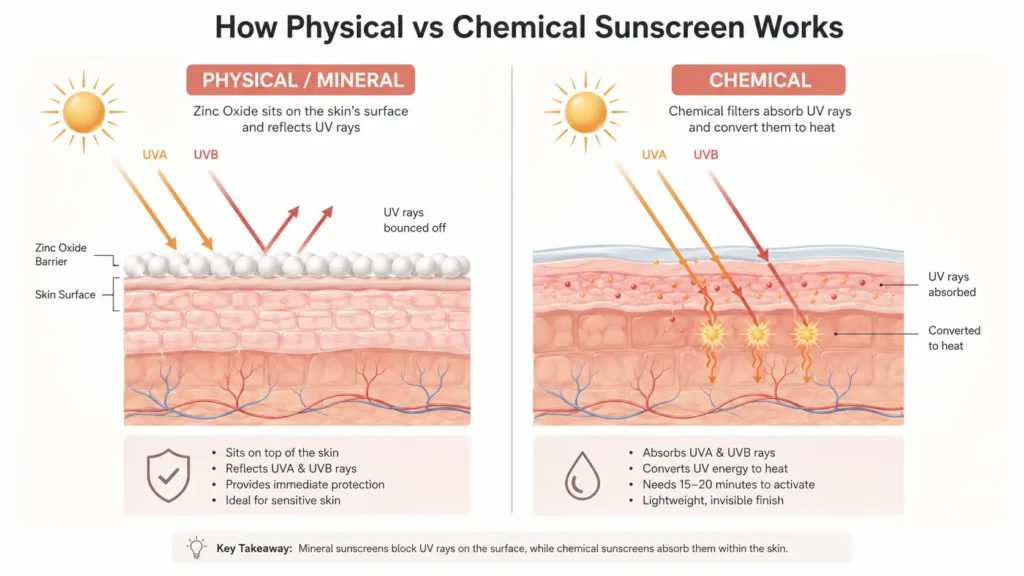
Physical and chemical sunscreens protect skin through fundamentally different mechanisms. Physical sunscreens block and scatter UV radiation on the skin’s surface without being absorbed. Chemical sunscreens must absorb into the skin first, where they convert UV energy into heat. Understanding this distinction clarifies every pros-and-cons comparison that follows. Much of the confusion around the pros and cons of physical vs chemical sunscreen in 2026 stems from not fully grasping how each type works at the skin level.
How Physical (Mineral) Sunscreen Works
Physical sunscreens — also called mineral sunscreens — use zinc oxide, titanium dioxide, or both as their active ingredients. These mineral particles sit on the skin’s surface and work by physically blocking, reflecting, and scattering UV radiation before it can penetrate the skin.
Crucially, they don’t need to be absorbed to work. You apply them, and they’re active immediately.
According to the American Academy of Dermatology, both titanium dioxide and zinc oxide are classified under the FDA’s GRASE designation — Generally Recognized As Safe and Effective — making them the only two sunscreen actives with full regulatory endorsement in the United States as of 2026.
How Chemical Sunscreen Works
Chemical sunscreens operate very differently. Ingredients like avobenzone, oxybenzone, octinoxate, octisalate, homosalate, and octocrylene need to absorb into the skin first. Once they’re there, they work by converting UV radiation into heat energy, which is then released from the skin.
This is why the standard recommendation is to apply chemical sunscreen 15–30 minutes before going outside — not because dermatologists are being overcautious, but because the chemistry literally requires that absorption time for protection to kick in.
According to SINY Dermatology’s guide on chemical vs. physical sunscreens, chemical filters tend to be lightweight, easier to apply, and cosmetically elegant — which is a real, non-trivial advantage when the goal is getting people to wear sunscreen every single day.
What’s New in 2026
Here’s something worth knowing, because it’s genuinely exciting: the first new chemical sunscreen ingredient to receive U.S. regulatory approval in 25 years is expected to launch in fall 2026. Dr. Heather D. Rogers, MD, a board-certified dermatologist, has noted that European chemical sunscreen ingredients have long been more photostable and associated with lower systemic absorption, and this development could help close that gap. The landscape is shifting — and that’s worth paying attention to.
There’s also a third category worth mentioning: hybrid sunscreens that combine both mineral and chemical filters. The AAD notes these are sometimes called “combination” sunscreens, and they aim to balance broad-spectrum protection with the cosmetic wearability of chemical formulas.
Physical Sunscreen: The Full Pros and Cons Breakdown
Let’s be straightforward here. Mineral sunscreen has some genuine advantages that aren’t just marketing language. But it’s also not magic — and pretending otherwise doesn’t help anyone choose wisely.
The Real Pros of Physical Sunscreen
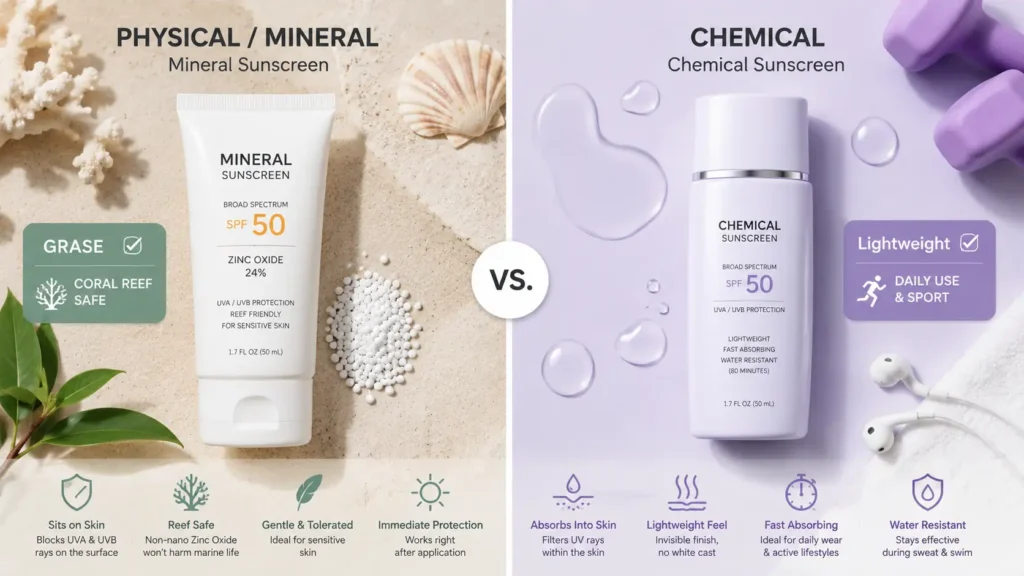
Physical Sunscreens carry the FDA’s full safety endorsement
Zinc oxide and titanium dioxide are the only sunscreen actives classified as GRASE. For anyone who worries about what’s going into their body — parents choosing sunscreen for kids, pregnant women, or people with compromised immune systems — that distinction carries real weight.
Physical sunscreens work immediately
No waiting period. Apply it, walk outside. That’s a meaningful practical advantage for rushed mornings and spontaneous outdoor plans.
Physical sunscreens significantly gentler on sensitive and reactive skin
Board-certified physician associate Paula Brezavseck, PA-C, put it plainly: “Mineral sunscreens are one of my go-to recommendations, especially for patients with sensitive or reactive skin. They’re much less likely to cause irritation, stinging, or breakouts”.
If you have rosacea, melasma, or post-procedure skin, mineral is almost always the starting point. Our curated guide to the top zinc oxide sunscreens for rosacea goes into this in more depth.
Physical sunscreens are photostable
Unlike some chemical filters — avobenzone being the most notable example — zinc oxide and titanium dioxide don’t degrade under UV exposure. The protection you applied at 8 AM is still working at noon.
Physical sunscreens generally reef-safe
Oxybenzone (a common chemical filter) has been banned in Hawaii and several other jurisdictions due to concerns about its toxicity to coral reefs. Mineral filters don’t carry the same environmental flags.
The Real Cons of Physical Sunscreen
Here’s where I’ll be honest — because the cons are real and they matter.
The white cast is not a myth
Titanium dioxide is notably chalky. Even with zinc oxide (which blends somewhat better), many mineral formulas leave a visible white or grey film — a legitimate problem for deeper skin tones, and one that directly affects whether people will actually use the product every day.
The texture is often heavier
Some mineral formulas feel like paste. This has improved dramatically with newer micronized formulations, but it’s still a factor — especially under makeup.
Less water-resistant during physical activity
Mineral filters sit directly on the skin, so they rub off more easily during swimming or heavy sweating. Frequent reapplication is a must.
Chemical Sunscreen: The Full Pros and Cons Breakdown
Let me be equally honest here. Chemical sunscreen has real advantages — and real concerns. Neither side of this conversation deserves to be dismissed.
The Real Pros of Chemical Sunscreen
The cosmetic experience is genuinely better for most people. Lightweight, no white cast, easy to layer under makeup. Licensed aesthetician Erin Blackwell notes: “Chemical sunscreens tend to be lighter and more water- and sweat-resistant, which can make them a better choice for sports or heavy sweating” .
If you’re active or find mineral textures genuinely unwearable, a chemical formula you’ll actually use is infinitely better than a mineral one you won’t.
Better water and sweat resistance
This is a real, practical advantage for athletes, swimmers, and anyone who lives in a humid climate.
For more on sun protection for active skin, this guide to sun protection and anti-aging is worth bookmarking.
Widely available at all price points
Drugstore chemical SPFs deliver broad-spectrum coverage at a fraction of the cost of many mineral formulas. Accessibility matters when the goal is consistent daily use.
European formulations offer superior photostability
The FDA has approved a narrower range of UV filters than European regulators. Some imported or European-brand chemical sunscreens use ingredients such as Tinosorb S and Tinosorb M, which are significantly more photostable and have lower systemic absorption than most U.S.-approved chemical filters, as noted by Dr. Rogers.
The Real Cons of Chemical Sunscreen
Systemic absorption — confirmed, still being studied
This is the one that gets the most attention, and it deserves to be addressed without hysteria or dismissal. An integrative review from Rowan University’s 2024 Research Day found that both avobenzone and oxybenzone exceeded the FDA’s safety threshold of 0.5 ng/mL after standard full-body application.
A 2025 study in ScienceDirect on non-GRASE UV filters confirmed that ten chemical filters — including avobenzone, oxybenzone, octinoxate, octisalate, homosalate, and octocrylene — are classified as non-GRASE, meaning the FDA requires additional long-term safety data.
To be clear: absorption does not equal harm. No study has demonstrated that chemical sunscreen use causes measurable health damage at real-world exposure levels. But the absence of long-term data is a real gap.
Higher irritation potential for sensitive skin.
Because chemical filters need to absorb, they can cause stinging, redness, and even allergic contact dermatitis in people with sensitive or reactive skin. The AAD specifically recommends mineral formulas for sensitive skin.
Environmental concerns.
Oxybenzone has been linked to coral reef toxicity and is banned in Hawaii, Florida’s national marine sanctuaries, and several other reef-protection jurisdictions.
Dermatologist Recommendations: Physical vs Chemical Sunscreen (2026)
Dermatologists do not universally recommend one sunscreen type over the other. The American Academy of Dermatology recommends mineral sunscreens specifically for sensitive skin, while most dermatologists agree that any broad-spectrum SPF 30 or higher worn consistently outperforms a theoretically superior sunscreen used inconsistently.
What they do universally agree on is this — the best sunscreen is the one you’ll actually wear every single day. That’s not a copout. It’s the scientific consensus.
Dr. Heather D. Rogers, MD, board-certified dermatologist, puts her preference plainly: “I personally choose zinc-based sunscreens for myself and my family” — while also acknowledging that “a lightweight chemical sunscreen may feel better and be easier to wear consistently”.
The AAD recommends mineral sunscreens specifically for people with sensitive skin, noting that if a sunscreen doesn’t contain titanium dioxide or zinc oxide, it’s a chemical formula — and that distinction matters for skin type matching.
Board-certified dermatologist Dr. Sonia Badreshia-Bansal takes a more integrative approach: she recommends sunscreens that “combine physical blockers with antioxidants like niacinamide, vitamin C, or DNA-repair enzymes” to combat oxidative stress and visible signs of aging. On that note — if you’re pairing vitamin C with your SPF, our breakdown of how vitamin C and sunscreen work together for skin glow is genuinely worth reading.
The non-negotiables every dermatologist agrees on, regardless of filter type
- Broad-spectrum protection against both UVA and UVB
- SPF 30 minimum; SPF 50 preferred for extended sun exposure
- Applied daily — including overcast days, year-round
- Reapplied every two hours during outdoor activity
Physical vs Chemical Sunscreen by Skin Type: Which Is Right for You?
This is where the physical vs chemical sunscreen pros and cons question gets personal. Because “best” depends entirely on your skin, not on which type wins a general comparison.
Sensitive or Rosacea-Prone Skin
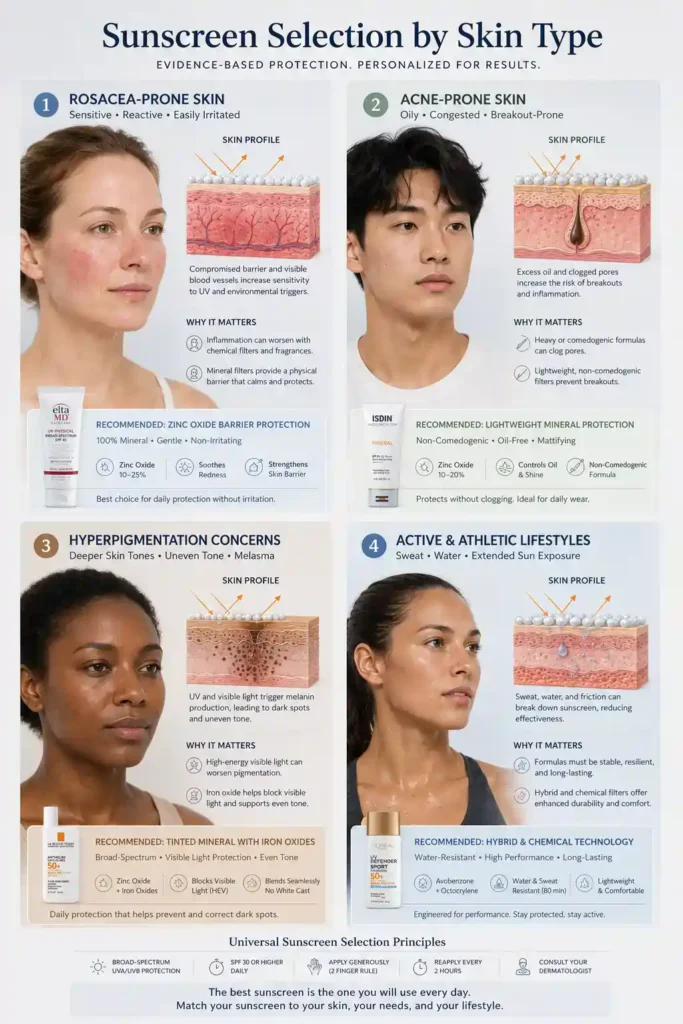
Physical sunscreen is the clear first choice. Full stop.
Dr. Steven Q. Wang, Medical Director of Dermatologic Oncology at the Hoag Family Cancer Institute and Chair of the Photobiology Committee of the Skin Cancer Foundation, advises rosacea patients to look for formulations free of “irritants such as alcohol, fragrances, and harsh chemicals” — with zinc oxide and titanium dioxide as the recommended active ingredients.
Dr. Samantha Schneider, MD, a board-certified dermatologist who also personally has rosacea, echoes this: “If you have rosacea and struggle with sunscreen, [mineral] might be a better option for you”.
Tinted mineral sunscreens with iron oxides are especially useful here — they blend more seamlessly and provide added protection against visible light, which can exacerbate hyperpigmentation and redness.
We’ve covered the best options in our top zinc oxide sunscreens for rosacea guide.
Acne-Prone Skin
Mineral sunscreen, generally, particularly lightweight zinc oxide formulas or powder formats that are non-comedogenic. Heavy occlusive mineral creams are a different story and should be avoided. For managing both acne and oiliness, our guide to the best skincare routine for oily skin in winter also covers SPF compatibility.
Skin of Color and Deeper Skin Tones
This one is nuanced. Chemical sunscreens have historically been recommended for deeper tones because of the white cast problem with mineral formulas. And that concern is valid. But the newer generation of tinted mineral sunscreens — formulated with iron oxides and micronized zinc oxide — now blend seamlessly across a much wider range of skin tones.
A 2021 study in the International Journal of Women’s Dermatology found that chemical formulas were disproportionately recommended for darker skin tones, despite sometimes offering lower SPF levels — worth knowing as you navigate the options.
Iron oxides, found in tinted mineral formulas, also provide protection against visible light (HEV), which contributes to hyperpigmentation in deeper skin tones. If hyperpigmentation is a concern alongside sun protection, our guide to the best skincare ingredients for hyperpigmentation is the companion resource.
Active Lifestyles, Swimming, Athletes
Chemical sunscreen, or a hybrid with water resistance. Mineral filters wipe off far more easily in water. Just ensure you’re still reapplying every 80 minutes or per label instructions during water activity.
Pregnancy and Children
Mineral formulas are the standard recommendation — not because chemical sunscreens are confirmed harmful during pregnancy, but because zinc oxide and titanium dioxide carry GRASE status and don’t raise systemic absorption questions. Always consult your physician.
Is Chemical Sunscreen Safe? What Does the 2026 Research Actually Say?
Chemical sunscreens have not been proven harmful, but several active UV filters are absorbed into the bloodstream at levels exceeding the FDA’s 0.5 ng/mL safety threshold, placing them in a non-GRASE classification that requires more long-term safety data. The documented risk of skin cancer from unprotected UV exposure remains far greater than any theoretical concern about sunscreen absorption. Here is what the research actually confirms.
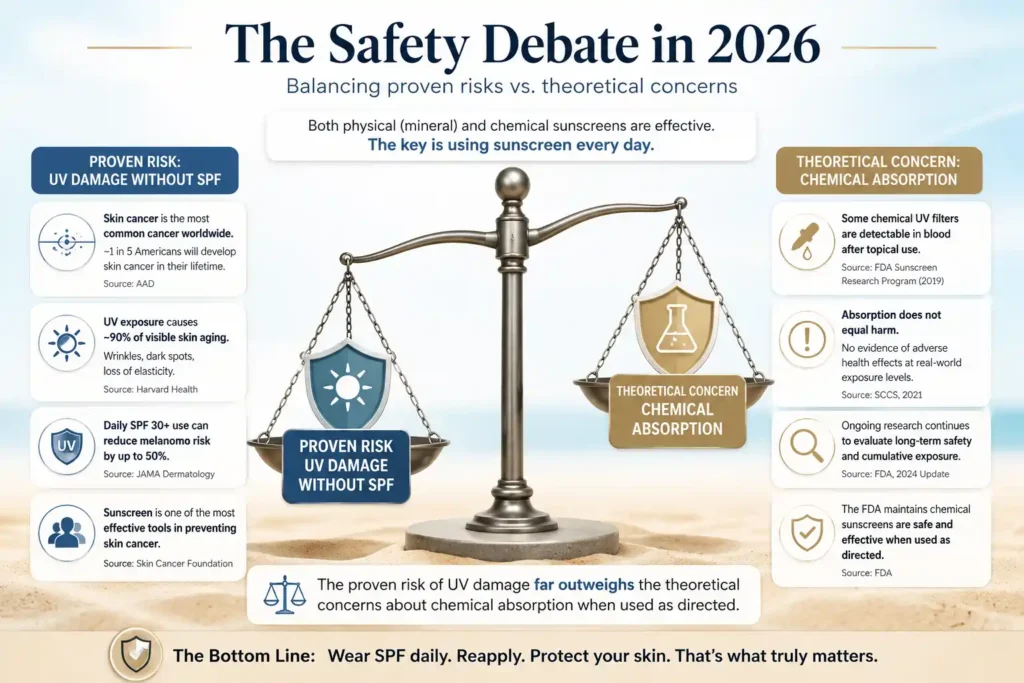
What the research confirms about chemical sunscreens!
Chemical UV filters are absorbed into the bloodstream. This is documented. An integrative review from Rowan University’s 2024 Research Day found that oxybenzone shows higher plasma concentrations than avobenzone and exceeds the FDA’s safety threshold.
Data show that oxybenzone was detected in urine samples from 97% of more than 2,500 Americans tested — confirming systemic exposure at the population level.
What does the research not confirm?
The research does not confirm that absorption causes harm. As of 2026, no peer-reviewed study has demonstrated that chemical sunscreen use causes cancer, endocrine disruption, or measurable illness in humans at real-world exposure levels.
Dermatologists at institutions including Yale and Stanford consistently emphasize that the documented, proven risk of skin cancer from unprotected UV exposure, while systemic absorption remains a theoretical concern requiring more data.
The FDA’s position
The non-GRASE classification for ten chemical UV filters doesn’t mean “unsafe.” It means “we need more long-term human safety data.” As the MDedge 2024 safety update explains, this request was driven by confirmed absorption — not by confirmed harm. The ingredients remain legally on sale while manufacturers provide that data.
The European context matters here
The EU’s Scientific Committee on Consumer Safety has flagged octinoxate as an endocrine-active substance and, in 2025, issued final safety opinions noting these concerns — while still allowing its use at specific concentrations. That nuance gets lost in most online coverage.
Formulation innovations in 2026 are closing the gap
Researchers are actively developing encapsulation technologies — polymeric nanoparticles, lipid-based carriers, silica matrices — designed to deliver chemical filters to the skin’s surface without the systemic absorption that raises these questions.
A 2025 review in ScienceDirect confirms this is an active, progressing field of research. And the skin microbiome angle is emerging too — aggressive chemical sunscreen use can disrupt surface microbiota in ways that affect barrier resilience over time, which our guide on the skin microbiome and how to protect it covers.
The bottom line on safety: mineral sunscreen offers the cleaner regulatory profile. Chemical sunscreen has been used for decades without demonstrated harm. Both protect against UV damage, which is, without question, the bigger risk.
Choosing a mineral if you want maximum peace of mind is entirely rational. Choosing a chemical if a mineral doesn’t work for your lifestyle is also entirely rational.
How to Apply Sunscreen Correctly: Amount, Timing & Layering Order
You’ve chosen your sunscreen — or you’re about to. Now here’s the part that actually determines whether any of this matters.
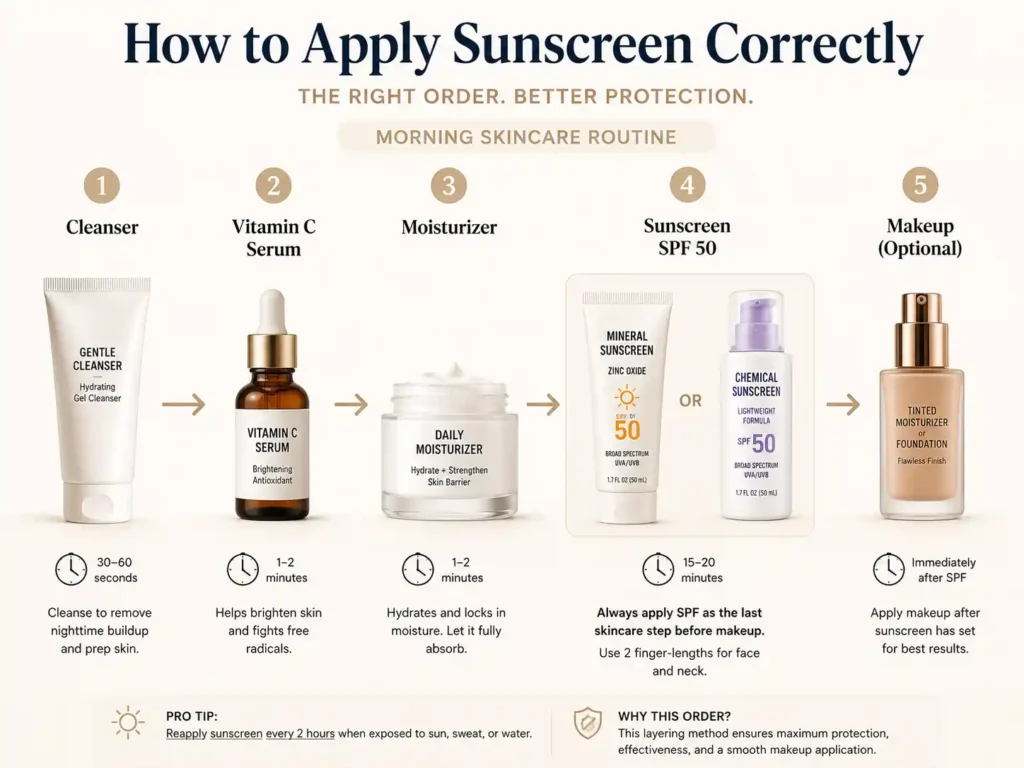
SPF 30 is the minimum. SPF 50 is better
No sunscreen blocks 100% of UV rays. SPF 30 blocks approximately 97%; SPF 50 blocks approximately 98%. That 1% sounds small until you’re applying it to your face 365 days a year.
Dr. Rachel Nazarian, board-certified dermatologist at Schweiger Dermatology in New York City, recommends SPF 50 as the ideal for daily and extended use.
Most people apply far too little
The standard recommendation is about a quarter teaspoon (a nickel-sized amount) for the face and neck alone. Skimping on the amount effectively reduces the real-world SPF significantly.
Timing matters depending on the type
- Mineral sunscreen: apply and go immediately
- Chemical sunscreen: apply 15–30 minutes before going outside
Reapply every two hours
Or immediately after swimming or heavy sweating. Even “water-resistant” labels have limits — the FDA defines water resistance as 40 or 80 minutes of swimming/sweating, after which reapplication is required.
Sunscreen is the final skincare step before makeup
Apply it after moisturizer, after serums, after any actives. If you’re wondering how it layers into a full skincare routine, the dermatologist-reviewed nighttime skincare routine order guide also covers the morning layering logic.
Spots people consistently miss
Ears, the back of the neck, tops of hands, lips (yes, there’s SPF lip balm), and the scalp along any hair part.
Conclusion: Physical vs Chemical Sunscreen Pros Cons
Here’s what I’ve come to after years of covering skincare, digging through research, and — honestly — overthinking this exact aisle moment more times than I’d like to admit.
The physical vs chemical sunscreen pros and cons debate doesn’t have a clean winner. What it has is a clearer framework for making a decision that actually fits your life.
Physical sunscreen is the more verifiably safe choice — FDA-endorsed, gentle, photostable, and the clear recommendation for sensitive, rosacea-prone, post-procedure, and pediatric skin. Chemical sunscreen is the more wearable choice for many people — lightweight, water-resistant, easier to integrate into daily life, and suitable to wear under makeup. Hybrid formulas are quietly becoming the best of both worlds.
What still stands true after everything: wearing sunscreen consistently and in the right amount is more important than which type you choose. The research on UV-induced skin damage is definitive. The research on sunscreen-related harm is not.
So pick the one you’ll use every day. Layer it correctly. Reapply when you should. And if you’re curious about what else belongs in your skincare routine alongside your SPF, our ultimate anti-aging skincare guide is a solid next read.
Your skin has about 36 years of sun to contend with if you start today at 25. That’s a long time to be on the fence.
FAQ: Physical vs Chemical Sunscreen Pros Cons
Is it better to use physical or chemical sunscreen?
Neither is universally better. Physical (mineral) sunscreen — containing zinc oxide and/or titanium dioxide — is the stronger choice for sensitive, rosacea-prone, acne-prone, or post-procedure skin, and for children and pregnant individuals. Chemical sunscreen suits active lifestyles, daily makeup use, and those who cannot tolerate mineral textures. The most important factor is consistent use of broad-spectrum SPF 30 or higher.
What kind of sunscreen should I use if I have rosacea?
Dermatologists strongly recommend physical (mineral) sunscreen for rosacea-prone skin. Zinc oxide and titanium dioxide are far less likely to trigger flushing or flares than chemical filters. Choose fragrance-free, alcohol-free formulas. Tinted mineral sunscreens with iron oxides are especially helpful — they blend more naturally and offer added visible-light protection. Dr. Steven Q. Wang of the Skin Cancer Foundation recommends avoiding “irritants such as alcohol, fragrances, and harsh chemicals.”
What is healthier, physical or chemical sunscreen?
From a regulatory standpoint, physical sunscreen carries the stronger safety profile. Zinc oxide and titanium dioxide are the only two sunscreen actives with FDA GRASE status. Chemical filters, including oxybenzone and avobenzone, are classified as non-GRASE — meaning the FDA requires additional long-term safety data due to confirmed systemic absorption above threshold levels. No study has proven that chemical sunscreens cause harm, but for maximum peace of mind — especially during pregnancy or for children — mineral sunscreens are the more evidence-backed choice.
Do dermatologists recommend physical or chemical sunscreen?
Dermatologists recommend both, depending on individual skin type and lifestyle. The American Academy of Dermatology recommends mineral sunscreens specifically for sensitive skin. Dr. Heather D. Rogers, MD, uses zinc-based sunscreens personally and for her family. Most dermatologists agree: any broad-spectrum SPF 30 or higher worn consistently outperforms a “perfect” sunscreen used inconsistently. Hybrid formulas that combine both filter types are also increasingly recommended as a middle ground.
Can I mix physical and chemical sunscreen?
Yes, and many dermatologists actually recommend it. Hybrid sunscreens that combine both mineral and chemical filters are widely available and aim to balance the photostability of zinc oxide with the lightweight texture of chemical formulas. You can also layer them — apply chemical sunscreen first, wait for it to absorb, then apply a mineral SPF on top. A single hybrid formula is simpler and ensures uniform coverage.
Does physical sunscreen last longer than chemical sunscreen?
Physical sunscreen is more photostable — zinc oxide and titanium dioxide do not degrade under UV light. Avobenzone, a common chemical filter, breaks down in sunlight unless paired with a photostabilizer like octocrylene. However, both types require reapplication every two hours during outdoor activity or immediately after swimming or heavy sweating, regardless of photostability.
Which sunscreen is better under makeup?
Chemical sunscreen is generally better under makeup due to its lightweight, non-greasy finish that layers smoothly without pilling. Tinted mineral sunscreens with iron oxides are also a strong option — they function as a tinted primer, reduce white cast, and provide added protection against visible light (HEV). Avoid thick, creamy mineral formulas under foundation; they tend to pill and disrupt makeup application.
Is mineral sunscreen better for oily skin?
Lightweight zinc oxide formulas and mineral sunscreen powders are generally a better fit for oily or acne-prone skin because they are non-comedogenic and sit on the skin’s surface without clogging pores. However, heavy mineral creams can feel occlusive and increase shine. For oily skin, look specifically for oil-free or mattifying mineral SPF formulas, or consider a hybrid sunscreen with a matte finish.

About Subhan Usafzai
Evidence-Based Skincare Educator & Formulation Specialist
I'm Subhan Usafzai (Fazli Subhan), an Evidence-Based Skincare Educator and Formulation Specialist. My background includes first-hand experience as a technician and research support in skin departments across tertiary military hospitals since 2006, and since 2008 I've focused on researching and translating clinical and formulation science into practical, evidence-based guidance. My formal training includes Coursera's Introduction to Cosmetic and Skincare Science and the four-course Introduction to Cosmetic Science and Ingredients specialization (Cosmetic Formulation Science, Cosmetic Product Development, and Quality Control and Regulatory in Cosmetic Science), authorized by Olay. Every article I write is checked against current research and reviewed by our medical team before publishing.
✅ Medically reviewed by Dr. Muhammad Khurram Ahmad, MD, Board-Certified Dermatologist · 📅 Last updated: June 2026
Medical Disclaimer
For Educational Purposes Only: This article is written by Subhan Usafzai, an Evidence-Based Skincare Educator and Formulation Specialist, for educational and informational purposes only. The information draws on scientific research, peer-reviewed studies, and dermatological literature available as of June 2026.
Not Medical Advice: This content does not constitute medical advice, diagnosis, or treatment. It is not a substitute for consultation with a qualified healthcare professional or dermatologist.
Individual Results May Vary: Skin conditions and responses to skincare products vary according to individual characteristics, skin type, hormonal factors, and environmental exposure.
Consult Your Healthcare Provider: Seek professional guidance before changing your skincare regimen, particularly during pregnancy or breastfeeding, or if you have a diagnosed skin condition, take medication, have sensitive skin, or receive dermatological treatment.
Product Safety: Consider patch testing new products. Discontinue use if irritation or an adverse reaction occurs, and seek medical advice when needed.
Affiliate Disclosure
Amazon Associates Disclosure: As an Amazon Associate I earn from qualifying purchases.
Editorial Independence: Affiliate relationships do not determine our product reviews or recommendations. We aim to provide balanced, research-informed information to help readers make informed skincare choices.
Supporting Glow Guide Hub: Qualifying purchases through affiliate links may earn us a commission at no additional cost to you.