

Skin Purging vs Breakout: The Real Difference, Explained
You started that hyped-up retinol three weeks ago, expecting glass skin. Instead, you woke up this morning with more pimples than you’ve had in years. Panic sets in. Is this skin purging or a breakout? Is your skin healing, or is it actively rebelling against a product you just spent real money on?
If you’ve been Googling at 1 a.m. trying to decide whether to keep going or throw the tube in the trash, you’re not alone — and you’re asking the right question. The internet is full of vague, contradictory advice about skin purging, and most of it doesn’t actually tell you how to read your own skin.
This article will cut through the noise. You’ll learn what purging really is on a cellular level, what separates it from a genuine breakout, the realistic timeline you should expect, which ingredients are actually responsible, and when it’s time to stop a product and call a dermatologist instead. By the end, you won’t need to guess anymore — you’ll know.
What Is Skin Purging? (The Real Definition)
Skin purging is a temporary increase in breakouts that happens when a new product speeds up your skin’s cell turnover rate. It’s not your skin “detoxing” or releasing toxins, despite what wellness influencers might claim — it’s a mechanical, predictable side effect of certain active ingredients doing their job faster than usual.
How purging actually works on a cellular level
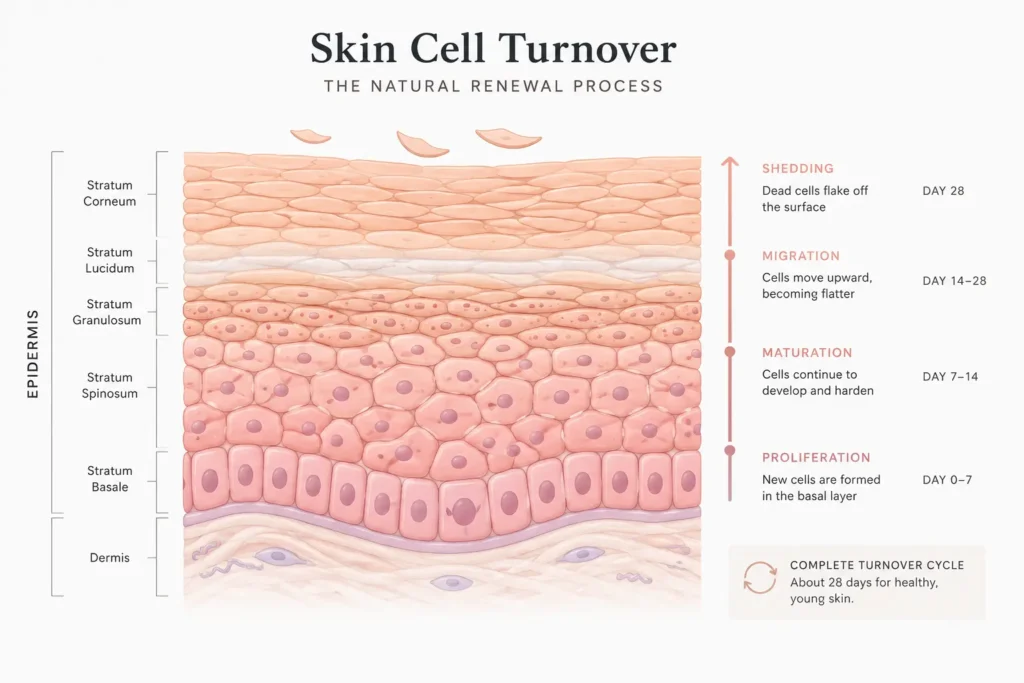
Your skin constantly produces new cells in the deeper epidermis and sheds older cells from the surface through a process called cell turnover. This process typically takes about 28 days in younger adults and becomes slower with age. Beneath the surface, however, many people have microcomedones — tiny, developing plugs of oil, dead skin cells, and debris that may eventually become visible breakouts.
When you introduce an ingredient that accelerates cell turnover, it speeds up the rate at which the skin sheds those dead cells and pushes new ones to the surface.
Rebecca Thiede, MD, a dermatologist with Banner – University Medicine, explains that starting a new skincare regimen prompts the skin to shed cells faster, and ingredients like retinoids, AHAs, BHAs, and some forms of vitamin C can bring hidden, pre-existing blemishes to the surface faster than they would have appeared on their own.
The key point is simple: purging does not create entirely new acne from nowhere. It may bring pre-existing, developing blemishes to the surface faster than they would have appeared naturally.
Curious about what retinol actually does beneath the skin? Explore our guide to how retinol works at the cellular level to understand the biological processes behind its effects on cell turnover, collagen, and photoaging.
Which ingredients typically cause purging
Purging is almost exclusively linked to ingredients that increase cell turnover or exfoliate the skin. That includes retinoids (retinol, retinaldehyde, tretinoin, adapalene), alpha hydroxy acids like glycolic and lactic acid, beta hydroxy acids like salicylic acid, and, in some formulations, vitamin C or benzoyl peroxide. If a product doesn’t do any of those things, it’s very unlikely to cause true purging — which is an important clue you’ll use later in this article.
Why purging is a sign the product is working, not failing
This is the part that trips people up the most: purging generally means the active ingredient is doing exactly what it’s supposed to do. It’s clearing out congestion that was already sitting under your skin, just faster than your skin would have processed it on its own. That doesn’t mean every breakout after a new product is purging — but when it genuinely is purging, it’s a sign of accelerated renewal, not a sign of damage.
What Is a Regular Breakout?
A regular breakout is new acne caused by something unrelated to accelerated cell turnover — think clogged pores from oil and bacteria, hormonal fluctuations, stress, or a product that’s simply irritating or comedogenic for your skin.
Common triggers: comedogenic ingredients, hormones, stress, bacteria, over-exfoliation
Breakouts can stem from a long list of causes that have nothing to do with a product “working.” Comedogenic ingredients — things like certain heavy oils, isopropyl myristate, or acetylated lanolin — can physically clog pores and create new blemishes rather than surfacing existing ones.
Hormonal shifts tied to your cycle, stress-driven cortisol spikes, humidity and sweat, unwashed pillowcases, and touching your face all contribute to classic acne mechanics: excess sebum, trapped bacteria, and inflammation. Ironically, over-exfoliating or layering too many actives at once can also trigger a breakout by damaging the skin barrier, which then invites irritation and congestion of its own.
Why breakouts signal something is wrong, not adjusting
Unlike purging, a true breakout usually isn’t a sign that your skin is adjusting to something beneficial — it’s a sign that something in your routine, environment, or body chemistry is currently working against your skin. That could be an ingredient that’s genuinely too harsh for your barrier, a pore-clogging formula, or an unrelated internal trigger like hormones.
Regular breakouts don’t follow the same predictable start-and-resolve pattern that purging does, and left unaddressed, they tend to persist or worsen rather than taper off.
If your breakouts keep returning, your routine may be contributing more than you realize. Discover the most common skincare mistakes that can trigger irritation, congestion, and breakouts—and how to fix them.
Purging vs Breakout: 5 Key Differences to Look For
| Factor | Skin Purging | Regular Breakout |
|---|---|---|
| Location | Your usual breakout zones | New, previously clear areas |
| Speed of onset | Fast — days after starting an active | Can appear anytime, sometimes weeks later |
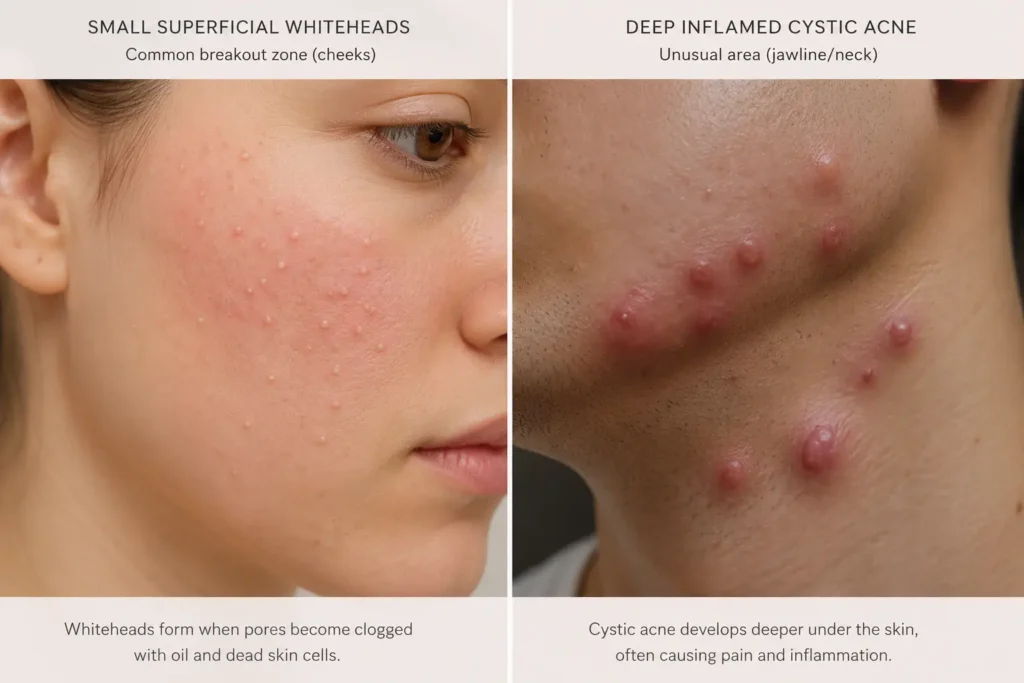
| Blemish type | Small whiteheads, blackheads, light pustules | Deeper cysts, nodules, or widespread inflammation |
| Accompanying symptoms | Flaking, tightness, mild pink tinge | Itching, burning, swelling, spreading irritation |
| Resolution after stopping | Fades within days to roughly 1–2 weeks | Often persists or continues without a clear endpoint |
1. Location on the face (usual breakout zones vs. new areas)
Purging shows up where you already tend to break out, because it’s surfacing microcomedones that were already forming there. A true breakout is more likely to show up in spots you rarely deal with — your cheeks, temples, or jawline, for example, if you’re typically a chin-and-forehead breakout type.
2. Speed of onset (purging = fast, tied to new product)
Purging tends to appear quickly after you introduce a cell-turnover ingredient, often within the first one to two weeks, because it’s simply speeding up a process that was already underway. A breakout caused by irritation or a comedogenic formula can take longer to build, sometimes not showing up for several weeks as pores gradually clog.
3. Type of blemish (small whiteheads/blackheads vs. deep cysts/nodules)
Purging blemishes tend to be smaller and more superficial — whiteheads, blackheads, and light pustules that come to a head and resolve relatively quickly. Deep, painful cysts or nodules are far more characteristic of a genuine breakout and are not a typical purging pattern.
4. Accompanying symptoms (flaking, tightness, pink tinge = purging clues)
Because purging is often driven by exfoliating or cell-turnover ingredients, it frequently comes with dryness, flaking, tightness, or a light pink tinge to the skin. A true breakout is more likely to bring burning, itching, swelling, or a rash-like spread that looks and feels different from ordinary dryness.
5. How quickly it resolves after stopping the product
This is one of the most useful differentiators. If you pause the product and the new blemishes calm down within a matter of days to about a week or two, that pattern lines up with purging. If new blemishes keep appearing or the irritation continues well after you’ve stopped, that points to a breakout — from either the product itself or an unrelated cause.
How Long Does Purging Last? (Realistic Timeline)
Week-by-week breakdown
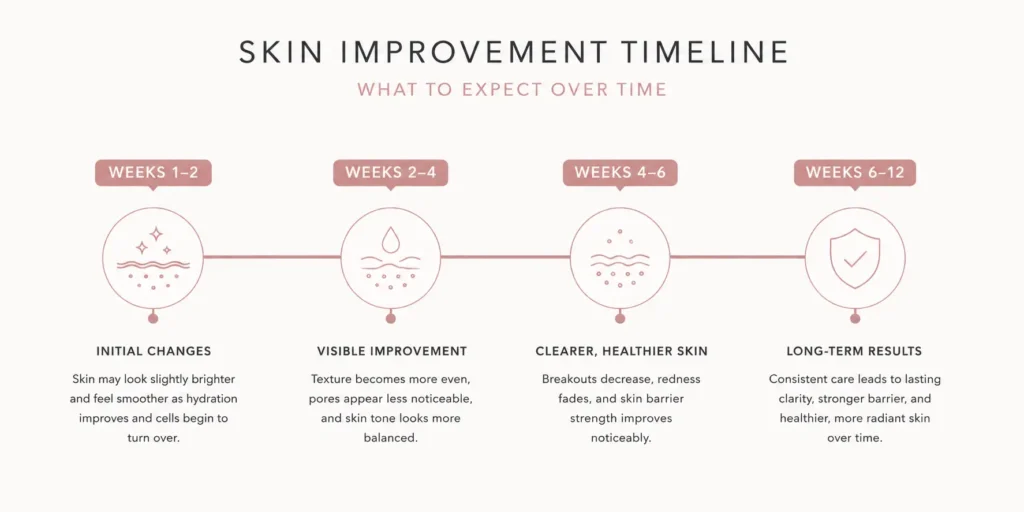
Most sources describe a similar general arc, though individual timelines vary by ingredient strength and skin type:
- Weeks 1–2: Initial adjustment. Skin may feel dry, tight, or slightly irritated as it adapts to the new active.
- Weeks 2–4: This is often when purging peaks, as microcomedones that were already forming get pushed to the surface faster.
- Weeks 4–6: Purging typically starts settling down. Dr. Thiede notes that purging usually follows a fairly predictable duration of roughly four to six weeks, which lines up with how long it takes skin to complete one renewal cycle.
- Weeks 6–12: For stronger actives like prescription retinoids, some dermatologists note the adjustment period can extend to eight or even twelve weeks before the full benefits become visible, with skin looking progressively clearer and smoother as it goes.
When purging becomes a red flag (past 6–8 weeks)
Board-certified dermatologist Andrea Suarez, MD, FAAD, has noted that if you’re still experiencing accelerated breakouts after six to eight weeks, it’s worth consulting a dermatologist rather than continuing to wait. If breakouts are still actively worsening, spreading to new areas, or showing no signs of settling down after that window, that’s no longer a typical purging pattern.
At that point, it’s reasonable to consider that the product may be irritating your skin, that it’s not the right fit, or that something else is driving the breakouts — and it’s worth reassessing rather than continuing to “wait it out” indefinitely.
Which Products Cause Purging? (And Which Don’t)
Ingredients known to trigger purging
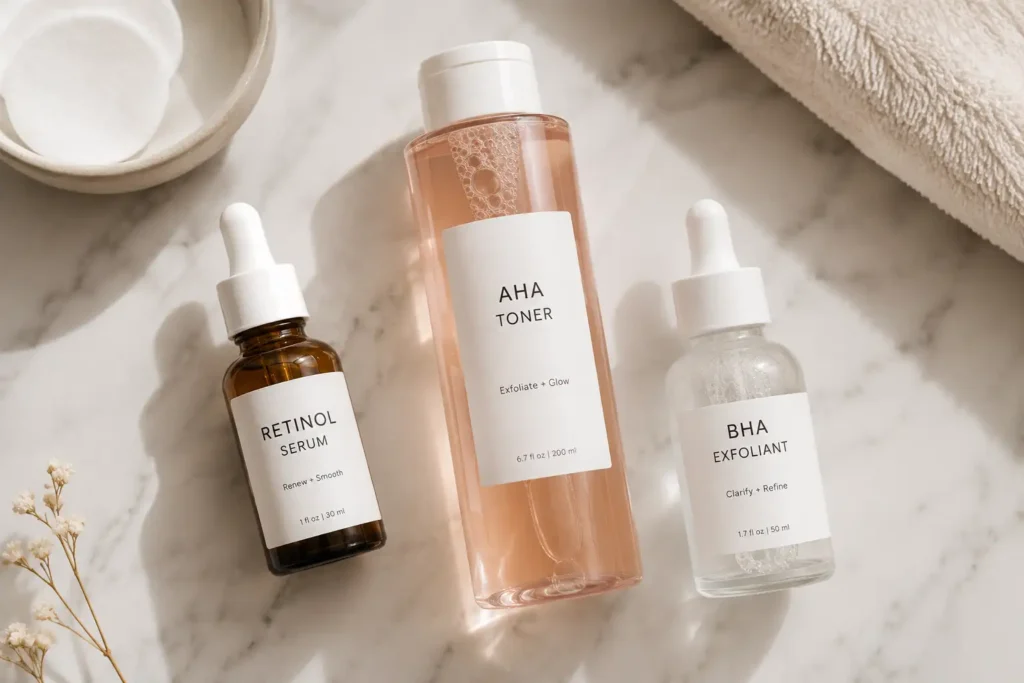
Retinoids are the most commonly discussed trigger. As synthetic derivatives of vitamin A, they accelerate cell turnover and are used specifically to treat acne, texture, and signs of aging — which is exactly why they’re so associated with purging.
Salicylic acid, a beta-hydroxy acid, works by penetrating into the pore lining to loosen and clear out debris, which can also temporarily surface congestion.
Benzoyl peroxide, while primarily antibacterial rather than exfoliating, can cause a similar adjustment period of dryness and irritation as skin acclimates to it.
Alpha hydroxy acids like glycolic and lactic acid, and in some formulations vitamin C, round out the list of ingredients most frequently linked to a purge.
Want to use exfoliating acids without overdoing it? Learn how to exfoliate your face effectively, choose the right exfoliant, and avoid common irritation mistakes in our Ultimate Guide to Face Exfoliation.
Ingredients that should NOT cause purging
Most other skincare categories simply don’t affect cell turnover in a way that would cause purging. Peptides, antioxidants like vitamin E, plain moisturizers, hyaluronic acid, and mineral or chemical sunscreens formulated without exfoliating acids aren’t expected to trigger a purge. If you break out after starting one of these, it’s far more likely to be an irritant reaction, a comedogenic ingredient, or an unrelated cause — not purging.
Quick gut-check: “Did I just add a cell-turnover ingredient?”
Before assuming you’re purging, ask yourself one simple question: did the new product contain a retinoid, an AHA, a BHA, or a comparable exfoliating or cell-turnover ingredient? If the answer is no, what you’re dealing with is much more likely to be a standard breakout, an allergic or irritant reaction, or a coincidence unrelated to the product at all.
How to Tell If It’s Purging or Breaking Out — A Simple Self-Check
Ask yourself these 4 questions
- Did I just start a product with a cell-turnover ingredient (retinoid, AHA, BHA, or similar)?
- Are the new blemishes appearing in my usual breakout zones, rather than somewhere new?
- Did this happen quickly — within the first couple of weeks of use — rather than building up gradually over a month or more?
- Am I also noticing dryness, flaking, or tightness, rather than burning, itching, or swelling?
The more of these you answer “yes” to, the more likely you’re dealing with purging rather than a true breakout.
The “stop test” — what happens if you pause the product for a few days
If you’re still unsure, pause the product for several days to a week and watch what happens. If breakouts start calming down fairly quickly, that pattern is consistent with purging — restarting the product at a lower frequency is usually the next step. If the skin keeps breaking out or the irritation continues despite stopping, that points toward a true breakout or reaction, and it’s worth reconsidering the product altogether.
Should You Stop Using the Product During Purging?
Why quitting too early sabotages your results
Stopping a cell-turnover ingredient the moment you see a few extra pimples is one of the most common reasons people never get to experience its benefits. Purging is generally understood as a predictable, front-loaded phase — stopping and restarting resets your skin’s adjustment period instead of letting it complete, which can mean going through the same uncomfortable stretch all over again later.
When it is safe (and smart) to stop immediately
That said, patience isn’t the right call in every situation. If you’re experiencing intense burning, significant swelling, blistering, or a rash that spreads well beyond your usual breakout areas, that’s not typical purging behavior, and continuing use isn’t worth the risk to your skin barrier. The same goes for breakouts that keep escalating well past the six-to-eight-week mark with no sign of improvement.
How to support your skin barrier while you wait it out
While your skin adjusts, keep the rest of your routine simple and barrier-friendly: a gentle, non-stripping cleanser, a fragrance-free moisturizer, and daily sunscreen.
Dr. Thiede’s guidance for managing purging includes resisting the urge to pick or squeeze blemishes and avoiding piling on additional new actives at the same time, since both can slow healing and increase irritation. Introducing a retinoid just once or twice a week before building up frequency is a commonly recommended way to ease into it.
If your skin is becoming dry, tight, stinging, or unusually sensitive while adjusting to a new active, your barrier may need extra support. Learn how to repair a damaged skin barrier, restore comfort, and rebuild a more resilient skincare routine.
When to See a Dermatologist
Red flags: worsening after 8 weeks, new areas, burning/itching, cystic or nodular breakouts
Certain signs mean it’s time to stop self-diagnosing and get a professional opinion: breakouts that are still worsening after eight weeks, blemishes spreading into new areas rather than settling in your usual zones, burning or intense itching, or the development of deep, painful cystic or nodular acne.
None of these fit the typical purging pattern, and a dermatologist can determine whether you’re dealing with irritant contact dermatitis, a true product-driven breakout, or an unrelated skin condition.
Why professional guidance matters for sensitive skin, rosacea, or eczema
If you already manage a condition like rosacea, eczema, or generally reactive skin, the purging-versus-breakout distinction gets harder to read on your own, because your baseline skin behavior already includes more redness or flare-ups than average. A dermatologist can help tailor ingredient choice, strength, and frequency to your specific skin so you’re not guessing your way through trial and error.
How to Prevent Unnecessary Breakouts When Trying New Products
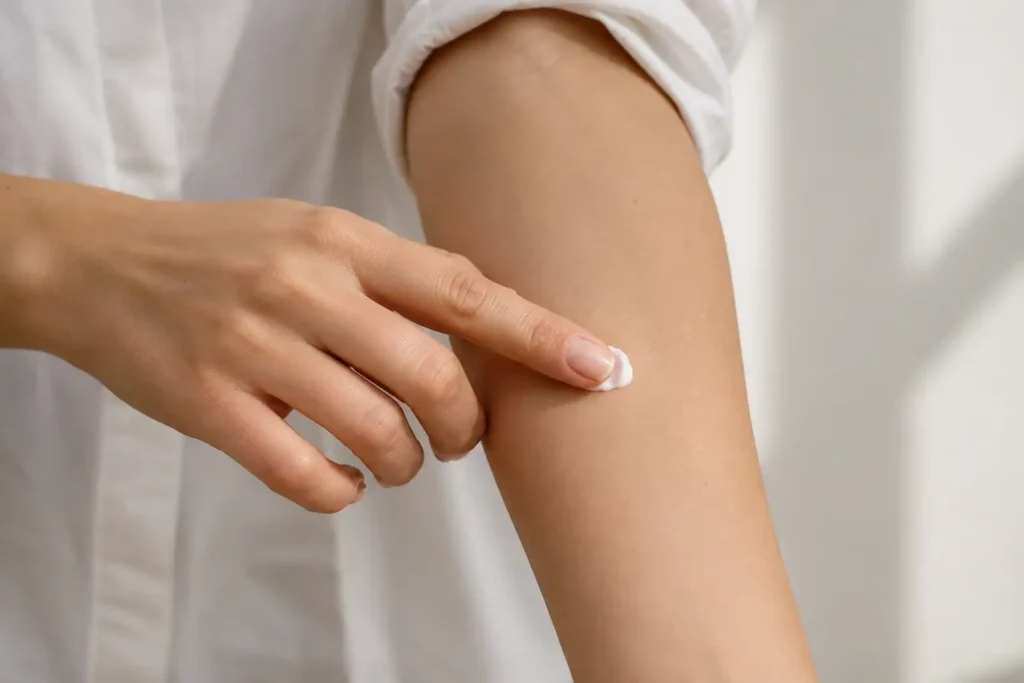
Patch-testing before full-face application
The American Academy of Dermatology recommends patch testing any new product before applying it to your whole face: apply it to a small, quarter-sized area — the inner arm or a discreet spot near the jaw works well — and repeat twice daily for seven to ten days, watching for irritation, redness, or new bumps before committing to full use. This single habit catches a meaningful share of reactions before they ever reach your whole face.
Introducing actives slowly (start low, go slow)
Rather than applying a new retinoid or acid every night right out of the gate, start with two to three times a week and build up gradually as your skin tolerates it. This “start low, go slow” approach is one of the most consistently recommended ways to minimize both purging intensity and the risk of true irritation.
Using more than one active? Learn how to combine and sequence them without overloading your skin. Read our guide to layering skincare actives without irritation for a safer, more effective routine.
Choosing non-comedogenic formulas
Look for products labeled non-comedogenic, and where possible, check the ingredient list for known pore-clogging culprits like isopropyl myristate or heavy occlusive oils if you’re particularly acne-prone. It’s not a perfect system — comedogenicity ratings were originally established using animal-skin testing rather than human trials — but choosing lighter, non-comedogenic formulas is still a reasonable way to reduce your odds of a true breakout.
Looking for ingredients that can help manage excess oil and breakouts without unnecessarily clogging your pores? Explore our guide to the top acne-fighting ingredients for oily skin and learn which actives are worth considering for a clearer, more balanced complexion.
Conclusion: Skin Purging vs Breakout
The core distinction really comes down to this: temporary blemishes in your usual zones, tied to a cell-turnover ingredient you just started, that fade within a matter of days to a couple of weeks once things settle — that’s purging, and it’s generally a sign your product is doing its job.
New, worsening, or spreading blemishes with no clear active-ingredient trigger, especially ones that come with burning, itching, or deep cystic bumps — that’s a breakout, and it’s your skin telling you something isn’t working.
Use the four-to-six-week rule as your practical litmus test, and don’t be afraid to extend that window to eight weeks for stronger prescription actives before deciding a product isn’t for you. Going forward, patch-test new products, introduce actives slowly, and pay attention to the pattern — not just the panic — the next time your skin changes. You now know how to read it.
FAQ: Skin Purging vs Breakout
How do I know if my skin is purging from new skincare?
Purging typically shows up within the first couple of weeks, in your usual breakout zones, after starting a product containing a cell-turnover ingredient like a retinoid, AHA, or BHA. It’s often paired with dryness or flaking rather than burning or swelling, and it tends to involve smaller whiteheads or blackheads rather than deep, painful cysts.
How long does purging last with a new product?
Most purging resolves within about four to six weeks, which roughly matches one full skin cell renewal cycle. Stronger prescription retinoids can extend that adjustment period to eight or even twelve weeks. If breakouts are still worsening well past that window, it’s a sign to reassess the product rather than continuing to wait.
How do you know if a product is making you break out?
If new blemishes appear in areas you don’t normally break out, keep worsening rather than settling, or come with burning, itching, or spreading irritation, that pattern points to a true breakout rather than purging. Breakouts also tend to lack the predictable start-and-resolve timeline that purging follows.
Does your skin look better after purging?
Yes — once purging resolves, skin typically looks clearer and more even in texture, since the ingredient has cleared out congestion that was already forming beneath the surface. This is the expected payoff of sticking with a cell-turnover ingredient through its adjustment period, assuming the reaction genuinely was purging.
Should I pop my pimples during purging?
No. Picking or squeezing blemishes during purging can worsen inflammation, prolong healing, and raise the risk of scarring or post-inflammatory dark spots. Letting blemishes resolve on their own, alongside a gentle, barrier-supportive routine, gives skin the best chance of clearing without lasting marks.
Should I stop using a product if my skin purges?
Generally, no — purging is considered an expected, temporary response, and stopping and restarting can reset the adjustment period rather than shorten it. The exceptions are if symptoms worsen significantly, spread to new areas, or persist beyond roughly six to eight weeks, in which case it’s worth reconsidering the product.
How long does it take to break out from a new skincare product?
True breakouts driven by irritation or comedogenic ingredients can appear anywhere from a few days to several weeks after starting a product. Unlike purging, they don’t follow a predictable improvement timeline and may continue or worsen instead of tapering off on their own.
What does purging skin look like?
Purging usually appears as small whiteheads, blackheads, or light pustules concentrated in your normal acne-prone areas. It’s often accompanied by mild dryness, flaking, or a light pink tinge to the skin, rather than the burning, swelling, or deep cystic bumps more typical of an irritant reaction or true breakout.

About Subhan Usafzai
Evidence-Based Skincare Educator & Formulation Specialist
I'm Subhan Usafzai (Fazli Subhan), an Evidence-Based Skincare Educator and Formulation Specialist. My background includes first-hand experience as a technician and research support in skin departments across tertiary military hospitals since 2006, and since 2008 I've focused on researching and translating clinical and formulation science into practical, evidence-based guidance. My formal training includes Coursera's Introduction to Cosmetic and Skincare Science and the four-course Introduction to Cosmetic Science and Ingredients specialization (Cosmetic Formulation Science, Cosmetic Product Development, and Quality Control and Regulatory in Cosmetic Science), authorized by Olay. Every article I write is checked against current research and reviewed by our medical team before publishing.
✅ Medically reviewed by Dr. Muhammad Khurram Ahmad, MD, Board-Certified Dermatologist · 📅 Last updated: August 2026
Medical Disclaimer
For Educational Purposes Only: This article is written by Subhan Usafzai, an Evidence-Based Skincare Educator and Formulation Specialist, for educational and informational purposes only. The information draws on scientific research, peer-reviewed studies, and dermatological literature available as of August 2026.
Not Medical Advice: This content does not constitute medical advice, diagnosis, or treatment. It is not a substitute for consultation with a qualified healthcare professional or dermatologist.
Individual Results May Vary: Skin conditions and responses to skincare products vary according to individual characteristics, skin type, hormonal factors, and environmental exposure.
Consult Your Healthcare Provider: Seek professional guidance before changing your skincare regimen, particularly during pregnancy or breastfeeding, or if you have a diagnosed skin condition, take medication, have sensitive skin, or receive dermatological treatment.
Product Safety: Consider patch testing new products. Discontinue use if irritation or an adverse reaction occurs, and seek medical advice when needed.
Affiliate Disclosure
Amazon Associates Disclosure: As an Amazon Associate I earn from qualifying purchases.
Editorial Independence: Affiliate relationships do not determine our product reviews or recommendations. We aim to provide balanced, research-informed information to help readers make informed skincare choices.
Supporting Glow Guide Hub: Qualifying purchases through affiliate links may earn us a commission at no additional cost to you.