
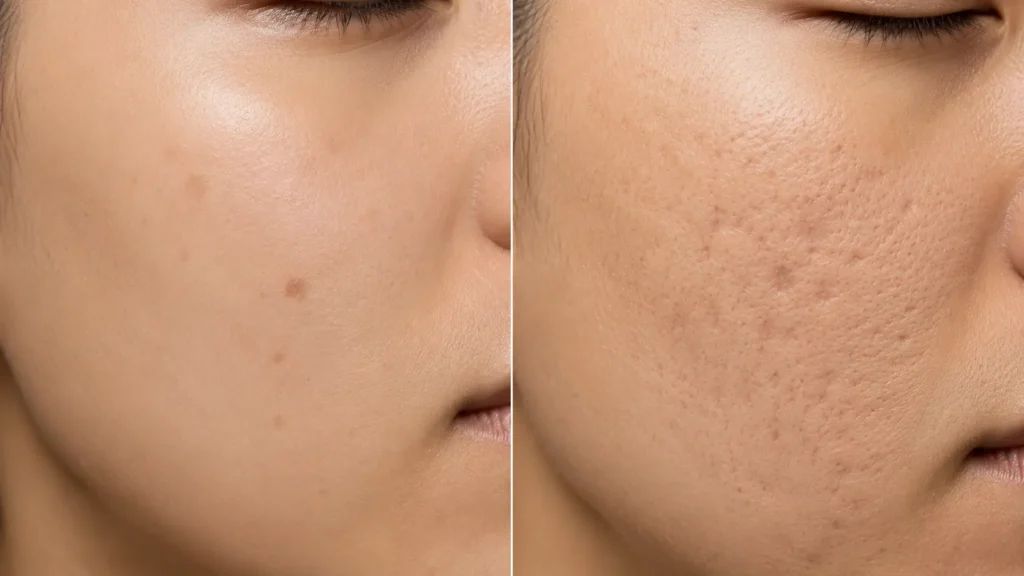
Acne Scars vs. Post-Inflammatory Hyperpigmentation: Know the Difference
Your breakout finally cleared. So why does your skin still look like it’s holding a grudge?
That flat brown or red mark left behind isn’t necessarily a scar—and that distinction matters more than most skincare routines give it credit for. Two of the most commonly confused post-acne concerns, acne scars and post-inflammatory hyperpigmentation (PIH), get lumped together constantly. Still, they behave differently, they respond to completely different treatments, and mistaking one for the other can waste months of effort on the wrong products.
Acne scars are a structural issue: they involve real changes to the skin’s texture caused by disrupted collagen production during healing. PIH, on the other hand, is a pigmentation issue—an overproduction of melanin triggered by inflammation, with no lasting change to the skin’s surface.
Both can follow the same breakout. Both can appear side by side on the same cheek. And both are manageable once you know which one you’re actually dealing with.
This guide breaks down what separates acne scars from post-inflammatory hyperpigmentation, why each one forms, how to tell them apart with a simple self-check, and what the current dermatological evidence says about treating—and preventing—both.
What’s the Difference Between Acne Scars and Hyperpigmentation?
The simplest way to separate these two conditions is to ask one question: does the mark change how your skin feels, or only how it looks?
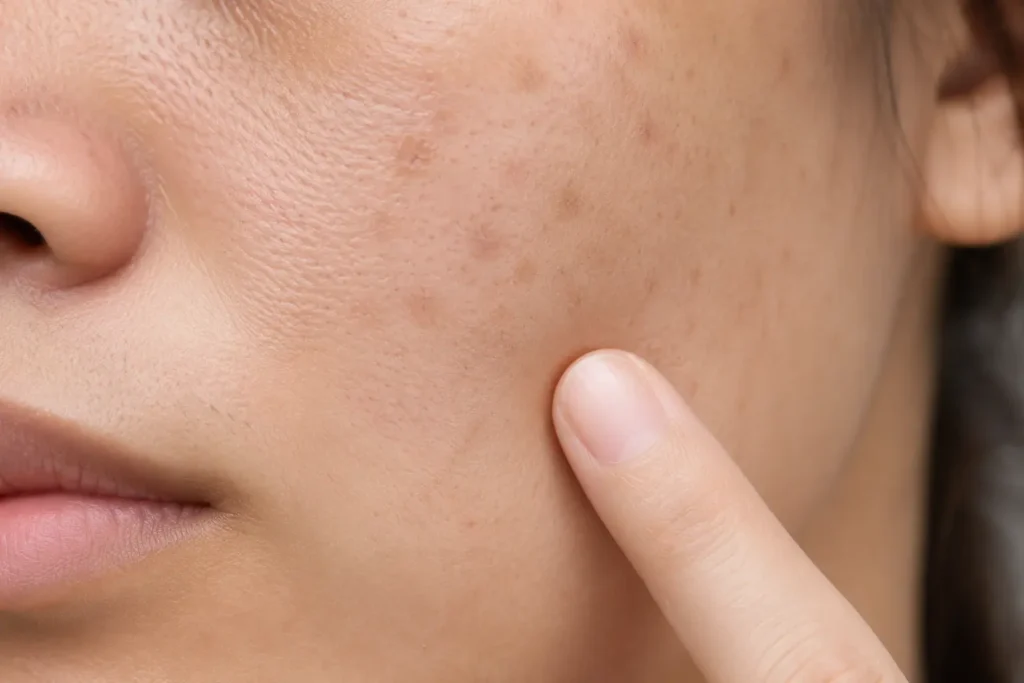
What Are Acne Scars?
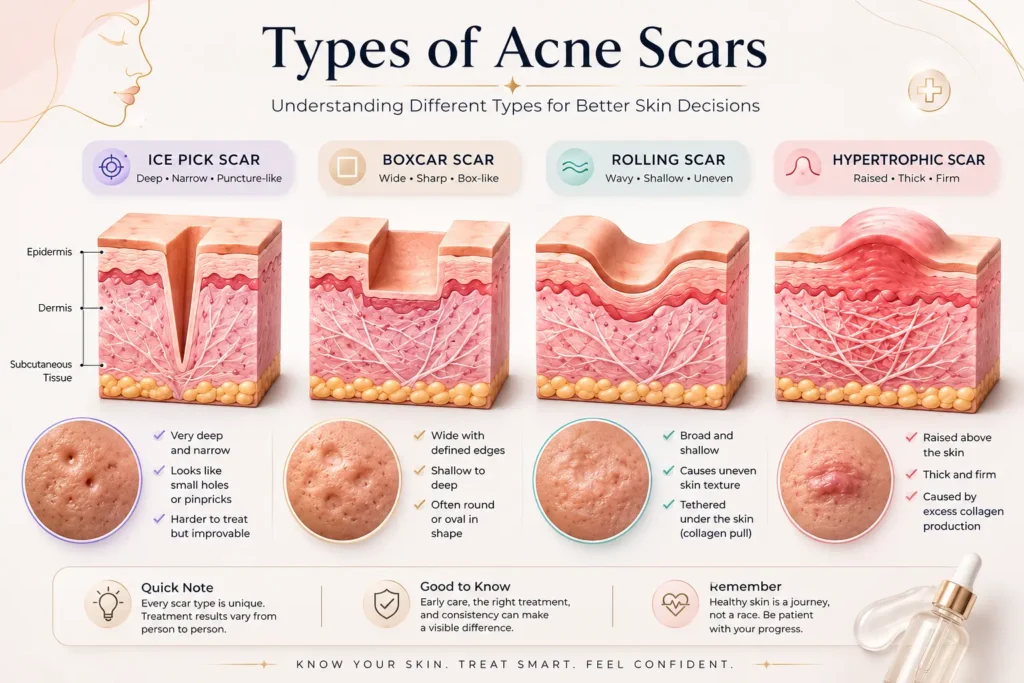
Acne scars form when an inflamed blemish damages the deeper layers of skin during the healing process. As the body repairs that damage, it either produces too little collagen (creating indented, atrophic scars) or too much (creating raised, hypertrophic or keloid scars). Because the underlying skin structure has changed, acne scars are permanent unless treated—they don’t fade on their own the way a temporary dark mark does.
What Is Post-Inflammatory Hyperpigmentation (PIH)?
PIH is not a scar at all. It’s a flat area of discoloration—brown, tan, red, purple, or dark—that appears after inflammation disrupts the skin’s melanin-producing cells (melanocytes), prompting them to release excess pigment into the surrounding tissue. The surface of the skin remains smooth; only the color has changed.
Quick Self-Check: Texture or Tone?
Run a fingertip lightly over the mark with your eyes closed. If you can feel a dip, a bump, or a change in surface texture, you’re likely dealing with a scar. If the skin feels completely smooth and the mark is only visible by color, it’s almost certainly PIH.
According to dermatologists at SLMD Skincare, founded by board-certified dermatologist Dr. Sandra Lee, hyperpigmentation does not alter the skin’s surface at all—the skin remains smooth even though the color looks uneven, which is the clearest way to distinguish it from true scarring.
To know the best skincare Ingredients for hyperpigmentation, read our complete guide for more details.
What Causes Acne Scars?
Collagen Damage During the Healing Process
When a deep or cystic breakout ruptures beneath the skin’s surface, it can damage the surrounding collagen and elastin network. If the body doesn’t rebuild that structure evenly, a permanent depression or raised area forms. This is fundamentally a wound-healing problem, not a pigmentation problem, which is why moisturizers and brightening serums alone can’t resolve it.
The Four Main Types of Acne Scars
| Scar Type | Appearance | Common Cause |
|---|---|---|
| Ice pick | Deep, narrow, pinpoint punctures | Severe cystic acne reaching deep into skin |
| Boxcar | Wide, box-like depressions with defined edges | Loss of tissue over a broad area |
| Rolling | Shallow, wave-like depressions | Fibrous bands tethering skin to deeper tissue |
| Hypertrophic/keloid | Raised, thickened tissue | Overproduction of collagen during healing |
Who’s Most at Risk of Scarring?
Scarring risk climbs with the severity and duration of active acne, a genetic tendency toward excess or insufficient collagen production, and behaviors like picking or squeezing blemishes. The American Academy of Dermatology notes that because scar type varies so much from patient to patient, board-certified dermatologists build individualized treatment plans rather than relying on a single universal fix.
To know more, read our detailed guide on acne-fighting ingredients for oily skin.
What Causes Post-Inflammatory Hyperpigmentation?
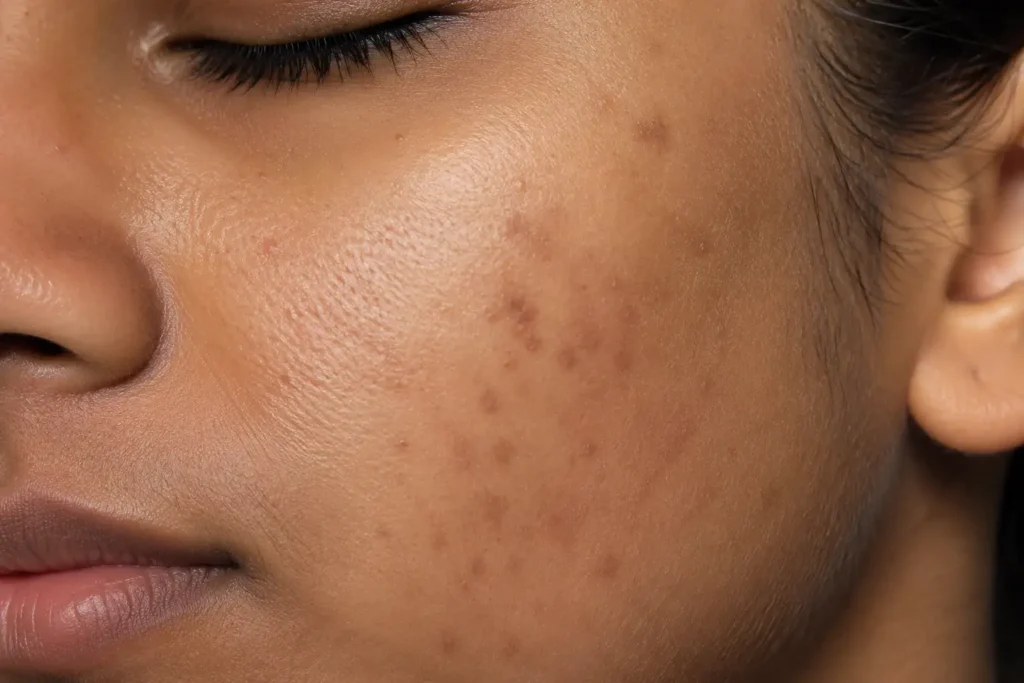
How Inflammation Triggers Melanin Overproduction
Any inflammatory event in the skin—an acne lesion, an insect bite, eczema, or even an aggressive extraction—can activate melanocytes in the affected area. Those cells respond by producing extra melanin as part of the skin’s natural defense mechanism. That pigment settles into the epidermis (and sometimes the deeper dermis), creating a visible dark mark long after the original irritation has healed.
Why PIH Is More Common—and More Stubborn—in Darker Skin Tones
Melanocytes in deeper skin tones tend to be more reactive to inflammation, which means PIH tends to appear more frequently, more intensely, and for longer periods in people with more melanin-rich skin. A study published via the National Library of Medicine found that post-acne pigmentation was present in roughly a quarter of acne patients overall. Still, it was nearly six times more likely among patients who also had melasma—another pigmentary condition strongly associated with darker, more UV-reactive skin.
The AAD’s Acne Resource Center similarly notes that people with skin of color are especially prone to developing lingering dark spots once their acne clears, which is why dermatologists often treat active acne and pigmentation prevention simultaneously in these patients.
Common Triggers That Make PIH Worse
- Picking, popping, or squeezing blemishes, which prolongs inflammation
- Unprotected sun exposure, which darkens existing pigment
- Aggressive exfoliation or over-treating already-inflamed skin
- Friction from masks, phones, or rough fabrics against active breakouts
For a complete plan to address these triggers, read our full guide on the skincare routine for hyperpigmentation.
How to Tell If You Have Acne Scars or Hyperpigmentation (Self-Assessment)
The “Touch Test”
As covered above, texture is the single most reliable marker. Scars change the physical landscape of the skin; PIH does not.
How the Mark Behaves in Sunlight
PIH tends to darken noticeably after sun exposure and gradually fade with consistent sun protection and time. Scar tissue doesn’t darken or lighten with UV exposure in the same way—its appearance stays largely tied to lighting and shadow rather than pigment.
Skipping SPF is basically feeding your dark spots. Here’s everything you need to know about sun protection.
When It’s Actually Both at Once
It’s common to have both conditions in the same area—a slightly indented scar with a ring of discoloration around it, for example. In these cases, treatment typically needs to address the texture and the tone separately, since no single product or procedure resolves both mechanisms.
How Long Does Each One Last?
How Long PIH Typically Takes to Fade
Post-inflammatory hyperpigmentation is, by definition, temporary—but “temporary” can still mean months. The SLMD Skincare team notes that PIH generally takes several weeks to several months to fade, with the exact timeline depending on skin tone, how deep the pigment sits, and how consistently sun protection is used. In deeper skin tones, PIH can occasionally persist for a year or longer without active treatment.
Why Acne Scars Usually Don’t Fade Without Treatment
Because true scars involve structural collagen changes rather than pigment, they generally do not resolve with time alone. Some very shallow scars may soften slightly as skin naturally remodels over a year or two, but moderate to severe scarring typically requires an in-office intervention to see meaningful improvement.
Factors That Speed Up or Slow Down Healing
Daily broad-spectrum sunscreen, avoiding picking, and starting treatment early all shorten PIH’s timeline considerably. For scars, early treatment of active acne—before scarring has a chance to form—remains the single most effective preventive factor.
Treatment Options for Post-Inflammatory Hyperpigmentation
At-Home Ingredients for Post-Inflammatory Hyperpigmentation That Help
Vitamin C (L-ascorbic acid, typically 10–20%): An antioxidant that inhibits tyrosinase, the enzyme responsible for melanin production, while also helping protect skin from UV-driven pigment darkening. Well tolerated by most skin types; can cause mild irritation at higher concentrations or in unstable formulations.
Azelaic Acid (typically 10–20% OTC, up to 20% by prescription): A dicarboxylic acid that both reduces inflammation and directly inhibits abnormal melanocyte activity, making it useful for PIH and active acne at once. It’s considered safe for most skin types, including sensitive and pregnant skin, with a low irritation profile compared to other brightening actives.
It’s rare to find an active that’s gentle enough for pregnancy yet still effective on stubborn pigmentation. See how it stacks up against other brighteners in our complete guide to azelaic acid for hyperpigmentation.
Niacinamide (typically 4–10%): Reduces the transfer of pigment from melanocytes to skin cells and supports barrier function, making it a gentler complementary option alongside stronger actives.
Retinoids (over-the-counter retinol or prescription tretinoin/adapalene): Increase skin cell turnover, which helps shed pigmented cells faster and can improve the penetration of other brightening ingredients. Best introduced gradually, since retinoids can initially increase sensitivity and, paradoxically, trigger irritation-related pigmentation if overused.
Hydroquinone (2% OTC, up to 4% by prescription): Directly inhibits tyrosinase and remains one of the most studied depigmenting agents available. However, it’s generally used in defined treatment cycles under dermatologist guidance rather than continuously.
| Ingredient | Mechanism | Best For | Watch Out For |
|---|---|---|---|
| Vitamin C | Antioxidant, tyrosinase inhibitor | Daily prevention, mild PIH | Stability issues, mild stinging |
| Azelaic Acid | Anti-inflammatory + melanocyte inhibitor | Sensitive skin, active acne + PIH | Mild tingling on application |
| Niacinamide | Blocks pigment transfer | Layering, sensitive skin | Rare flushing in high concentrations |
| Retinoids | Increases cell turnover | Long-term texture and tone | Initial dryness, sun sensitivity |
| Hydroquinone | Tyrosinase inhibitor | Stubborn, deeper pigment | Rebound pigmentation if overused |
In-Office Options
Chemical peels (glycolic, salicylic, or mandelic acid), low-strength laser or light therapy, and professional-grade microneedling can accelerate pigment clearance beyond what topicals achieve alone, particularly for deeper or longstanding PIH. These treatments carry a small risk of triggering more pigmentation if performed too aggressively on active inflammation, which is why they’re best done under professional supervision, especially for medium to deep skin tones.
Why Daily SPF Is Non-Negotiable for PIH
UV exposure is one of the strongest drivers of pigment darkening. Mayo Clinic specifically recommends consistent sunscreen use to limit the contrast between healing skin and its surroundings and to prevent existing marks from becoming more resistant to treatment. Without daily SPF, even the most effective brightening routine will progress far more slowly.
Since SPF is doing most of the heavy lifting here, it’s worth picking the right kind. Our guide to physical vs. chemical sunscreen breaks down the pros and cons of each.
Treatment Options for Acne Scars
Topical Options and Their Limits
Retinoids and alpha-hydroxy acids can modestly improve very shallow scarring by encouraging collagen turnover, and consistent sunscreen use helps minimize the contrast between scarred and unscarred skin. However, topical products generally cannot rebuild lost collagen volume or resolve moderate-to-severe indentation on their own.
Professional Procedures
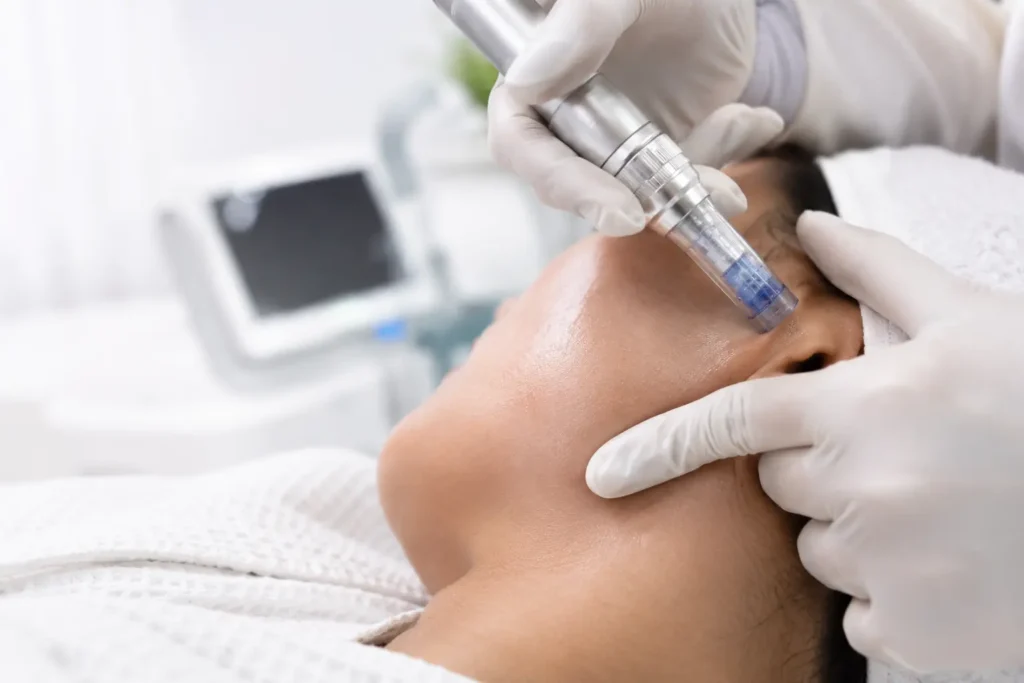
- Microneedling: Creates controlled micro-injuries that stimulate new collagen production, commonly used for rolling and shallow boxcar scars.
- Fractional and ablative lasers: Resurface the skin in controlled patterns to encourage collagen remodeling; effective across several scar types but requires downtime.
- Chemical peels (including TCA CROSS for ice pick scars): Use targeted acid application to stimulate resurfacing in specific scar types.
- Dermal fillers: Temporarily plump indented scars by adding volume beneath the skin; results are not permanent.
- Subcision: A minor procedure that releases the fibrous bands tethering rolling scars to deeper tissue, allowing the skin to sit more evenly.
A Cochrane systematic review, summarized in JMIR Dermatology, evaluated 24 randomized controlled trials and found that fractional lasers, chemical peeling (with and without skin needling), and injectable treatments each showed measurable improvement in atrophic acne scars.
However, the review also noted that many studies were small and that no single treatment outperformed all others across every scar type. Separately, the Journal of the American Academy of Dermatology outlines a broad range of procedural and surgical modalities—including peels, fillers, and radiofrequency microneedling—each suited to different scar presentations, reinforcing that treatment should be tailored rather than one-size-fits-all.
What Dermatologists Say About Combination Treatment Plans
Because most patients have more than one scar type, dermatologists frequently combine two or three modalities—for example, microneedling paired with a chemical peel, or subcision followed by laser resurfacing—rather than relying on a single procedure. Results also depend heavily on skin tone, since some laser and peel treatments carry a higher risk of triggering PIH in deeper skin if not calibrated appropriately.
Since chemical peels are one of the most common tools in these combination plans, it helps to understand how exfoliation actually works before trying it at home. Read our complete guide on face exfoliation.
Can You Prevent Acne Scars and Hyperpigmentation?
Treating Active Acne Early
The single most effective way to prevent both scarring and PIH is to treat inflammatory acne before it has the chance to damage skin or trigger excess pigment. The AAD’s updated guidelines for acne vulgaris, published in JAAD, emphasize prompt, consistent treatment—strongly recommending topical retinoids, benzoyl peroxide, and, for more severe or scarring-prone acne, oral isotretinoin—as the foundation of reducing long-term skin damage.
Hands-Off Healing
Picking or popping a blemish extends inflammation, increases the odds of deeper tissue damage, and is one of the most preventable contributors to both scarring and PIH. Cool compresses and appropriate spot treatments are safer ways to manage an active breakout without manipulating the skin.
Building a Scar-and-Spot-Prevention Routine
A simple, consistent framework works better than an aggressive, ever-changing one: a gentle cleanser, an evidence-based acne treatment (such as benzoyl peroxide or a topical retinoid), a lightweight moisturizer to support the skin barrier, and broad-spectrum sunscreen every morning. Adding a brightening ingredient like azelaic acid or vitamin C once acne is under control can help address any early pigmentation before it deepens.
Not sure whether vitamin C or niacinamide fits better into this last step? We compare the two head-to-head in Vitamin C or Niacinamide: Which One Should You Use?
When to See a Dermatologist
Signs Your Marks Won’t Fade on Their Own
If a dark mark hasn’t budged after several months of consistent sun protection and topical treatment, or if you notice any textural change—dips, ridges, or raised tissue—it’s worth a professional evaluation rather than continuing to guess.
What to Expect at a Consultation
A board-certified dermatologist will typically assess your skin under proper lighting, sometimes using a Wood’s lamp to determine how deep the pigment sits, and will factor in your skin type, scar type, and treatment history before recommending a plan.
Combining Treatments for Faster, Safer Results
Professional guidance is especially valuable when scarring and pigmentation overlap, since the wrong combination of at-home actives and in-office procedures can occasionally worsen PIH in deeper skin tones. A dermatologist can sequence treatments to minimize that risk.
Conclusion: Acne Scars Vs. Post-Inflammatory
Acne scars and post-inflammatory hyperpigmentation aren’t the same condition wearing two names—they’re two different processes with two different timelines and two different treatment paths.
Scars are structural and generally require professional intervention to improve. PIH is pigment-based, tends to fade with time and consistent sun protection, and responds well to targeted topical ingredients like azelaic acid, vitamin C, and retinoids.
The fastest route to clearer skin isn’t guessing your way through a shelf of products; it’s identifying which one you’re dealing with, treating active acne early to prevent both, and building a routine—reinforced by daily SPF—that matches the actual mechanism behind your marks.
If your skin still isn’t budging after a few months of consistent care, that’s your cue to bring in a board-certified dermatologist rather than keep experimenting alone.
FAQ: Acne Scars Vs. Post-Inflammatory Hyperpigmentation
How do I know if I have acne scars or hyperpigmentation?
Run a finger over the mark. If you feel a dip, bump, or texture change, it’s likely a scar. If the skin feels completely smooth and only the color looks different, it’s post-inflammatory hyperpigmentation. Marks that darken with sun exposure and fade with sunscreen use are also more consistent with PIH than true scarring.
Why is PIH so hard to get rid of?
PIH forms when inflammation triggers melanocytes to overproduce pigment, and that excess melanin can settle deep in the skin, especially in medium-to-deep skin tones. Sun exposure repeatedly reactivates it, and picking or re-irritating the area restarts the inflammatory cycle, which is why consistent treatment and daily sunscreen are essential.
How long does post-inflammatory hyperpigmentation from acne last?
PIH typically fades within several weeks to a few months with consistent care, though timelines vary by skin tone and pigment depth. In deeper skin tones or untreated cases, marks can persist for a year or longer. Daily sunscreen and active ingredients like azelaic acid or vitamin C can meaningfully shorten this timeline.
At what age does hyperpigmentation start?
PIH can occur at any age after acne or another inflammatory skin event, including in teenagers. It’s not tied to a specific age of onset; rather, it’s tied to inflammation. That said, deeper or more persistent hyperpigmentation is often reported more frequently in adults with longer histories of recurring breakouts.
What is the fastest way to remove PIH?
There’s no truly “fast” fix, since PIH resolves through gradual pigment turnover. Still, consistent daily sunscreen combined with evidence-based actives—azelaic acid, vitamin C, or a retinoid—produces the quickest realistic results. In-office treatments like chemical peels can accelerate fading further under professional supervision.
What permanently lightens hyperpigmentation?
No product “permanently” prevents new pigmentation from ever forming again, since PIH depends on future inflammation and sun exposure. However, consistent tyrosinase-inhibiting ingredients like azelaic acid, vitamin C, and hydroquinone, paired with daily SPF, can fully resolve existing marks and significantly reduce the risk of recurrence.
How to know if PIH is permanent?
True PIH is not permanent by definition, though it can take a year or more to fade in some cases, especially without treatment. If a dark mark has remained completely unchanged for over a year despite consistent sun protection, it’s worth having a dermatologist confirm it isn’t a different pigmentary condition, like a scar or post-inflammatory erythema.
What worsens post-inflammatory hyperpigmentation?
Unprotected sun exposure is the biggest aggravator, since UV light directly stimulates melanin production. Picking or popping blemishes, aggressive exfoliation on inflamed skin, and skipping sunscreen during active treatment can also prolong or intensify PIH.
How to fade post-inflammatory hyperpigmentation from acne?
Start with daily broad-spectrum sunscreen, since UV exposure undoes progress from other treatments. Add a proven brightening ingredient such as azelaic acid, vitamin C, or a retinoid, and avoid picking at active breakouts. For stubborn or deep marks, a dermatologist-guided peel or laser treatment can speed up results.
Can acne scars be 100% removed?
Complete removal isn’t a realistic guarantee for most moderate-to-severe scars. However, significant improvement is achievable with the right combination of treatments, such as microneedling, laser resurfacing, subcision, or fillers. Very shallow scarring responds best, while deeper ice pick or boxcar scars typically see meaningful, but partial, improvement.

About Subhan Usafzai
Evidence-Based Skincare Educator & Formulation Specialist
I'm Subhan Usafzai (Fazli Subhan), an Evidence-Based Skincare Educator and Formulation Specialist. My background includes first-hand experience as a technician and research support in skin departments across tertiary military hospitals since 2006, and since 2008 I've focused on researching and translating clinical and formulation science into practical, evidence-based guidance. My formal training includes Coursera's Introduction to Cosmetic and Skincare Science and the four-course Introduction to Cosmetic Science and Ingredients specialization (Cosmetic Formulation Science, Cosmetic Product Development, and Quality Control and Regulatory in Cosmetic Science), authorized by Olay. Every article I write is checked against current research and reviewed by our medical team before publishing.
✅ Medically reviewed by Dr. Muhammad Khurram Ahmad, MD, Board-Certified Dermatologist · 📅 Last updated: August 2026
Medical Disclaimer
For Educational Purposes Only: This article is written by Subhan Usafzai, an Evidence-Based Skincare Educator and Formulation Specialist, for educational and informational purposes only. The information draws on scientific research, peer-reviewed studies, and dermatological literature available as of August 2026.
Not Medical Advice: This content does not constitute medical advice, diagnosis, or treatment. It is not a substitute for consultation with a qualified healthcare professional or dermatologist.
Individual Results May Vary: Skin conditions and responses to skincare products vary according to individual characteristics, skin type, hormonal factors, and environmental exposure.
Consult Your Healthcare Provider: Seek professional guidance before changing your skincare regimen, particularly during pregnancy or breastfeeding, or if you have a diagnosed skin condition, take medication, have sensitive skin, or receive dermatological treatment.
Product Safety: Consider patch testing new products. Discontinue use if irritation or an adverse reaction occurs, and seek medical advice when needed.
Affiliate Disclosure
Amazon Associates Disclosure: As an Amazon Associate I earn from qualifying purchases.
Editorial Independence: Affiliate relationships do not determine our product reviews or recommendations. We aim to provide balanced, research-informed information to help readers make informed skincare choices.
Supporting Glow Guide Hub: Qualifying purchases through affiliate links may earn us a commission at no additional cost to you.