
Best Moisturizing Soap for Dry Skin in 2026: Dermatologist-Recommended Picks
Dry skin can make an ordinary shower surprisingly uncomfortable. You wash, rinse, and step out feeling clean—but within minutes, your skin feels tight, rough, or strangely uncomfortable. By the end of the day, the dryness may be even more obvious, especially on areas such as the legs, arms, and hands.
Cold weather and low humidity can certainly worsen dryness, but your cleanser may also be contributing to the problem.
Cleansing should remove sweat, dirt, excess oil, and other buildup. The problem starts when a cleanser removes too much of the skin’s own lipids. For already-dry skin, repeated exposure to harsh cleansing agents can leave the surface feeling tight and rough and may make it harder for the skin to maintain a comfortable barrier.
A moisturizing label alone tells you very little. The cleansing agents, emollients, humectants, fragrance, and overall formula are what determine how a product behaves on dry skin.
Below, we’ll look at what actually makes a cleansing product suitable for dry skin, the ingredients worth looking for, the ones that may be troublesome when your skin is already sensitive, and the best moisturizing soaps for dry skin based on formulation rather than marketing promises.
Why Regular Soap Can Make Dry Skin Worse
Regular soap can leave dry skin feeling tighter because it removes oils effectively, and its naturally alkaline pH can also be less compatible with the skin’s mildly acidic surface. When cleansing repeatedly removes too much of the skin’s surface lipids, water can escape more easily, and the skin may become rough, tight, or irritated.
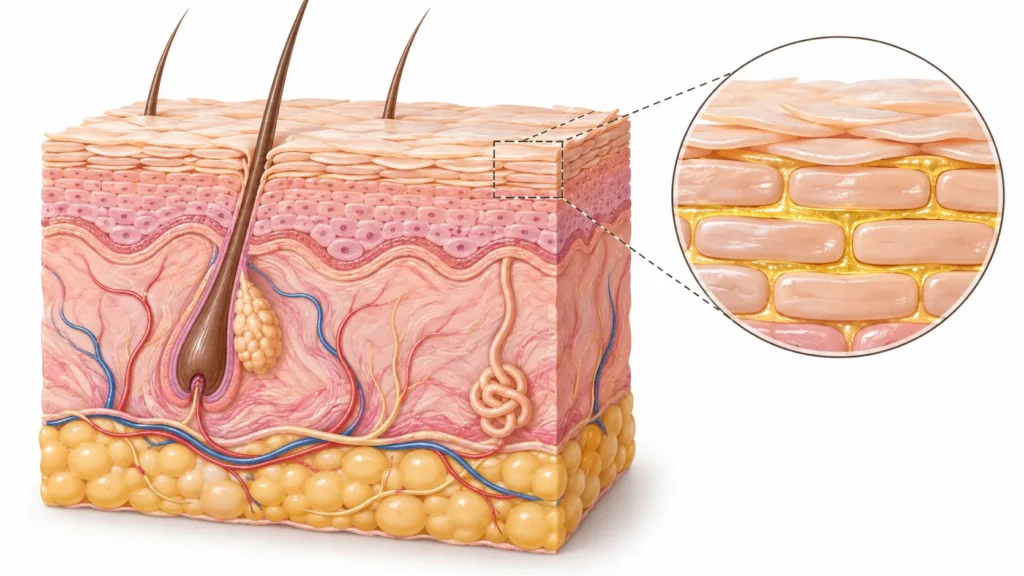
The outermost layer of your skin, the stratum corneum, plays an important role in preventing this water loss. Think of it as a carefully organized barrier: skin cells form the “bricks,” while lipids such as ceramides, cholesterol, and fatty acids help fill the spaces between them. When this barrier is disrupted, the skin becomes more vulnerable to dryness, cracking, itching, and irritation. Johns Hopkins Medicine also notes that a damaged skin barrier can make the skin more susceptible to these problems.
Traditional bar soap is made through a process called saponification, which produces an alkaline cleanser, typically with a pH around 9–10 and sometimes higher. Skin, by contrast, has a naturally acidic surface pH of roughly 4.5–5.5. According to DermNet NZ, traditional soaps can increase dryness and irritation because of their alkalinity and cleansing action. They can also remove surface oils that help keep skin comfortable and reduce water loss.
The cleansing agents themselves can matter too. Sodium lauryl sulfate (SLS), for example, is very effective at removing oil, sweat, and debris. That makes it a useful cleansing ingredient, but with enough exposure, its ability to disrupt the skin barrier can become a concern, particularly for already-sensitive or dry skin.
In a controlled study of healthy volunteers, 24-hour exposure to SLS altered the expression of several proteins involved in epidermal barrier function, including profilaggrin, a precursor involved in the formation of the skin’s natural moisturizing factor. The study, published in PubMed, provides evidence of how certain surfactants can affect barrier-related processes even over relatively short exposure periods.
This is why the feeling of being “squeaky clean” isn’t necessarily a sign that your cleanser is doing a better job. If your skin feels tight or uncomfortable immediately after washing, the cleanser may be removing more than you need. For dry skin, the better approach is usually to remove sweat, dirt, and buildup while preserving as much of the skin’s protective barrier as possible.
Signs Your Current Soap Is Too Harsh
- Skin feels tight or “squeaky” immediately after rinsing
- Visible flaking, especially on the shins, forearms, or hands
- New or worsening redness after showering
- Itchiness that appears shortly after bathing rather than throughout the day
- Skin that looks dull or ashy despite regular moisturizing
If two or more of these sound familiar, your cleanser is a reasonable place to start troubleshooting before assuming your moisturizer isn’t working hard enough.
If your skin is already showing signs of barrier damage, our guide to how to repair a damaged skin barrier explains what to change beyond the cleansing step.
Ingredients to Look For in a Moisturizing Soap for Dry Skin
A cleanser doesn’t have to leave skin feeling stripped. Syndet bars and gentle body washes can remove sweat and debris while minimizing the loss of surface lipids.
If you want to understand how these ingredients fit into skincare more broadly, see our guide to the top skincare ingredients that actually work in 2026.
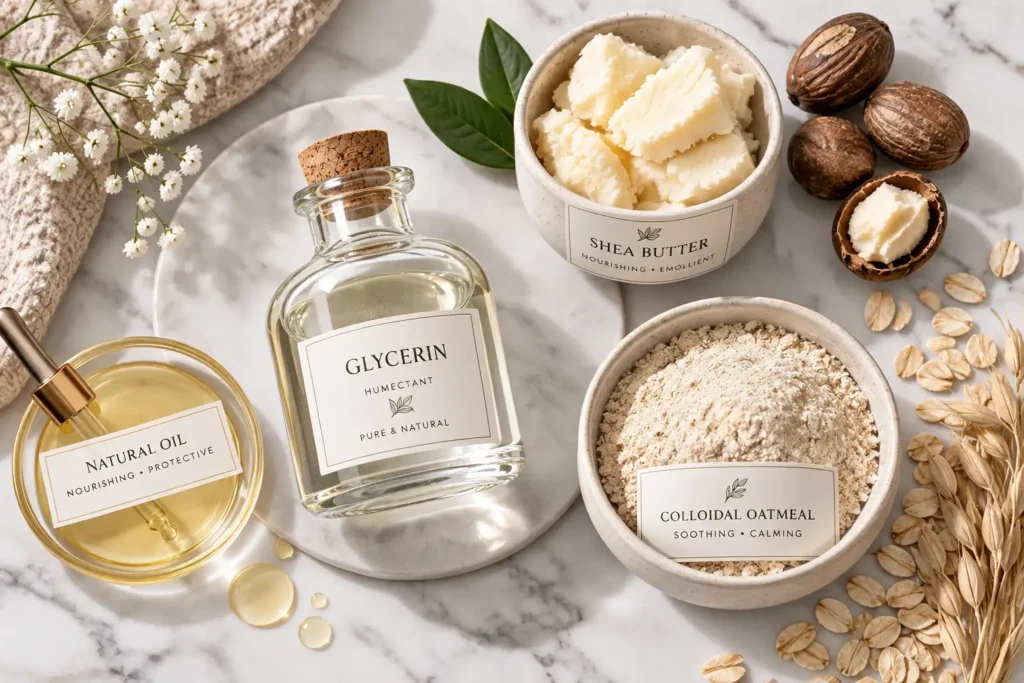
Here’s what to look for on the ingredient label, and why each category matters.
Humectants: Glycerin and Hyaluronic Acid
Humectants pull water into the skin’s outer layer, either from deeper layers or from the surrounding air. Glycerin is the most well-studied humectant in skincare and is naturally produced as a byproduct of traditional soap-making, though commercial soap manufacturing often removes it and sells it separately.
A controlled clinical study published in the International Journal of Cosmetic Science found that a cream containing 20% glycerin significantly increased skin hydration, measured by corneometer readings, after just ten days of use, and helped protect the skin against surfactant-induced irritation. Look for glycerin listed near the top of the ingredient list, since concentration matters for the effect.
Hyaluronic acid is another humectant with strong water-binding properties. In a rinse-off cleanser, however, its contribution is likely more limited than in a leave-on product.
Emollients: Shea Butter, Ceramides, and Natural Oils
While humectants attract water, emollients fill in the gaps between skin cells and smooth the surface. Shea butter is rich in fatty acids and vitamins A and E, and dermatologists commonly use it in formulas for very dry or eczema-prone skin.
Ceramides matter because they are naturally present in the skin’s barrier lipids. In leave-on products, ceramides can help support a compromised barrier; in cleansers, their main advantage is that the overall formula can be designed to minimize barrier disruption.
Other beneficial oils include coconut, olive, and avocado oil, all of which contribute fatty acids that support the skin’s lipid layer.
Soothing Agents: Colloidal Oatmeal and Niacinamide
The FDA has recognized colloidal oatmeal as a skin protectant since 2003, and its benefits go beyond simple soothing.
Research published in the Journal of Drugs in Dermatology found that avenanthramides, the primary active compounds in oats, upregulate genes related to skin barrier repair and tight junction formation, helping the skin retain moisture more effectively while reducing inflammation-driven itch.
Niacinamide (vitamin B3) is another ingredient worth watching, especially in wash-off formulas paired with a niacinamide moisturizer.
A landmark study in the British Journal of Dermatology found that nicotinamide increased ceramide and other stratum corneum lipid biosynthesis in human keratinocytes and reduced transepidermal water loss when applied topically.
Most formulations use concentrations between 2% and 5%, which appears to be sufficient for barrier-support benefits without added irritation.
🔗 Ceramides and niacinamide support the skin barrier in different ways. If you’re deciding which matters more for your routine, see our full breakdown of ceramide vs. niacinamide for skin barrier repair →
Ingredients to Avoid on a Dry Skin Soap Label
| Ingredient | Why It’s a Problem | What to Choose Instead |
|---|---|---|
| Sodium Lauryl Sulfate (SLS) / Sodium Laureth Sulfate (SLES) | Strips natural lipids along with dirt; linked to barrier protein disruption | Decyl glucoside, cocamidopropyl betaine, sodium cocoyl isethionate |
| Synthetic fragrance/parfum | Common trigger for allergic and irritant contact dermatitis | Fragrance-free or naturally scented with minimal essential oil |
| Denatured or SD alcohol | Evaporates quickly and pulls moisture from the skin surface | Fatty alcohols like cetearyl alcohol (these are conditioning, not drying) |
| Parabens and phthalates | Preservatives some sensitive-skin users react to | Phenoxyethanol or other modern preservative systems |
🔗 Want a deeper ingredient-by-ingredient breakdown for reactive skin? Explore our full guide to skincare ingredients for sensitive skin →
Best Moisturizing Soaps for Dry Skin in 2026
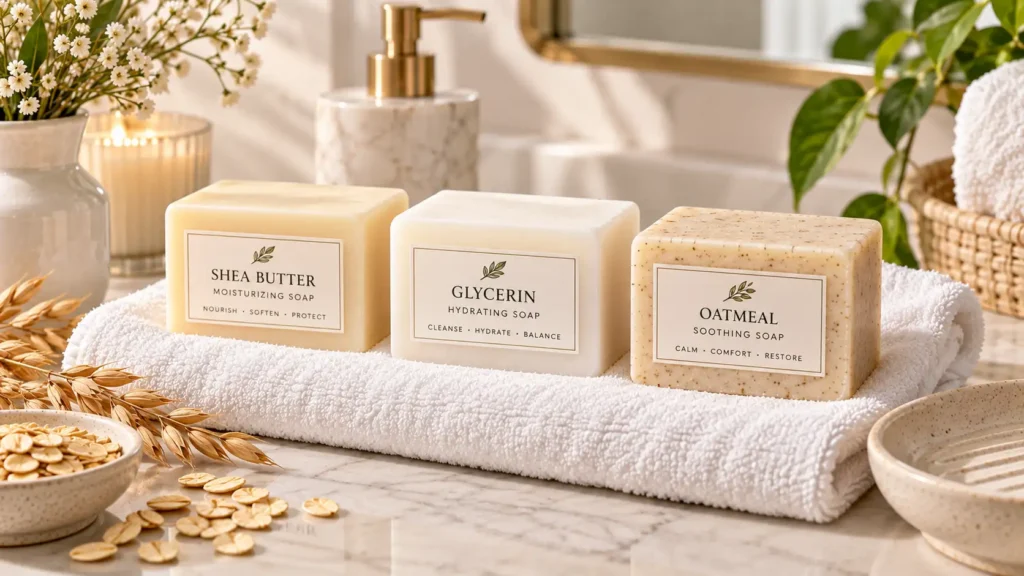
We selected the following picks based on published ingredient research, formulation transparency, and suitability for different dry-skin needs, not popularity alone. Prices are approximate and may vary by retailer.
| Product | Best For | Key Ingredients | Fragrance | Price Range |
|---|---|---|---|---|
| CeraVe Hydrating Cleansing Bar | Best overall | Ceramides, hyaluronic acid, glycerin | Fragrance-free | $ |
| Dove Sensitive Skin Beauty Bar | Best budget-friendly | 1/4 moisturizing cream, glycerin | Fragrance-free | $ |
| Vanicream Cleansing Bar | Best for sensitive/reactive skin | Glycerin, minimal ingredient list | Fragrance-free, dye-free | $$ |
| Aveeno Skin Relief Body Wash | Best for eczema-prone skin | Colloidal oatmeal, glycerin | Fragrance-free | $ |
| Cetaphil Gentle Cleansing Bar | Best for daily face-and-body use | Glycerin, mild surfactants | Fragrance-free | $ |
Best Overall: CeraVe Hydrating Cleansing Bar
This bar is built around CeraVe’s ceramide complex (ceramides 1, 3, and 6-II) alongside hyaluronic acid, which together support both hydration and barrier repair. It’s formulated to be non-comedogenic and non-drying, developed with dermatologists, and it lathers gently without the tight, stripped feeling associated with true soap. It’s a solid daily option for normal-to-dry and sensitive skin.
Strengths: Barrier-supporting ceramides, fragrance-free, widely available.
Limitations: Doesn’t lather as richly as traditional bar soap, which some users interpret (incorrectly) as less effective cleansing.
🔗 See how this compares to other picks in our original roundup: 10 Best Soaps for Dry Skin: Ultimate Guide →
Best Budget-Friendly: Dove Sensitive Skin Beauty Bar
Dove’s beauty bar is technically a syndet (synthetic detergent) rather than true soap, which is why it performs better for dry skin—it maintains a more skin-compatible pH and contains a portion of moisturizing cream in its formula. It’s fragrance-free and widely available at a lower price point than most dermatologist-branded options.
Strengths: Affordable, accessible, fragrance-free, gentle lather.
Limitations: Contains fewer active barrier-repair ingredients (like ceramides) compared to premium options.
🔗 We’ve also reviewed the Dove Sensitive Skin Beauty Bar separately, including its ingredients, cleansing performance, and suitability for dry skin. Read our full review: Is Dove Sensitive Skin Beauty Bar the Best for Your Skin? →
Best for Sensitive or Reactive Skin: Vanicream Cleansing Bar
Vanicream products are formulated without dyes, fragrance, lanolin, parabens, or formaldehyde releasers, which makes this bar a common recommendation for people with allergic contact dermatitis or extremely reactive skin. The trade-off is a shorter, simpler ingredient list, which some users find less “spa-like” but which minimizes the risk of an adverse reaction.
Strengths: Minimal ingredient list, low allergy risk, dermatologist-recommended for reactive skin. Limitations: Fewer actives means less targeted barrier repair for very compromised skin.
Best for Eczema-Prone Skin: Aveeno Skin Relief Body Wash
Built around Aveeno’s Triple Oat Complex (oat flour, oat extract, and oat oil), this wash leans on the same avenanthramide science discussed earlier. Formulas using colloidal oatmeal in this category frequently carry the National Eczema Association Seal of Acceptance, meaning they’ve been reviewed against a strict exclusion list of common irritants and allergens.
Strengths: Backed by oat-derived barrier research, fragrance-free, soap-free.
Limitations: Some users find the texture thinner than a cream-based wash.
🔗 If you prefer plant-derived or organic-focused formulations, see our guide to the best organic cleansers for sensitive skin →
Best for Daily Face-and-Body Use: Cetaphil Gentle Cleansing Bar
Cetaphil has built decades of dermatology-office recommendations around mild, glycerin-based formulas. This bar is designed for both face and body, simplifying routines for people who don’t want separate cleansers. It rinses cleanly and leaves no heavy residue.
Strengths: Dual-use for face and body, mild, glycerin-forward formula.
Limitations: Contains fewer specialty actives (like niacinamide or ceramides) than newer formulations.
🔗 If you’re choosing a cleanser specifically for dry facial skin, our guide to the Best Dry Skin Soap for Face focuses on products suited to facial skin.
Bar Soap vs. Body Wash: Which Is Better for Dry Skin?
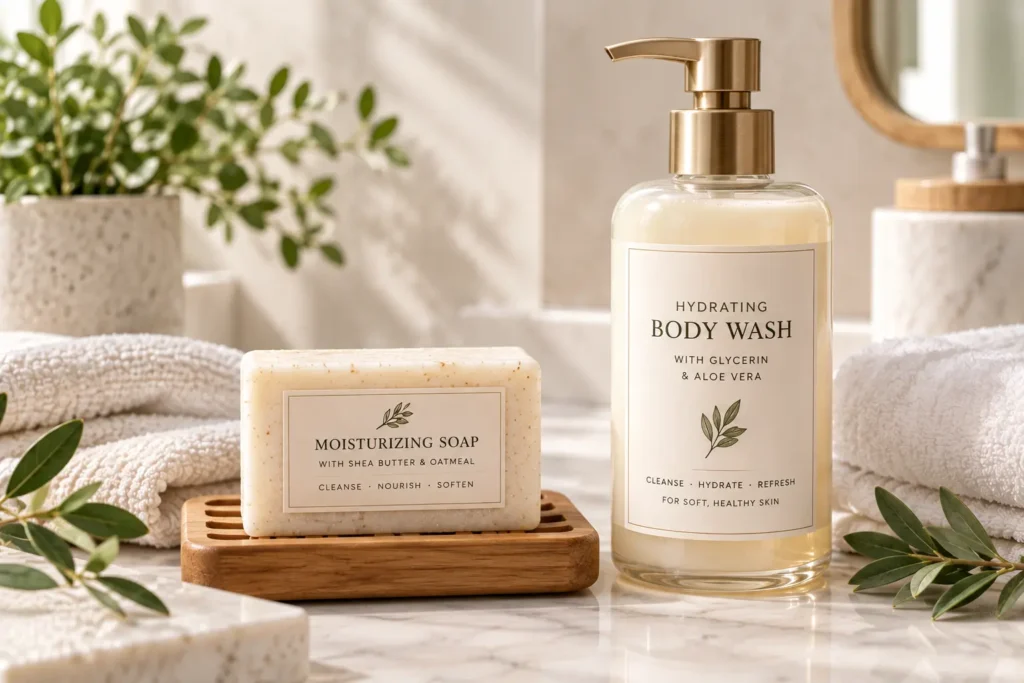
This is one of the most common questions people ask once they start paying attention to ingredients, and the honest answer is: it depends more on formulation than on format.
| Factor | Bar Soap (Syndet) | Liquid Body Wash |
|---|---|---|
| Typical pH | Can be formulated skin-neutral (syndet bars) or alkaline (true soap) | Usually formulated closer to the skin’s natural pH |
| Portability | Better for travel, no spill risk | Bulkier, but easier to dispense a controlled amount |
| Preservative load | Generally lower (less water content) | Higher, due to water-based formulas |
| Moisturizing additives | Can include emollients, but may separate over time | Easier to stabilize oils, ceramides, and humectants |
| Cost per use | Often more economical | Can be pricier depending on brand |
True bar soap (the kind made through saponification) tends to be more alkaline and drying, while syndet bars and most liquid body washes can be formulated at a skin-friendly pH.
The National Eczema Association notes that many sensitive-skin products with its Seal of Acceptance are soap-free by design, in both bar and liquid formats. In other words, the “bar vs. wash” debate matters far less than checking whether the specific product you’re using is labeled soap-free, fragrance-free, and pH-balanced.
How to Use a Moisturizing Soap the Right Way
Even the best-formulated soap can’t fully offset habits that work against your skin. The American Academy of Dermatology recommends keeping baths and showers to about five to ten minutes and using warm rather than hot water, since prolonged exposure and high temperatures can worsen dryness.
If swimming is part of your routine, chlorine exposure can add another source of dryness. Our post-swim skincare routine covers how to cleanse and moisturize after swimming without over-stripping the skin.
When to Apply Moisturizer After Showering
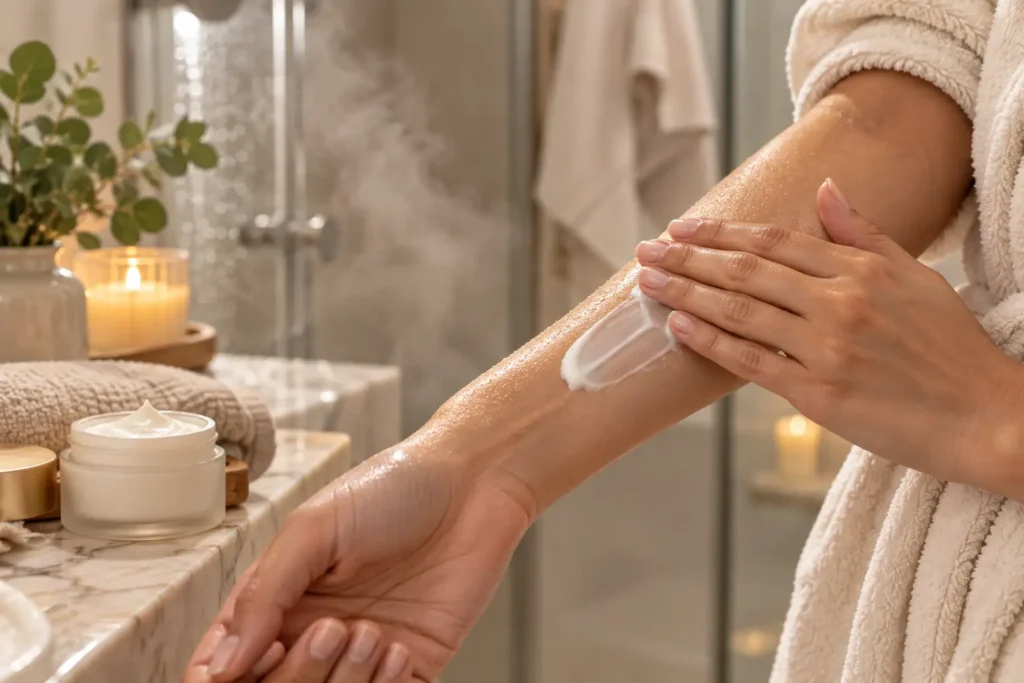
The timing matters less than the habit: apply moisturizer soon after bathing while your skin is still slightly damp. This helps trap water on the skin’s surface, and the American Academy of Dermatology recommends moisturizing within minutes of washing.
How Often Should You Use a Moisturizing Soap for Dry Skin?
Daily use of a gentle, moisturizing cleanser is appropriate for most people, as long as the formula is soap-free or low-alkaline and fragrance-free. If your skin is extremely dry, cracked, or eczema-prone, consider using cleanser only where you actually need it (underarms, groin, feet) and rinsing the rest of your body with warm water alone, a practice the AAD specifically recommends for very dry or damaged skin.
Other Habits That Matter
- Pat skin dry with a towel instead of rubbing, which can aggravate already-compromised skin.
- Keep the bathroom door closed during your shower to trap humidity.
- Consider a humidifier in dry climates or during winter months, when indoor heating significantly drops ambient humidity.
🔗 Building out a full seasonal routine? Check out our Winter Skincare Essentials guide for 2026 →
What Real People Say Works (Community Insights)
Clinical research explains why certain ingredients and cleansing approaches may help dry skin, while community discussions offer useful context about the products and routines people actually use.
Oil-based body washes come up repeatedly. In one Reddit discussion about body washes for dry skin, multiple commenters recommended oil-based or cleansing-oil products, including Bioderma Atoderm. Other commenters mentioned similar products from Avène and La Roche-Posay, particularly for very dry or eczema-prone skin.
These recommendations are based on personal experience rather than clinical comparisons, but they reflect a common preference for richer, less-stripping cleansers.
Gentle drugstore options are popular, too. Commenters recommended Dove Sensitive Skin body wash and bar, Aveeno body wash, and Cetaphil RestoraDerm. Several people described these products as gentle, moisturizing, or less likely to leave their skin feeling stripped. The discussion also shows that personal tolerance varies: the original poster specifically said Dove bars left their skin feeling dry.
Moisturizing after cleansing is another recurring theme. Several commenters described applying body lotion or oil after showering, often while the skin was still damp. One commenter said this combination made a noticeable difference for very dry skin, while others described using body lotion, mineral oil, or richer moisturizers as part of their routine.
Exfoliation is more personal. Some commenters preferred scrubs, exfoliating body washes, or alternating a nourishing cleanser with an exfoliating product. Others focused primarily on gentle, moisturizing cleansers. This is a useful reminder that a product that feels effective for one person’s dry skin may not be appropriate for someone whose skin is irritated or highly sensitive.
Community experiences don’t replace clinical evidence, and they can’t establish that one cleanser is objectively better than another. What they do show is how people with dry skin often approach the problem in practice: choosing a cleanser that doesn’t leave them feeling stripped, adjusting for seasonal dryness, considering price and availability, and following cleansing with moisturizer.
Special Considerations for Sensitive Skin Conditions
Best Soap for Eczema and Psoriasis-Prone Skin
For eczema and psoriasis, cleanser choice matters more because the skin barrier is already compromised. The AAD’s guidance for psoriasis specifically recommends using a gentle, moisture-rich cleanser and avoiding deodorant soaps or physical scrubs, which can trigger flares.
Products carrying the National Eczema Association Seal of Acceptance are a reliable shortcut, since they’ve been independently reviewed against a detailed list of excluded irritants and allergens.
Can a Soap Help Relieve Itchy, Dry Skin?
A soap alone won’t resolve chronic itch, but the right formula can meaningfully reduce it. Colloidal oatmeal and niacinamide-containing washes are the most evidence-supported options here, since both have documented anti-inflammatory and barrier-repair mechanisms rather than simply masking discomfort. If itching is persistent, worsening, or accompanied by broken skin, discuss it with a board-certified dermatologist rather than relying on over-the-counter products alone.
Is a Fragrance-Free Soap Really Better for Dry Skin?
For most people with dry or sensitive skin, yes. Fragrance is one of the most common triggers for allergic and irritant contact dermatitis, and it provides no cleansing or hydrating benefit. Products labeled “fragrance-free” don’t contain masking fragrance, whereas “unscented” products sometimes do, so read labels carefully rather than relying on marketing terms alone.
Conclusion: Best Moisturizing Soap for Dry Skin
The soap in your shower does more work than most people give it credit for, and if it’s formulated with harsh sulfates, a highly alkaline pH, and synthetic fragrance, it may be actively undoing what your moisturizer is trying to accomplish. The fix isn’t complicated: look for a soap-free or syndet formula built around glycerin, ceramides, colloidal oatmeal, or niacinamide, keep your showers warm rather than hot, and apply a rich moisturizer within a few minutes of stepping out.
None of this requires an expensive routine overhaul. Whether you choose a dermatologist favorite like CeraVe or Cetaphil, or a budget-friendly bar like Dove Sensitive Skin, the ingredient list matters more than the price tag. Start with one change this week, swap your current soap for a fragrance-free, glycerin- or ceramide-based formula, and give your skin a few weeks to show you the difference.
FAQ: Best Moisturizing Soap for Dry Skin
What is the best moisturizing soap for dry skin?
There isn’t a single universal answer, since “best” depends on skin sensitivity and budget, but formulas built around ceramides, glycerin, and colloidal oatmeal consistently perform well in clinical and dermatological literature. CeraVe Hydrating Cleansing Bar and Aveeno Skin Relief Body Wash are two well-studied, widely available options that prioritize barrier support over harsh cleansing.
What is the best soap for dry skin?
The best soap for dry skin is typically a soap-free (syndet) formula with a skin-compatible pH, free of sulfates and synthetic fragrance. Look for glycerin, shea butter, or ceramides near the top of the ingredient list. True alkaline soap, even “moisturizing” varieties, tends to disrupt the skin barrier more than syndet bars or gentle liquid washes.
What soap would hydrate my skin and not dry it out?
Choose a fragrance-free, soap-free cleanser with humectants like glycerin or hyaluronic acid, plus emollients such as shea butter or ceramides. These ingredients actively add moisture during cleansing rather than only removing oil. Avoid products listing sodium lauryl sulfate or sodium laureth sulfate near the top of the ingredient list, since these surfactants are known to strip protective skin lipids.
Which brand is best for dry skin?
No single brand is universally “best,” but dermatologists consistently recommend CeraVe, Cetaphil, Vanicream, and Aveeno for dry and sensitive skin because of their fragrance-free, barrier-supporting formulations. The right choice depends on your specific concerns, such as eczema, general dryness, or reactive, allergy-prone skin.
Which No. 1 soap is best for skin?
Rather than a single “No. 1” product, dermatologists generally point to a category: soap-free, fragrance-free, glycerin- or ceramide-based cleansers. Within that category, CeraVe Hydrating Cleansing Bar is frequently cited for its ceramide complex and dermatologist-developed formula, making it a strong default recommendation for most dry-skin types.
Is body wash better than soap for dry skin?
Neither format is inherently better; formulation matters more than whether it’s a bar or a liquid. Syndet bars can be just as pH-balanced and gentle as liquid body washes. Choose based on ingredients (soap-free, fragrance-free, humectant-rich) and personal preference for texture and application rather than assuming liquid body wash is automatically gentler.
Can I use a soap for dry skin every day?
Yes, daily use of a gentle, soap-free cleanser is appropriate for most people and is recommended by the American Academy of Dermatology. For very dry or eczema-prone skin, consider limiting cleanser to areas that need it most, like underarms and feet, and rinsing the rest of your body with warm water alone.
What ingredients should I avoid in a soap for dry skin?
Avoid sodium lauryl sulfate (SLS) and sodium laureth sulfate (SLES), synthetic fragrance or parfum, and drying alcohols like SD alcohol or denatured alcohol. These ingredients are linked to stripped skin lipids, increased transepidermal water loss, and higher rates of irritant or allergic contact dermatitis, especially with daily use.
Can a soap help relieve itchy dry skin?
A well-formulated soap can help reduce itch when it contains colloidal oatmeal or niacinamide, both of which have documented anti-inflammatory and barrier-repair effects. However, soap alone won’t resolve chronic or severe itching. Persistent itch, especially with broken or bleeding skin, warrants an evaluation from a board-certified dermatologist.
Is a fragrance-free soap better for dry skin?
For most people with dry or sensitive skin, yes. Fragrance is one of the most common triggers of allergic and irritant contact dermatitis and offers no cleansing or hydrating benefit. Look specifically for “fragrance-free” rather than “unscented,” since unscented products can still contain masking fragrance ingredients that may trigger reactions.

About Subhan Usafzai
Evidence-Based Skincare Educator & Formulation Specialist
I'm Subhan Usafzai (Fazli Subhan), an Evidence-Based Skincare Educator and Formulation Specialist. My background includes first-hand experience as a technician and research support in skin departments across tertiary military hospitals since 2006, and since 2008 I've focused on researching and translating clinical and formulation science into practical, evidence-based guidance. My formal training includes Coursera's Introduction to Cosmetic and Skincare Science and the four-course Introduction to Cosmetic Science and Ingredients specialization (Cosmetic Formulation Science, Cosmetic Product Development, and Quality Control and Regulatory in Cosmetic Science), authorized by Olay. Every article I write is checked against current research and reviewed by our medical team before publishing.
✅ Medically reviewed by Dr. Muhammad Khurram Ahmad, MD, Board-Certified Dermatologist · 📅 Last updated: October 2026
Medical Disclaimer
For Educational Purposes Only: This article is written by Subhan Usafzai, an Evidence-Based Skincare Educator and Formulation Specialist, for educational and informational purposes only. The information draws on scientific research, peer-reviewed studies, and dermatological literature available as of October 2026.
Not Medical Advice: This content does not constitute medical advice, diagnosis, or treatment. It is not a substitute for consultation with a qualified healthcare professional or dermatologist.
Individual Results May Vary: Skin conditions and responses to skincare products vary according to individual characteristics, skin type, hormonal factors, and environmental exposure.
Consult Your Healthcare Provider: Seek professional guidance before changing your skincare regimen, particularly during pregnancy or breastfeeding, or if you have a diagnosed skin condition, take medication, have sensitive skin, or receive dermatological treatment.
Product Safety: Consider patch testing new products. Discontinue use if irritation or an adverse reaction occurs, and seek medical advice when needed.
Affiliate Disclosure
Amazon Associates Disclosure: As an Amazon Associate I earn from qualifying purchases.
Editorial Independence: Affiliate relationships do not determine our product reviews or recommendations. We aim to provide balanced, research-informed information to help readers make informed skincare choices.
Supporting Glow Guide Hub: Qualifying purchases through affiliate links may earn us a commission at no additional cost to you.