

How Does Retinol Work at Cellular Level in 2026? Science-Backed Guide
“Retinoids remain the gold standard in anti-aging skincare”—a claim backed by decades of dermatological research. But how does retinol work at the cellular level exactly?
This is where the science becomes particularly compelling.
Retinol doesn’t just sit on your skin—it communicates with your cells, rewires their behavior, and accelerates biological processes that slow down with age. From boosting collagen production to normalizing keratinization, its effects are deeply rooted in skin biology.
In this guide, I’ll break it all down—simply, clearly, and backed by science—so you understand not just what retinol does, but how it transforms your skin from within.
What Is Retinol? Understanding Its Biological Classification
Is retinol a vitamin or an active drug?
Retinol belongs to the vitamin A family, a group of fat-soluble compounds essential for vision, immune defense, and skin cell turnover. In topical skincare, it falls within the broader category of retinoids, which includes over-the-counter forms (such as retinol and retinyl esters) and prescription options (such as tretinoin).
From a regulatory standpoint, the U.S. FDA does not classify retinol as a drug when sold over the counter. However, from a biological standpoint, it behaves differently from a typical nutrient.
Once applied to the skin, retinol is enzymatically converted to retinoic acid, the active form that binds to nuclear receptors (RARs and RXRs) in skin cells. This interaction directly influences gene expression—affecting collagen production, cell turnover, and keratinization. Because of this receptor-driven activity, retinol functions more like a topical bioactive agent than a simple vitamin.
According to research published in Advances in Dermatology and Allergology, Vitamin A derivatives (retinoids) are among the most studied compounds in dermatology, with evidence spanning more than four decades of clinical and molecular research.
How is retinol converted inside the skin?
Retinol does not exert its effects immediately upon application; it must first undergo a controlled biochemical conversion within the skin.
This process takes place primarily in keratinocytes (the main cells of the epidermis) and involves two sequential enzymatic steps mediated by retinol dehydrogenases and aldehyde dehydrogenases:
Conversion pathway:
Retinol → Retinaldehyde → Retinoic Acid
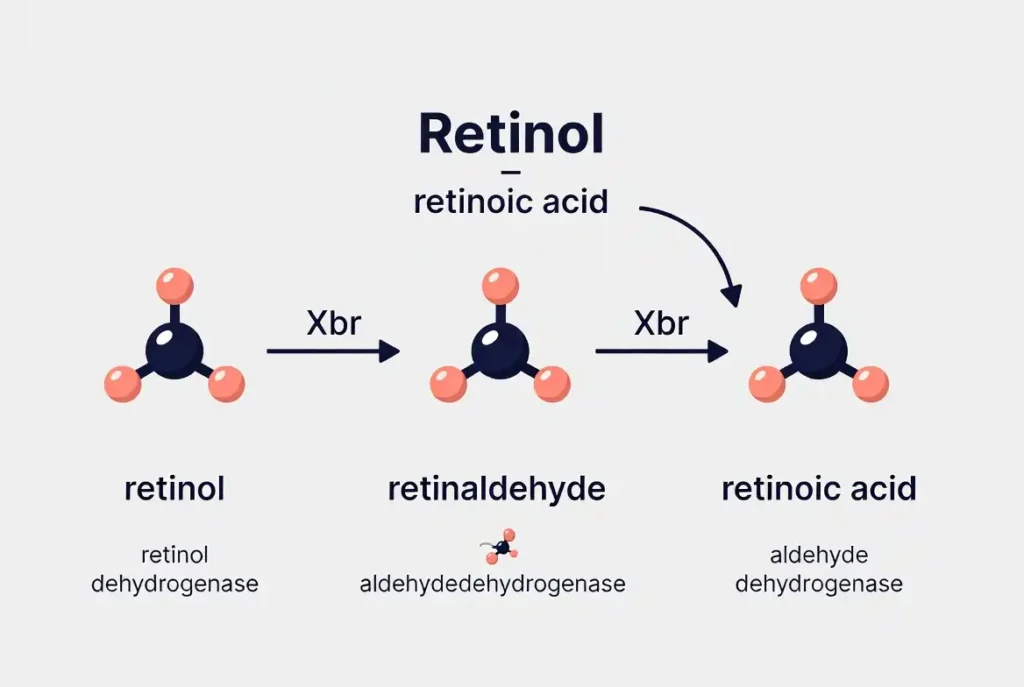
Only retinoic acid is the biologically active form that binds to nuclear receptors (RARs and RXRs) and regulates gene expression. In this context, retinol functions as a precursor molecule that requires in-skin activation before exerting its effects.
This conversion mechanism explains several clinically observed differences between retinol and prescription retinoids:
- Delayed visible results: The stepwise conversion slows the availability of retinoic acid, so improvements typically appear after several weeks
- Faster action of tretinoin: Prescription tretinoin is already in the retinoic acid form, bypassing the need for enzymatic conversion
- Lower irritation potential: Gradual formation of retinoic acid reduces the intensity of skin turnover, making over-the-counter retinol generally better tolerated
In practical terms, the controlled conversion of retinol yields a slower, more measured release of active retinoic acid—balancing efficacy and tolerability to support long-term skincare use.
Why is retinol considered a “cell-communicating ingredient”?
Retinol is often described as a cell-communicating ingredient because of its influence on cellular behavior at the genetic level.
Once converted into retinoic acid, its active form, it penetrates into the cell nucleus rather than remaining on the skin’s surface. There, it binds to specific nuclear receptors known as Retinoic Acid Receptors (RARs) and Retinoid X Receptors (RXRs).
These receptor complexes bind to specific DNA regions and function as transcription factors, regulating the expression of genes involved in critical skin processes such as collagen synthesis, cell turnover, and keratinization.
This mechanism is well-documented in dermatological research. As explained in a peer-reviewed review by Zasada and Budzisz (2019), retinoids directly influence the formation of skin structure by modulating gene activity at the molecular level.
In practical terms, this means retinol does more than produce surface-level changes—it helps guide how skin cells function, repair, and renew over time.
How Does Retinol Work at the Cellular Level? (Core Mechanism)

What happens when retinol enters skin cells?
When you apply retinol to your skin, it’s absorbed through the stratum corneum (the outermost layer) and taken up by keratinocytes in the epidermis. Inside these cells, it binds to cellular retinol-binding proteins (CRBPs), which escort it to enzymes that convert it.
The process isn’t instantaneous, and not all retinol is converted successfully. A significant portion gets oxidized or excreted before it ever reaches the active retinoic acid form. This inefficiency is why consistency matters far more than occasional use of a high concentration.
Once retinoic acid forms, it binds to intracellular retinoic acid-binding proteins (CRABP-II) and is delivered into the cell nucleus — where the real action begins.
How does retinol affect gene expression?
Genes upregulated (turned on) include:
- Procollagen I and III genes — new collagen synthesis
- Involucrin and loricrin — skin barrier proteins
- Hyaluronan synthase genes — your skin’s own hyaluronic acid production
Genes downregulated (turned off) include:
- MMP-1, MMP-3, MMP-9 — collagen-degrading enzymes
- AP-1 transcription factors — overactivated by UV and associated with skin aging
How does retinol increase cell turnover?
How does retinol stimulate collagen production?
Retinol and Skin Renewal: What Changes Over Time?
What happens in the first 7–28 days?
How does retinol improve texture and tone?
How does retinol reduce wrinkles long-term?
Retinol for Acne: Cellular-Level Benefits
How does retinol unclog pores?
Does retinol reduce oil production?
How does it reduce inflammation?
Why Retinol Can Irritate Skin (Cellular Explanation)
Why does retinol cause peeling and dryness?
What is “retinization”?
How can you minimize irritation?
Smart protocols dramatically ease retinization:
- Buffer first: moisturizer, then retinol (slows penetration).
- Start slow: 1–2 nights weekly, build gradually.
- Seal immediately with a ceramide or niacinamide moisturizer on top.
- SPF daily: retinol exposes newer cells to UV.
The same NCBI source notes that these buffering and gradual-introduction strategies greatly improve tolerance and reduce discontinuation rates. Consistency always wins over intensity.
Sunscreen, always: Retinol increases photosensitivity by exposing fresher cells. Skipping SPF during retinol use is genuinely counterproductive.
To read more about sun protection in detail, read this guide.
How to Use Retinol Safely for Maximum Cellular Benefits
What is the correct retinol concentration for beginners?
What is the 1/2/3 rule for retinol?
The 1/2/3 rule is a proven week-by-week protocol that lets your skin’s retinol-metabolizing enzymes and barrier proteins adapt safely:
- Week 1: Apply once per week
- Week 2: Apply twice per week
- Week 3: Apply three times per week
Can you use retinol every day?
What ingredients should you avoid mixing with retinol?
Certain pairings cancel benefits or amplify irritation — separate them to preserve retinol’s cellular power:
- AHAs and BHAs (same routine): double exfoliation strips lipids and weakens the barrier.
- Benzoyl peroxide: oxidizes and deactivates retinol — use in the morning.
- Pure L-ascorbic acid Vitamin C: pH conflict reduces both actives’ potency. Apply retinol at night and the others in the morning, or on alternate days. This simple timing strategy keeps irritation low and results high.
Retinol vs Tretinoin: Cellular-Level Differences
Retinol vs Tretinoin: Which works faster at the cellular level?
Why is tretinoin prescription-only in some regions?
In countries like the US, this level of potency is classified as requiring a physician’s oversight.
Retinol’s slower conversion naturally limits its maximum effective concentration, which is why it remains safely available OTC.
Why did Europe regulate tretinoin use?
What Results Can You Expect? (Realistic Timeline)
When do you start seeing results?
What improvements are permanent vs temporary?
Does retinol stop working over time?
Conclusion
Frequently Asked Questions
How Does Retinol Work On A Cellular Level?
Retinol penetrates the skin and is converted into retinoic acid inside cells. This active form binds to the nuclear receptors RAR and RXR, triggering changes in gene transcription. The process boosts cell turnover, enhances collagen synthesis, and suppresses collagen-degrading enzymes. These cellular modifications lead to improved skin structure and reduced signs of aging. Backed by decades of research, this mechanism makes retinol highly effective for long-term skin rejuvenation when used correctly.
What Does Retinol Do To Your Skin?
Retinol delivers multiple benefits by accelerating skin cell turnover to reveal fresher layers, stimulating collagen production for a firmer texture, normalizing keratinization of the pores to prevent clogging, and dispersing melanin for an even tone. Over months of use, it visibly reduces fine lines, improves density, and enhances overall radiance. These combined effects make retinol a powerful tool for addressing signs of aging, acne, and uneven pigmentation across various skin types.
Is It Okay To Use Retinol Every Day?
Yes, daily retinol use becomes safe once your skin builds tolerance through gradual introduction. Start with two or three applications per week for the first month, then increase frequency slowly. This prevents irritation and helps strengthen the skin barrier. With proper moisturizing and sunscreen, most users successfully tolerate nightly application, reaping maximum anti-aging benefits without discomfort. Always listen to your skin signals during the process.
What Is The 1/2/3 Rule For Retinol?
The 1/2/3 rule involves using retinol once in the first week, twice in the second week, and three times in the third week. This phased approach helps your skin adapt by upregulating metabolic enzymes and repairing its barrier between sessions. It minimizes redness, dryness, and peeling commonly associated with sudden introduction. Following this method lays the foundation for safe, long-term daily use and improved overall tolerance.
Why Do People Say Not To Use Retinol?
People warn against retinol due to its frequent misuse, which can cause irritation, dryness, flaking, and increased sun sensitivity. Without gradual buildup and sun protection, it can significantly damage the skin barrier. However, when introduced slowly with supportive hydration and SPF, retinol proves beneficial for most skin types. The caution stems from common beginner errors rather than the ingredient itself being inherently problematic.
Is 40 Too Late To Start Retinol?
Absolutely not; starting retinol at 40 or later offers excellent benefits for mature skin. It continues to stimulate collagen production, accelerate cell renewal, and improve pigmentation regardless of age. Studies demonstrate increased dermal thickness and reduced wrinkles even in older adults. Many users over 40 notice firmer skin and fewer lines with consistent use, proving it’s never too late to start an effective anti-aging routine.
Can I Use Cosrx Snail Mucin With Retinol?
Yes, pairing Cosrx snail mucin with retinol is highly recommended and complementary. The mucin provides growth factors, glycoproteins, and natural hyaluronic acid that hydrate deeply and repair the barrier damaged by retinol’s exfoliation. This combination reduces dryness and irritation while enhancing overall results. Apply snail mucin after retinol or on off-nights to soothe and support recovery for smoother, healthier skin.
What Cannot Mix With Retinol?
You should avoid mixing retinol with certain actives to prevent excessive irritation and reduced effectiveness. Key incompatibles include strong exfoliants like AHAs and BHAs, which intensify peeling; benzoyl peroxide, which can oxidize and weaken results; and high-strength vitamin C applied simultaneously. Instead, use these on alternate days or at different times of day. Proper separation maintains skin barrier health and safely maximizes retinol benefits.
Why Did Europe Ban Tretinoin?
Europe has not banned tretinoin outright, but it is subject to strict safety regulations. The EU’s SCCS evaluated cosmetic retinoids in 2023 and imposed limits on over-the-counter retinol concentrations. Prescription tretinoin requires doctor supervision due to its potency, potential systemic absorption, and risks like birth defects. These measures protect consumers while allowing medical use under guidance. Misinformation often confuses regulation with a full ban.

About Subhan Usafzai
Skincare Writer, Researcher & Formulation Specialist
Welcome to my skincare blog! I'm Subhan Usafzai, a passionate skincare enthusiast with over 18 years of experience exploring and learning about all things skin. Join me as I share my tried-and-true tips, product insights, and skincare wisdom.
✅ Medically reviewed by Dr. KhurramKhan, MD, Board-Certified Dermatologist · 📅 Last updated: May 2026
📋 Medical Disclaimer
For Educational Purposes Only: This article is written by Subhan Usafzai, a Medical Writer and Researcher, and is intended for informational and educational purposes only. The content provided is based on scientific research, peer-reviewed studies, and dermatological literature available as of December 2025.
Not Medical Advice: The information in this article does not constitute medical advice, diagnosis, or treatment recommendations. It should not be used as a substitute for professional medical consultation, diagnosis, or treatment from a board-certified dermatologist or qualified healthcare provider.
Individual Results May Vary: Skin conditions, including hyperpigmentation, melasma, and UV-induced pigmentation, vary significantly between individuals based on genetics, skin type, hormonal factors, and environmental exposure.
Consult Your Healthcare Provider: Before starting any new skincare regimen, especially if you are pregnant, breastfeeding, have diagnosed skin conditions, are taking medications, have sensitive skin, or are undergoing dermatological treatments.
Product Safety: Always perform a patch test before using new skincare products. Discontinue use and consult a healthcare professional if you experience irritation or adverse reactions.