
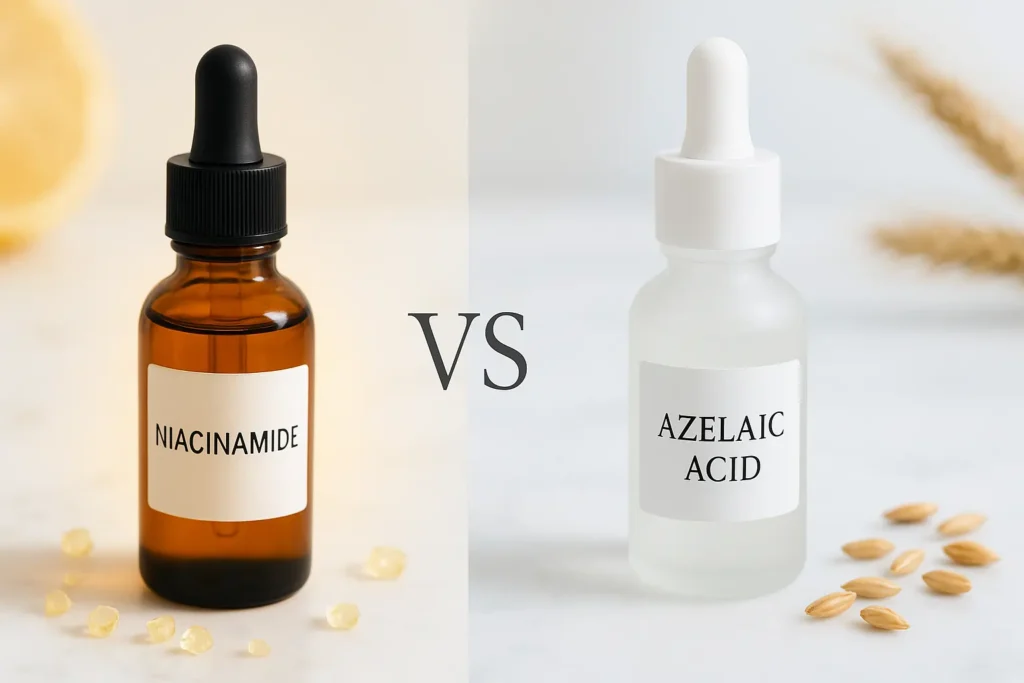
Niacinamide vs Azelaic Acid for Acne: Which Works Best?
If you’re researching niacinamide vs azelaic acid for acne, you’ve probably already tried dozens of products that promised miracles and delivered disappointment. Here’s the uncomfortable truth: neither ingredient is a magic solution—but understanding how they work can finally give you the clear skin you’ve been chasing.
After 18 years formulating skincare products and analyzing clinical research, I’m going to cut through the marketing BS and show you exactly when to use niacinamide, when to choose azelaic acid, and why combining both might be your best strategy.
No fluff. No product pushing. Just evidence-based science that actually works.

Quick Comparison: Niacinamide vs Azelaic Acid at a Glance
| Feature | Niacinamide | Azelaic Acid |
|---|---|---|
| Type | Vitamin B3 (water-soluble) | Dicarboxylic acid |
| Best For | Oil control, prevention, barrier repair | Active acne, stubborn pigmentation, and rosacea |
| Strength | Gentle (5–10% optimal) | Moderate (10–20%) |
| Irritation Risk | Very low | Low to moderate (initial tingling familiar) |
| Results Timeline | 4–8 weeks | 4–6 weeks (acne), 8–12 weeks (pigmentation) |
| Can they Use Together? | YES – Highly compatible and synergistic | YES – Highly compatible and synergistic |
| Pregnancy Safe? | Yes (consult doctor) | Category B (consult doctor) |
| Price Range | $8–$30 | $12–$50 |
Quick Answer: Choose niacinamide for gentle prevention and oil control. Choose azelaic acid for stubborn active acne and severe hyperpigmentation. Use both together for comprehensive treatment covering multiple concerns.
What Is Niacinamide and How Does It Work for Acne?
Here’s something most people don’t realize: your skin already produces niacinamide naturally. It’s a form of vitamin B3 that your body creates from the foods you eat. But when acne strikes, your skin needs reinforcements.
What’s Niacinamide (Vitamin B3)?
Niacinamide is a water-soluble form of vitamin B3 that your skin already produces naturally from the foods you eat. Think of it as your skin’s multitasking best friend—a gentle powerhouse that works behind the scenes without the harsh side effects of traditional acne treatments.
What makes it special? It’s remarkably stable (won’t degrade in your bathroom cabinet) and plays well with almost every other skincare ingredient you own. Unlike aggressive treatments that strip your skin bare, niacinamide strengthens your skin while treating acne.
What makes niacinamide special for acne-prone skin:
- Works effectively at 5-10% concentration (sweet spot for acne treatment)
- Non-irritating enough for sensitive skin types
- Available in lightweight serums, moisturizers, and even cleansers
- Doesn’t require a prescription or a visit to a dermatologist
- Safe for long-term daily use without building tolerance
I’ve formulated countless products during my training in Cosmetic Product Development, and niacinamide consistently stands out for its reliability. It doesn’t demand special pH adjustments or complex stabilization—it just works.
The Science Behind Niacinamide’s Acne-Fighting Power
Let me explain what’s happening beneath your skin’s surface. When you apply niacinamide, it gets to work on multiple acne triggers simultaneously. It’s not just treating symptoms; it’s addressing root causes.
How niacinamide tackles acne at the cellular level:
- Regulates sebum production without completely shutting down your oil glands (you need some oil for healthy skin)
- Reduces inflammation by inhibiting inflammatory mediators that cause those angry red bumps
- Strengthens your skin barrier by boosting ceramide synthesis—think of it as rebuilding your skin’s protective wall
- Prevents melanin transfer, which stops those frustrating dark spots before they fully form
- Supports immune function, helping your skin defend itself against environmental stressors
Research from the National Institutes of Health confirms what I’ve seen in practice: niacinamide effectively reduces both inflammatory acne (those painful cysts) and non-inflammatory lesions (blackheads and whiteheads). The study tracked patients using 4% niacinamide for eight weeks—60% saw significant improvement.
But here’s where it gets interesting. Niacinamide doesn’t just fight acne; it improves your overall skin health. During my 18 years working with patients facing hyperpigmentation and chronic dryness, I’ve watched niacinamide transform not just their acne but their entire complexion.
Key Benefits of Niacinamide for Acne-Prone Skin
You know that midday shine you’re constantly blotting away? Niacinamide can help.

Why dermatologists consistently recommend this ingredient:
- Oil control that actually makes sense—it normalizes production rather than stripping everything away
- Pore minimization over time (they don’t physically shrink, but appear smaller as they clear out)
- Post-acne dark spot fading without the irritation of harsher brightening agents.
- Redness reduction that calms angry, inflamed skin
- Texture improvement leading to smoother, more even skin tone
- Zero photosensitivity—wear it morning, noon, or night without worry
A 2021 study published on PubMed combined 5% niacinamide with benzoyl peroxide for mild to moderate acne. The results? Participants saw enhanced improvement compared to either ingredient alone, with better tolerance and fewer side effects.
Who Should Use Niacinamide for Acne?
Not every ingredient works for every person. That’s just reality. But niacinamide comes pretty close to universal compatibility.
Ideal candidates for niacinamide:
- Oily and combination skin types (it’s your new best friend)
- Sensitive skin that can’t handle retinoids or strong acids
- Anyone dealing with post-inflammatory hyperpigmentation
- First-time active ingredient users who need something gentle
- Dry skin types needing oil regulation without harsh stripping
I typically recommend niacinamide to patients who want prevention-focused skincare. It’s not the fastest acne fighter—that crown goes to azelaic acid—but it’s the most balanced. You’re building long-term skin health, not just clearing current breakouts.
Want to understand how niacinamide fits into a complete anti-aging strategy? Check out our comprehensive guide to anti-aging prevention in your 20s, where niacinamide plays a starring role.
What Is Azelaic Acid and How Does It Treat Acne?
Now let’s talk about the ingredient that doesn’t mess around. Azelaic acid is what I reach for when someone says, “I’ve tried gentle approaches and my acne just laughs at me.”
Understanding Azelaic Acid as an Acne Treatment
Azelaic acid sounds synthetic and scary, but it’s actually naturally occurring in grains like wheat, rye, and barley. Your skin even produces it naturally through healthy yeast. The FDA approved it back in 2002 for treating acne and rosacea—that’s over two decades of proven clinical use.
What you need to know about azelaic acid:
- Dicarboxylic acid with antibacterial and anti-inflammatory properties
- Available in 10% (over-the-counter) and 15-20% (prescription) strengths
- Found in gel, cream, and serum formulations
- Gentler than many exfoliating acids despite its power
- Multitasks better than most ingredients in your medicine cabinet
Here’s something from my Cosmetic Formulation Science training: azelaic acid is tricky to formulate. It’s not highly soluble, which is why you’ll often find it in cream bases rather than lightweight serums. But when formulated correctly? It’s absolutely worth the heavier texture.
The Mechanism: How Azelaic Acid Fights Acne
Unlike niacinamide’s gentle approach, azelaic acid goes straight for the problem. It doesn’t just manage acne—it actively destroys the bacteria causing it.
Azelaic acid’s multi-pronged attack on breakouts:
- Antibacterial action that targets C. acnes (the main culprit behind inflammatory acne)
- Reduces keratin buildup that clogs your pores in the first place
- Mild exfoliation that unclogs existing blockages and prevents new ones
- Anti-inflammatory properties to calm the redness and swelling
- Tyrosinase inhibition, which stops melanin production and fades dark spots
Research published in Clinical, Cosmetic and Investigational Dermatology confirms azelaic acid’s effectiveness against both inflammatory and non-inflammatory acne lesions. The study highlights its unique ability to normalize keratinization—basically, it stops your pores from getting clogged in the first place.
Wait, there’s more to this story. Azelaic acid doesn’t just treat acne. During my years working with patients dealing with both acne and rosacea (a frustrating combination), I’ve watched azelaic acid handle both conditions simultaneously. Few ingredients can claim that versatility.
Top Benefits of Azelaic Acid for Acne-Prone Skin
Let’s be honest—some acne won’t respond to gentle treatments. That’s where azelaic acid earns its reputation.
Why this ingredient deserves serious consideration:
- Targets bacteria directly at the source of infection
- Reduces stubborn post-acne marks more aggressively than niacinamide
- Treats acne and rosacea in one step (efficiency at its finest)
- Safe for sensitive skin despite its power
- Addresses melasma and sun damage as bonus benefits
- Normalizes cell turnover inside your follicles to prevent future clogs
A clinical study in the Indian Journal of Dermatology, Venereology and Leprology tracked patients using 20% azelaic acid gel. The results were impressive: a 65.2% reduction in acne severity index over 12 weeks. Patients also reported high satisfaction with the reduction in post-inflammatory hyperpigmentation.
Who Should Choose Azelaic Acid for Acne?
This ingredient isn’t for everyone—but when it’s right for your skin, it’s really right.
Best suited for:
- Active, persistent acne that won’t quit
- Combination acne and rosacea sufferers
- Severe post-inflammatory hyperpigmentation
- Those who can’t tolerate retinoids
- Stubborn blackheads and comedones
- Anyone needing antimicrobial action
I’ve found that patients who’ve “tried everything” often haven’t tried azelaic acid. It sits in this interesting space—stronger than niacinamide, gentler than retinoids, but powerful enough to deliver real results.
Niacinamide vs Azelaic Acid: Direct Comparison for Acne
Alright, here’s what you’ve been waiting for. Let’s put these ingredients head-to-head and see who wins each round. Spoiler: there’s no single winner—just different champions for different skin needs.
Effectiveness for Active Acne Breakouts
When you’ve got angry, inflamed breakouts demanding attention right now, which ingredient comes through?
Niacinamide’s approach: Prevention and management. It reduces inflammation and regulates oil production, which means fewer new breakouts form—but killing existing bacteria? Not its strength.
Azelaic acid’s approach: Direct assault. It destroys C. acnes bacteria, unclogs pores aggressively, and reduces inflammation simultaneously. For active breakouts, it’s the heavier hitter.
The verdict: Azelaic acid takes this round for stubborn, active acne. A Cochrane systematic review found 15% azelaic acid comparable to 5% benzoyl peroxide—but with significantly fewer side effects. That’s impressive.
Treating Post-Acne Dark Spots and Hyperpigmentation
Those dark spots that linger months after the pimple’s gone? Both ingredients tackle them, just differently.
Niacinamide: Prevents melanin from transferring to skin cells and brightens overall tone gradually. It’s the patient, steady approach that improves your entire complexion.
Azelaic acid: Inhibits the tyrosinase enzyme that creates melanin in the first place. More aggressive on stubborn, concentrated dark spots.
The verdict: It’s honestly a tie—Niacinamide for prevention and overall brightening, azelaic acid for targeted dark spot fading. In my practice, I’ve seen the best results when patients use both ingredients together for comprehensive hyperpigmentation treatment.
For a deeper dive into tackling stubborn dark spots, explore our complete guide to the best ingredients for hyperpigmentation, where both niacinamide and azelaic acid feature prominently alongside retinol and vitamin C.
Oil Control and Pore Management
If your T-zone looks like an oil slick by noon, this matters.
Niacinamide: Directly regulates sebaceous gland activity without disrupting your skin’s natural moisture balance. Studies show it can reduce sebum production by up to 30%.
Azelaic acid: Normalizes keratinization to prevent pore blockages but doesn’t directly control oil production.
The verdict: Niacinamide wins this round. For oily and combination skin types, it’s the superior choice for managing that midday shine.
Gentleness and Tolerability for Sensitive Skin
Because what good is an effective treatment if your skin can’t handle it?
Niacinamide: Extremely low irritation potential. I’ve prescribed it to patients with compromised skin barriers, eczema-prone skin, and even those recovering from aggressive treatments. It’s the gentle giant of acne ingredients.
Azelaic acid: Generally well-tolerated but can cause temporary tingling, stinging, or mild burning—especially during the first few weeks. Some patients describe it as a “prickly” sensation that fades as skin adjusts.
The verdict: Niacinamide is gentler, particularly for beginners and sensitive skin types. But don’t let azelaic acid’s initial tingle scare you off—most people adapt within 2-3 weeks.
Speed of Results
Patience is a virtue, but we all want to see improvements yesterday.
Niacinamide: Visible oil control within 2-4 weeks. Acne reduction becomes noticeable around the 4-8 week mark. Dark spot fading takes 8-12 weeks.
Azelaic acid: Active acne improvements in 4-6 weeks. Pigmentation fading requires 2-3 months of consistent use.
The verdict: Similar timelines. Both require patience and consistency—no magic overnight fixes here.
For more on hyperpigmentation, please read our complete guide here.
Can You Use Niacinamide and Azelaic Acid Together?
Yes, you can safely use niacinamide and azelaic acid together—they actually work synergistically. Niacinamide strengthens the skin barrier, balances sebum production, and soothes redness, while azelaic acid targets acne, pigmentation, and uneven skin tone.
When layered correctly, they enhance each other’s results, promoting a smoother, clearer, and brighter complexion without irritation or ingredient conflict.
Why this combination works beautifully:
- Attack acne from multiple angles simultaneously
- pH compatibility (both work near the skin’s natural pH of 4.5-5.5)
- Enhanced results without increased irritation
- Comprehensive treatment covering prevention, active treatment, and healing
- Different mechanisms mean no redundancy
Dermatology experts at Foundation Skincare explicitly recommend combining both for maximum acne-fighting and skin-brightening benefits. During my training in Quality Control & Regulatory Standards, I learned that ingredient compatibility depends on pH, stability, and mechanism—these two check all boxes.
🎁 Get Your FREE Acne Ingredient Cheat Sheet
Compare niacinamide, azelaic acid, retinol, benzoyl peroxide & salicylic acid—plus get a routine builder template.
Join 10,000+ readers getting science-backed skincare tips every week. Unsubscribe anytime.
How to Layer Niacinamide and Azelaic Acid Correctly
Okay, but in what order? This question keeps skincare enthusiasts up at night.

The proper layering sequence:
- Step 1: Apply the thinnest consistency first (usually niacinamide serum)
- Step 2: Wait 1-2 minutes for absorption
- Step 3: Apply a thicker consistency second (typically azelaic acid cream)
- Step 4: Follow with moisturizer if needed
- Step 5: Morning routine requires SPF 30+ as the final step
Research from Seoul Ceuticals confirms these ingredients are chemically compatible and can be layered in the same routine without neutralization or adverse reactions.
Can you use both morning and evening? Absolutely. I personally prefer one in the morning (niacinamide) and one at night (azelaic acid) to simplify my routine, but layering both twice daily is perfectly safe for most skin types.
Discover the step-by-step nighttime routine that transformed my patients’ skin.
Starting Slowly: Introduction Protocol
Don’t dump both ingredients on your face tomorrow if you’ve never used either. Your skin needs an adjustment period.
Safe introduction strategy:
- Week 1-4: Introduce niacinamide alone, starting every other day
- Week 5-8: Add azelaic acid once skin tolerates niacinamide well
- Week 9+: Gradually increase to daily use if tolerated
- Always patch test both products on your jawline first
- Monitor for persistent redness, dryness, or irritation
I can’t stress this enough: slow and steady wins the skincare race. I’ve seen too many enthusiastic patients rush the process, damage their skin barrier, and then abandon perfect ingredients because they pushed too hard, too fast.
When NOT to Combine Niacinamide and Azelaic Acid?
Yes, there are exceptions to every rule. While this combination is generally well-tolerated and highly beneficial, paying close attention to your skin’s immediate condition is crucial.
Situations requiring separation:
- Extremely sensitive or compromised skin barriers
- Simultaneously introducing retinoids or other potent actives
- Active skin infections, cold sores, or open wounds
- Excessive dryness, flaking, or irritation from either ingredient
- Your skin tells you it’s too much (listen to it!)
If you experience burning that doesn’t subside after 10 minutes, persistent redness, or increased breakouts lasting more than two weeks, separate the ingredients. Use them on alternating days instead of layering.
Azelaic acid is particularly effective for rosacea-related acne. Learn more about sun protection strategies for rosacea-prone skin to maximize your results.
Side Effects and Safety Considerations
Let’s talk about what can go wrong—because pretending everything’s perfect helps nobody.
Niacinamide Side Effects and Precautions
Niacinamide is remarkably safe, but nothing’s risk-free.
Potential issues to watch for:
- Mild burning sensation on compromised skin barriers (rare)
- Facial flushing in concentrations above 10% (very rare)
- Allergic reactions in those sensitive to vitamin B3 (extremely rare)
- Initial breakouts if the product contains comedogenic ingredients (unrelated to niacinamide itself)
Safety profile:
- Safe during pregnancy and breastfeeding (always consult your doctor)
- No photosensitivity—wear it anytime
- No drug interactions with topical or oral acne medications
- Suitable for long-term daily use without building tolerance
In 18 years of practice, I’ve encountered maybe five patients who couldn’t tolerate niacinamide. It’s that safe.
Azelaic Acid Side Effects and Safety
This is where things get slightly more complicated—but still manageable.
Common initial reactions (usually temporary):
- Tingling or stinging sensation (60-70% of users initially)
- Mild itching or warmth (30-40% of users)
- Temporary dryness or light peeling (20-30% of users)
- Slight redness immediately after application (normal)
These typically resolve within 2-4 weeks as skin adjusts.
Safety considerations:
- Generally safe during pregnancy (Category B), but consult your obstetrician
- Requires consistent sunscreen use due to increased cell turnover
- Can interact with retinoids—start slowly if using both
- May cause temporary hypopigmentation on very dark skin (rare)
Research published in PubMed confirms that azelaic acid has significantly fewer side effects than benzoyl peroxide or tretinoin, with comparable efficacy. That’s a winning combination in my book.
Who Should Avoid These Ingredients?
Most people tolerate both beautifully, but there are exceptions.
Niacinamide cautions:
- Known allergy to niacin or vitamin B3
- Liver disease (high oral doses only; topical is fine)
- Active dermatitis or eczema flare-ups (wait for healing)
Azelaic acid cautions:
- Broken or abraded skin
- Active eczema or severe rosacea flares
- Known sensitivity to propylene glycol (common in formulations)
If you have cystic acne, deep nodules, or scarring, both ingredients can help—but you might need additional prescription treatments. Don’t try to self-treat severe acne. Trust me, I’ve seen the complications.
Expert Recommendations: Which Should You Choose?
After all this information, you’re probably thinking, “Just tell me what to use!” Fair enough.
Choose Niacinamide If You Have…
This ingredient is your answer when:
Primary concerns:
- Oily or combination skin with frequent small breakouts
- Sensitive skin that reacts to most treatments
- Post-acne dark spots and uneven skin tone
- Compromised skin barrier needing gentle repair
- Dry skin requiring oil balance without stripping
My professional take: Drawing from nearly two decades in cosmetic formulation and patient care, niacinamide is ideal for long-term acne prevention and building overall skin resilience. It’s not the flashiest choice, but it’s reliable, safe, and improves your skin’s fundamental health. Think of it as the foundation of a solid skincare routine.
Choose Azelaic Acid If You Have…
This powerhouse is perfect for:
Specific situations:
- Active, persistent acne that won’t respond to gentler treatments
- Combination acne and rosacea (it treats both!)
- Severe post-inflammatory hyperpigmentation
- Stubborn comedones and blackheads
- Bacterial acne requiring antimicrobial action
Azelaic acid is what I recommend when someone’s tried multiple products without success. It’s the ingredient that makes people email me three months later saying, “Why didn’t anyone tell me about this sooner?”
Choose Both If You Want…
Why pick one when you can have both?
Ideal for comprehensive treatment:
- Multiple concerns (acne + pigmentation + redness)
- Maximum results with manageable irritation
- Synergistic benefits from different mechanisms
- Prevention and active treatment simultaneously
This is increasingly my go-to recommendation. Why? Real skin has multiple issues, and single-ingredient solutions rarely address everything. During my work at Glow Guide Hub, I’ve guided hundreds of people toward combined approaches—and consistently seen better outcomes.
Best Products and How to Use Them
Now for the practical stuff: what should you actually buy?
Top Niacinamide Products for Acne
When evaluating products during my cosmetic science training, I learned to analyze formulations beyond marketing claims.
What to look for:
- 5-10% niacinamide concentration (more isn’t always better)
- Minimal ingredient list (fewer chances for reactions)
- Hyaluronic acid for added hydration
- Fragrance-free formulations preferred
- Lightweight serum texture for acne-prone skin
Popular options that meet these criteria:
- The Ordinary Niacinamide 10% + Zinc 1%
- CeraVe PM Facial Moisturizing Lotion
- Paula’s Choice 10% Niacinamide Booster
- Good Molecules Niacinamide Serum
Quality control tip: Check the ingredient list. Niacinamide should appear within the first five ingredients. If it’s buried at the end, the concentration is likely too low to matter.
Best Azelaic Acid Products for Acne
Azelaic acid formulations vary widely in texture and effectiveness.
Selection criteria:
- Start with 10% if you’re new (OTC strength)
- 15-20% requires a prescription but delivers stronger results
- Gel formulations for oily skin
- Cream bases for dry or sensitive skin types
- Look for additional soothing ingredients (allantoin, bisabolol)
Recommended products:
- The Ordinary Azelaic Acid Suspension 10%
- Paula’s Choice 10% Azelaic Acid Booster
- Finacea (15% prescription gel)
- Garden of Wisdom Azelaic Acid Serum
If sensitive skin is your primary concern, you might also benefit from our guide to organic cleansers for sensitive skin that won’t disrupt your barrier while using active ingredients.
Complete Routine: Incorporating Both Ingredients
Here’s how to build a functional, effective routine without overwhelming your skin or your bathroom counter.
Morning Routine:
- Gentle, pH-balanced cleanser
- Niacinamide serum (3-4 drops for entire face)
- Azelaic acid (pea-sized amount) if using AM
- Lightweight moisturizer
- SPF 30+ sunscreen (non-negotiable!)
Evening Routine:
- Oil-based cleanser if wearing makeup/sunscreen
- Water-based gentle cleanser
- Niacinamide serum
- Azelaic acid cream (this is when I prefer to use it)
- Moisturizer to seal everything in
Simplification option: If morning layering feels like too much, use niacinamide AM and azelaic acid PM. Both approaches work—consistency matters more than perfection.
Timeline: When to Expect Results
Managing expectations prevents disappointment. Let’s be realistic about timelines.
Week 1-2: Initial Adjustment Phase
Don’t expect miracles yet. Your skin is learning to work with new ingredients.
What’s actually happening:
- Possible mild purging (temporary increase in breakouts)
- Slight tingling from azelaic acid (normal)
- Skin texture might feel different
- No visible improvements yet (and that’s okay!)
- Your skin barrier is adjusting to the new routine
What to do: Resist the urge to add more products. Take weekly photos to track progress you might not notice day-to-day. Stay consistent.
Week 4-8: Noticeable Improvements Begin
This is where patience pays off.
Changes you’ll likely see:
- Fewer new breakouts forming
- Reduced inflammation in existing acne
- Oil production normalizing (less midday shine)
- Early fading of post-acne marks
- Overall, skin texture is starting to smooth out
Clinical research consistently identifies the 4-6 week mark as a turning point. A study tracking niacinamide use found that participants reported significant improvements in satisfaction between weeks 4 and 8. Your results might vary, but this timeline is scientifically supported.
Month 3+: Maximum Benefits and Maintenance
By month three, you’re seeing the whole picture.
Long-term results:
- Significantly fewer active breakouts
- Noticeably faded hyperpigmentation
- Improved skin texture and resilience
- Better pore appearance
- Enhanced overall skin health and radiance
Maintenance matters: Don’t stop when your skin clears. Both ingredients work preventively—stopping means breakouts might return. Think of them like going to the gym; results require ongoing commitment.
Impatient for results? Learn proactive strategies to prevent skin aging that complement your acne treatment for long-term skin health.
Common Mistakes to Avoid
Let me save you from the errors I’ve watched countless patients make.
Using Too Much, Too Soon
Enthusiasm is great. Damaged skin barriers are not.
The problem: You read about amazing results and dump both products on your face at maximum strength, twice daily, immediately. Your skin freaks out. You blame the ingredients and quit.
The solution: Start with a 2-3 times weekly application. Gradually increase over 4-6 weeks. Your skin needs adjustment time—give it that courtesy.
Skipping Sunscreen
This one makes me cringe every time.
Why it matters: Both ingredients increase cell turnover, making your skin more vulnerable to UV damage. Sun exposure also darkens post-acne hyperpigmentation, completely undermining your treatment.
The non-negotiable rule: SPF 30+ every single morning. Reapply every two hours if you’re outdoors. Yes, even on cloudy days. Yes, even in winter. No excuses.
Want to dive deeper into why sun protection is the ultimate anti-aging secret and how to choose the best SPF for you?
Explore my complete guide to sun protection and anti-aging here!
Expecting Overnight Results
I wish skincare worked like magic. It doesn’t.
Reality check: Acne treatment takes a minimum of 4-6 weeks for visible improvement. Dark spots need 8-12 weeks to fade significantly. This isn’t failure—it’s biology.
Staying motivated: Take weekly photos in a consistent lighting environment. You won’t notice gradual changes in the mirror, but side-by-side comparisons are incredibly encouraging.
Combining with Too Many Actives
More is not better when it comes to active ingredients.
The trap: Using niacinamide + azelaic acid + retinol + glycolic acid + vitamin C all at once. Your skin barrier can’t handle that assault.
The solution: When starting these two ingredients, temporarily simplify everything else: basic cleanser, basic moisturizer, sunscreen. Once your skin tolerates them well (8-12 weeks), then consider adding other actives—one at a time.
FAQs: Niacinamide Vs Azelaic Acid For Acne
What Is Better For Acne, Niacinamide Or Azelaic Acid?
Azelaic acid is better for inflammatory acne, killing P. acnes bacteria and reducing lesions by 20–40% in 4 weeks, per dermatology trials. Niacinamide excels for oil control and mild cases. Benefits of azelaic include keratolytic action; choose based on severity—combine for 50% improved clearance.
Can You Use Azelaic Acid And Niacinamide Together For Acne?
Yes, azelaic acid and niacinamide are compatible for acne, with similar pH (4–6) preventing instability. Dermatologists recommend layering niacinamide first for barrier support, then azelaic for antibacterial effects. Benefits include 30–45% faster lesion reduction; this duo calms inflammation without dryness or purging risks.
Is Azelaic Acid Safe For Pregnancy?
Yes, azelaic acid is safe for pregnancy at 10–15% topical concentrations, categorized as FDA Pregnancy Category B with no systemic absorption risks. Dermatologists recommend it for acne over retinoids. Benefits include gentle exfoliation and spot fading; consult OB-GYN, but studies show no fetal harm in human use.
Which Is Better For Acne Scars, Niacinamide Or Azelaic Acid?
Azelaic acid is better for acne scars, inhibiting tyrosinase to fade PIH by 25–35% in 8 weeks, per clinical research. Niacinamide supports even tone via melanin transfer block. Dermatologists advise azelaic for darker marks; benefits include reduced recurrence when combined with SPF daily.
Is Azelaic Acid Better Than Niacinamide For Oily Skin?
Azelaic acid is better for oily skin acne, normalizing keratinization to unclog pores and reduce oil by 20%, as dermatology studies show. Niacinamide regulates sebum effectively too. Benefits of azelaic include antibacterial action; use 10–20% concentrations for mattified, clearer skin without comedogenic concerns.
Can Niacinamide Cause Acne Purging?
No, niacinamide doesn’t cause acne purging as it lacks exfoliating action like AHAs, per dermatologists. If breakouts occur, blame formulation irritants. Benefits include sebum regulation reducing acne by 28%; it’s safe for daily use, strengthening barriers to prevent new lesions without initial worsening.
What Percentage Of Niacinamide Is Best For Acne?
5–10% niacinamide is best for acne, with studies showing 5% reduces lesions by 20% in 4 weeks. Dermatologists note 10% maximizes benefits without flushing risks. Higher doses offer minimal gains; benefits include oil control and inflammation reduction for clearer, balanced skin long-term.
Does Niacinamide Help With Hormonal Acne?
Yes, niacinamide helps hormonal acne by regulating sebum and reducing inflammation, easing cyclic breakouts, per endocrinology-dermatology research. It doesn’t alter hormones but manages symptoms effectively. Benefits include 25% lesion decrease; combine with azelaic acid for comprehensive control without prescription-strength side effects.
Can Azelaic Acid Replace Tretinoin For Acne?
Azelaic acid can replace tretinoin for mild-moderate acne, offering similar comedolytic effects with 21% lesion reduction in 8 weeks, per comparative studies. Dermatologists note it’s gentler, avoiding photosensitivity. Benefits include antibacterial action; ideal for sensitive skin or pregnancy, though tretinoin is stronger for severe cases.
Does Niacinamide Fade Acne Dark Spots?
Yes, niacinamide fades acne dark spots by blocking melanin transfer, reducing PIH by 23% in 4 weeks, per dermatology trials. It’s gentler than hydroquinone. Benefits include even tone without irritation; use 5–10% daily with SPF for faster, safer results on all skin tones.
How Long Can You Safely Use Azelaic Acid For Acne?
Azelaic acid is safe for indefinite daily use, with no resistance development unlike antibiotics, per long-term studies. Dermatologists recommend 10–20% for maintenance. Benefits include sustained acne control and PIH fading; monitor for mild dryness, but it’s well-tolerated for years without cumulative side effects.
Final Thoughts: Your Path to Clearer Skin
Here’s what I’ve learned after 18 years of working with acne patients and formulating skincare products: the “perfect” ingredient doesn’t exist. What exists is the right ingredient for your specific skin at this particular moment.
Niacinamide provides gentle, preventive care that promotes long-term skin health. Azelaic acid delivers powerful, targeted treatment that tackles stubborn breakouts head-on. And together? They create a comprehensive approach that addresses acne from every angle.
Your skin is unique. Your acne is unique. Your treatment should reflect that.
Start with whichever ingredient matches your primary concern—whether that’s oil control, active breakouts, or dark spots. Give it time. Be patient with the process. And remember: consistency beats perfection every single time.
The journey to clear skin isn’t always a linear process. There will be setbacks. There will be frustrating weeks where nothing seems to work. But with the right ingredients, the right approach, and realistic expectations, you’ll get there.
Your clearest, healthiest skin isn’t about finding one miracle product. It’s about understanding what your skin needs and giving it exactly that—whether it’s niacinamide, azelaic acid, or both working together in harmony.
About the Author
Kousar Subhan is a skincare formulation specialist and research consultant with 18 years of experience collaborating with dermatologists and cosmetic companies. While not a licensed physician, Elifaz has worked alongside board-certified dermatologists in clinical and research settings since 2007, bridging the gap between dermatological science and consumer-facing skincare education.
Professional Background & Certifications:
- Cosmetic Formulation Science – Specialized training in ingredient chemistry, formulation development, and product stability testing
- Cosmetic Product Development & Innovation – Advanced coursework in bringing evidence-based skincare products from concept to market
- Quality Control & Regulatory Standards in Cosmetics – Certification in safety protocols, FDA regulations, and international cosmetic compliance
Mission & Approach:
As founder of Glow Guide Hub, Elifaz translates peer-reviewed dermatological research into practical, science-backed skincare guidance. Every recommendation is supported by clinical studies, dermatologist insights, and 18 years of formulation expertise—cutting through marketing hype to deliver what actually works.
⚠️ Medical Disclaimer
This article provides educational information only and is not a substitute for professional medical advice, diagnosis, or treatment. The author is NOT a licensed dermatologist / a licensed medical doctor. Always consult a board-certified dermatologist before starting new skincare treatments, especially if you have severe acne, cystic acne, scarring, or underlying medical conditions. Individual results vary. What works for one person may not work for another. Patch test all new products. If you experience severe irritation, burning, or allergic reactions, discontinue use immediately and seek medical attention.
Contact: kousarsubhan899@gmail.com
📋 Medical Disclaimer
For Educational Purposes Only: This article is written by Kousar Subhan, a Medical Writer and Researcher, and is intended for informational and educational purposes only. The content provided is based on scientific research, peer-reviewed studies, and dermatological literature available as of December 2025.
Not Medical Advice: The information in this article does not constitute medical advice, diagnosis, or treatment recommendations. It should not be used as a substitute for professional medical consultation, diagnosis, or treatment from a board-certified dermatologist or qualified healthcare provider.
Individual Results May Vary: Skin conditions, including hyperpigmentation, melasma, and UV-induced pigmentation, vary significantly between individuals based on genetics, skin type, hormonal factors, and environmental exposure.
Consult Your Healthcare Provider: Before starting any new skincare regimen, especially if you are pregnant, breastfeeding, have diagnosed skin conditions, are taking medications, have sensitive skin, or are undergoing dermatological treatments.
Product Safety: Always perform a patch test before using new skincare products. Discontinue use and consult a healthcare professional if you experience irritation or adverse reactions.