
Azelaic Acid Before and After: 13 Case Studies and What to Expect (2026)
Quick answer: Azelaic acid works slowly, so judge it over months, not weeks. In a 24-week randomized, double-masked trial in people with skin phototypes IV–VI, a 20% azelaic acid cream reduced facial pigmentation significantly more than vehicle (Lowe et al., 1998, abstract). Early irritation is common: in the Finacea (15% gel) FDA label trial data, burning, stinging, or tingling was the most common reaction, reported in 29% of patients. The case studies below show what individual results can look like. They are not trial data.
Affiliate note: As an Amazon Associate, I earn from qualifying purchases. Some product links on this page may be affiliate links, which cost you nothing extra.
Most people expect dramatic change in the first month. Pigment treatments rarely work that way, and expecting it is a common reason people stop early. The 13 case studies below cover Fitzpatrick types I through V and several kinds of discoloration: post-inflammatory hyperpigmentation (PIH), melasma, sun spots, acne marks, and rosacea-related redness. They are individual examples, not averages. Only three of the 13 (Cases 1, 3, and 13) used azelaic acid alone; the rest added another active, a procedure, or a medication change.
Three things to keep in mind before you scroll:
- Little visible change in the first month is common in these cases. The first visible fading appeared around weeks 6–8, and bigger gains came by weeks 12–16 or later.
- Complete clearance is not the benchmark. None of the 13 cases report full clearance. The greatest reported improvement is 85% (Case 1).
- Sunscreen and tolerance matter. See the safety section before the case studies.
New to the ingredient? Start with our guide to azelaic acid for hyperpigmentation to learn how it works and which strengths are available.
Why Azelaic Acid Before and After Photos Tell the Real Story
You’ve read the science. You understand the mechanisms. You know azelaic acid works by inhibiting tyrosinase, exfoliating, reducing inflammation, and fighting bacteria.
But here’s what you really want to know: Does it actually work? And what will my results look like?
After nearly two decades working in skin departments and cosmetic formulation research, I’ve learned one critical truth: people don’t believe ingredients work until they see proof.
That’s why I’ve compiled 13 detailed before-and-after case studies spanning Fitzpatrick types I through V, several kinds of hyperpigmentation (PIH, melasma, sun spots, acne-related darkening), rosacea-related redness, and timelines from 12 to 28 weeks.
These aren’t cherry-picked success stories. They honestly represent what azelaic acid can—and can’t—achieve. Some results are dramatic. Others are modest but meaningful. A few required adjustments when initial protocols didn’t work.
Here’s what you’ll discover:
✓ Results at set checkpoints, from baseline to the final week
✓ Exact products used with concentrations and application schedules
✓ What worked, what didn’t, and why
✓ Realistic improvement percentages (60-80% is excellent, not failure)
✓ Skin type-specific insights for your own journey
Let’s look at real results.
How to Interpret Azelaic Acid Before and After Results (Set Realistic Expectations)
Before we examine the case studies, let’s establish what “success” actually looks like with azelaic acid.
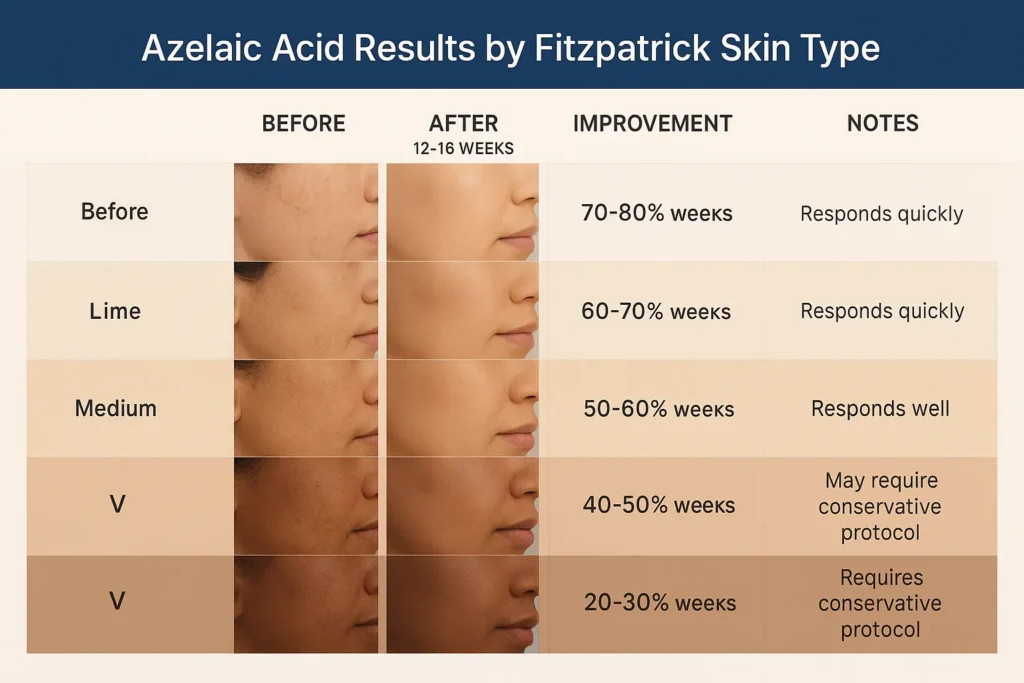
How to Read the Improvement Percentages
These bands are this article’s own reading guide, not clinical thresholds.
- 70–80% or more: a large, visible change. Spots fade enough that others notice, though they rarely vanish.
- 40–60%: a good result, most visible in natural light.
- 20–30%: a mild result. Side-by-side photos show lightening, but people who see you daily may not notice.
- 0–10%: little or no change. Check sun protection, consistency, and whether the product and strength match your pigment type, then ask a dermatologist.
What Before and After Photos Can’t Show You
Photos show pigment, not how a treatment feels or how people rate their own results. In a 20-week open, split-face trial of 33 people with melasma, 20% azelaic acid and 4% hydroquinone both reduced the modified MASI score with no significant difference between sides.
Patients rated their own improvement at 66.6% on the azelaic acid side and 75.7% on the hydroquinone side (Maryam et al., 2013, abstract). It was a small, unblinded study, so it shows that doctors and patients can rate the same treatment differently, not that satisfaction runs ahead of measured change.
Quality of life has also been measured. In a 6-month trial of 40 women with adult acne, 15% azelaic acid gel improved all Acne-QoL-BR domains (Bomfim et al., 2024), and in a 12-week acne-marks trial the azelaic acid group had a greater quality-of-life improvement than placebo (Shucheng et al., 2024).
PIH vs. PIE: Are You Treating Pigment or Redness?
Before comparing your before-and-after photos to the case studies below, it’s worth knowing which condition you’re treating—because they fade at different rates.
– PIH (post-inflammatory hyperpigmentation): Brown, tan, or black-brown marks caused by excess melanin. This is what most of the case studies in this article document, and it’s what azelaic acid’s tyrosinase-inhibiting mechanism targets most directly.
– PIE (post-inflammatory erythema): Pink, red, or purple-red marks caused by damaged capillaries rather than pigment — more common on lighter skin tones (Fitzpatrick I–III) after acne or eczema.
Azelaic acid may help PIE through its anti-inflammatory action rather than by blocking pigment, but none of the 13 case studies is a pure PIE case, so don’t use them as a benchmark for pink or red marks. If you’re unsure whether marks are PIE, PIH, or something else, such as rosacea, ask a dermatologist.
For more, see our guide: acne scars vs post-inflammatory hyperpigmentation.
If your marks are pink or red rather than brown, adjust your expectations accordingly and give it the full 16 weeks before judging results.
Azelaic Acid Timeline: What Changed and When in These Case Studies
- Weeks 1–4: little to no visible change in most cases.
- Weeks 6–8: first visible fading. Reported improvement ranged from 10% to 45% across the cases with a checkpoint in this window.
- Weeks 12–16: reported improvement ranged from 20% to 85%.
- Week 20 onward: further gains in the cases that continued, up to week 28.
Now let’s see how this plays out in each case.
Azelaic Acid Before and After for Hyperpigmentation: All 13 Cases at a Glance
| Case | Concern | Fitzpatrick | Azelaic acid product | Also used | Reported result |
|---|---|---|---|---|---|
| 1 | Recent acne PIH | III | The Ordinary 10% | Sunscreen only | 85% at week 16 |
| 2 | Old acne PIH | IV | Paula’s Choice 10%, then Finacea 15% | Niacinamide 5% from week 9 | 70% at week 24 |
| 3 | PIH from ingrown hairs | V | The Ordinary 10% | Moisturizer, sunscreen | 65% at week 16 |
| 4 | Post-eczema marks | II | Cos De BAHA 10% + niacinamide 2% | Sunscreen | 60% at week 12 |
| 5 | Pregnancy melasma | III | Finacea 15% | Tretinoin from week 17; vitamin C, niacinamide | 65% at week 24 |
| 6 | Melasma (birth control) | IV | Skinoren 20% | Tranexamic acid 3%; contraception change | 70% at week 28 |
| 7 | Melasma + sun damage | II | Azelex 20% | Tretinoin; 3 IPL sessions | 75% at week 24 |
| 8 | Mild sun spots | II | Paula’s Choice 10% | Vitamin C 15% | Face 70%, hands 55% at week 20 |
| 9 | Sun spots (man, 53) | III | Finacea 15% | Retinol from week 16 | 60% at week 24 |
| 10 | Severe sun damage | I | Skinoren 20% | Tretinoin; 3 glycolic peels | 70% at week 24 |
| 11 | Acne + PIH | IV | The Ordinary 10% | Benzoyl peroxide 2.5%; niacinamide 5% | PIH 75% at week 16 |
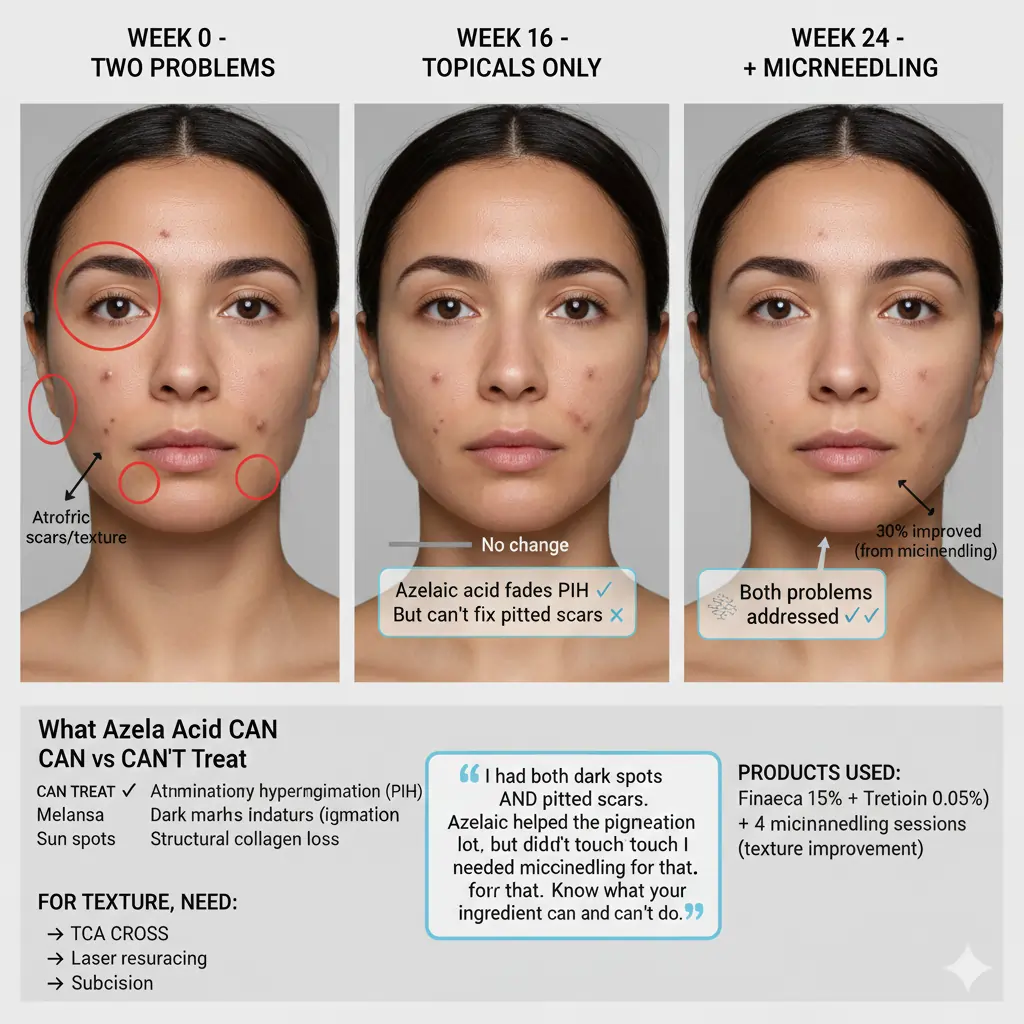
| 12 | PIH + pitted scars | V | Finacea 15% | Tretinoin; 4 microneedling sessions | PIH 65%, texture 30% at week 24 |
| 13 | Rosacea redness + marks | II | Finacea 15% | Trigger avoidance | Redness 60%, marks 55% at week 16 |
Azelaic Acid Safety: Side Effects and What the FDA Labels Cover
- Approved uses: Finacea (azelaic acid 15% gel) is FDA-labeled for inflammatory papules and pustules of mild-to-moderate rosacea (label). Azelex (azelaic acid 20% cream) is labeled for mild-to-moderate inflammatory acne (label). Using either for melasma, sun spots, or post-inflammatory marks is outside those labeled uses (off-label), so ask a prescriber first.
- Irritation is common: in the Finacea label’s trial data, 29% of patients reported burning, stinging, or tingling; 11% reported itching; 8% reported scaling or dry skin; and 4% reported redness or irritation. In the 24-week darker-skin trial, 20% azelaic acid cream caused slightly more burning and stinging than vehicle (Lowe 1998).
- Lighter patches: both labels note isolated reports of hypopigmentation. The Finacea label adds that azelaic acid has not been well studied in people with dark complexions and that they should be monitored for early signs.
- Eyes and asthma: The Finacea label says the gel has been reported to cause eye irritation (avoid eyes and mucous membranes, and rinse with water if contact occurs). It also says worsening of asthma has been reported with azelaic acid products; speak to a physician if that happens.
Case Studies 1-4: Post-Inflammatory Hyperpigmentation (PIH)
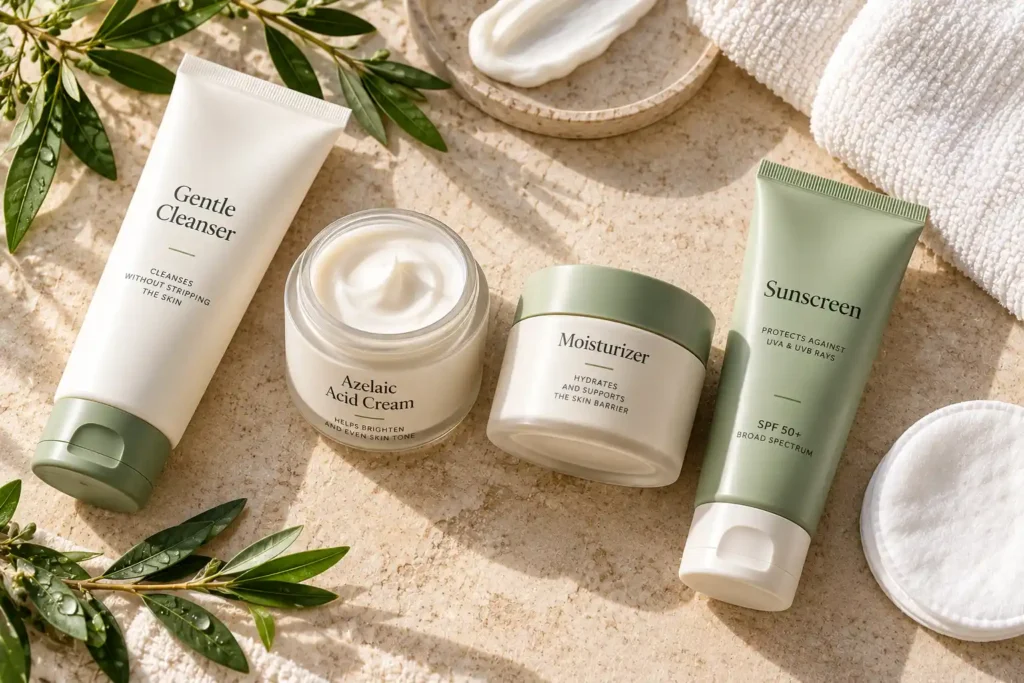
Case Study #1: Recent PIH From Acne on Light-Medium Skin (The Ordinary Azelaic Acid 10%)
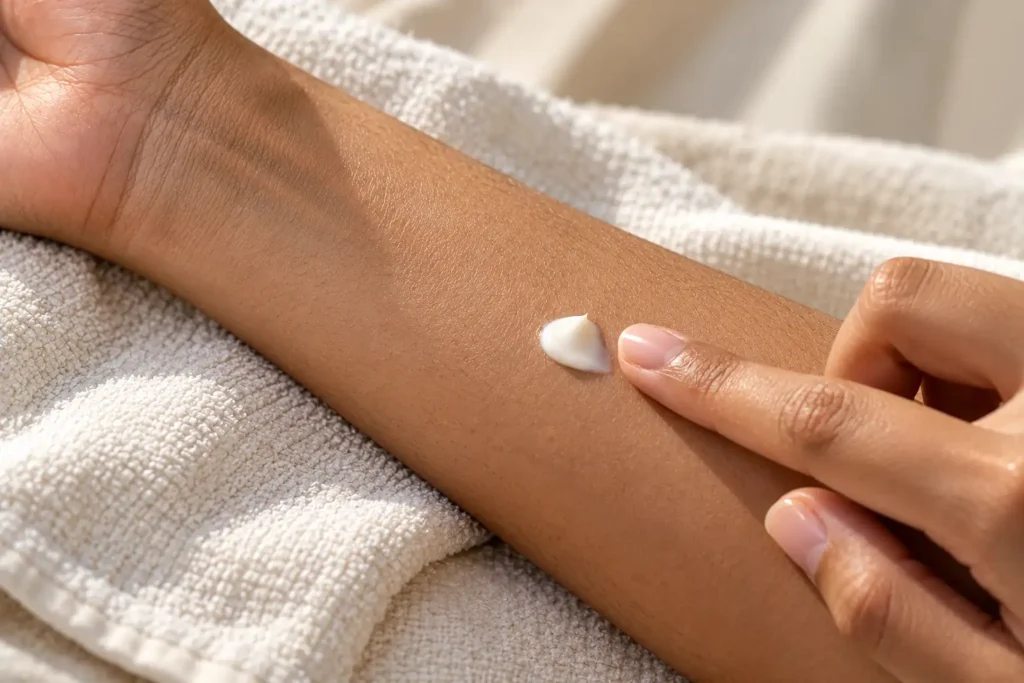
Patient Profile:
- Age: 28
- Sex: Female
- Skin Type: Combination (oily T-zone, normal cheeks)
- Fitzpatrick Type: III
- Concern: Dark brown spots on cheeks and jawline from acne breakouts 3-6 months prior
Product Used:
The Ordinary Azelaic Acid Suspension 10%
Application Protocol:
- Weeks 1-2: Every other night (PM only)
- Weeks 3-8: Nightly application
- Week 9+: Twice daily (AM + PM)
- Morning: broad-spectrum sunscreen (EltaMD UV Clear, SPF 46; it combines 9% zinc oxide with 7.5% octinoxate, so it is not a purely mineral formula), reapplied every 2 hours outdoors.
Timeline Results:
| Timepoint | Improvement | Visual Changes |
|---|---|---|
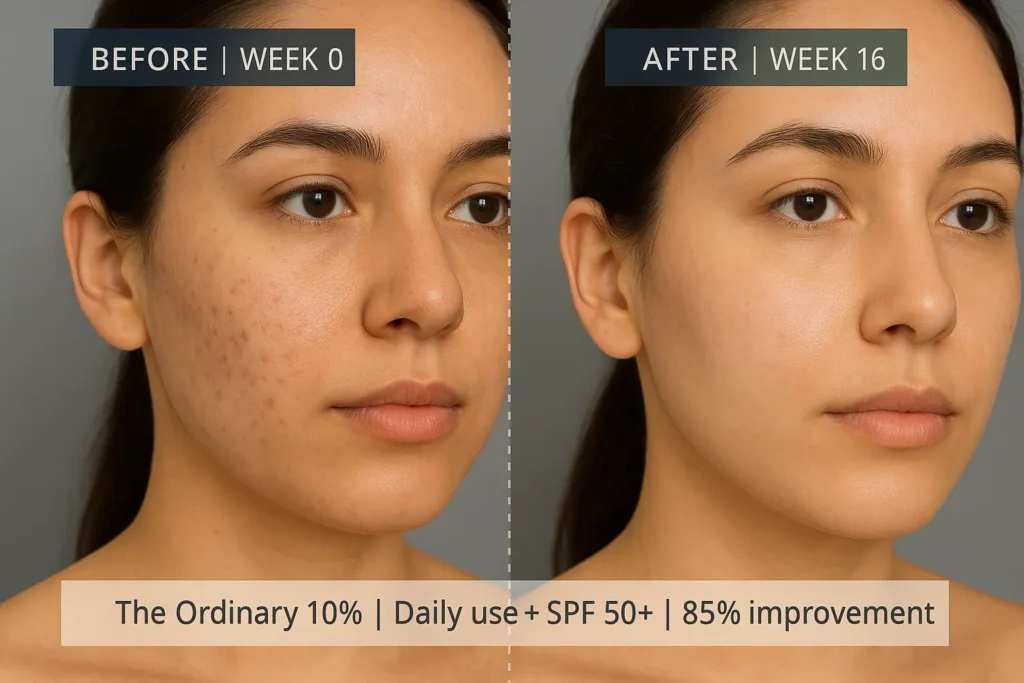
| Week 0 | Baseline | 15-20 dark brown spots, clearly visible from 3 feet away |
| Week 4 | 15% lighter | Minimal change, continued use despite frustration |
| Week 8 | 45% lighter | Noticeable fading, spots now medium brown vs. dark brown |
| Week 12 | 75% lighter | Dramatic improvement, spots barely visible in natural light |
| Week 16 | 85% lighter | Near-complete resolution, maintenance schedule begun |
What Worked:
- Starting with 10% OTC (built tolerance without irritation)
- Religious SPF 50+ reapplication (every 2 hours when outdoors)
- Patience through weeks 1-4 when nothing seemed to happen
- Upgrading to twice daily after establishing tolerance
Lessons Learned: “I almost quit at week 3. Zero visible change and mild tingling made me think it wasn’t working. Comparing week 8 photos to baseline was the turning point—I could finally see progress. My advice? Take weekly photos in the same spot with the same lighting. You won’t notice day-to-day changes, but month to month? Undeniable.”
My Expert Insight:
Recent PIH (less than 6 months old) responds fastest to azelaic acid because the melanin deposits are still primarily in the surface layer of skin. Epidermal PIH typically fades faster with consistent topical treatment, while deeper dermal pigmentation requires longer treatment.
Case Study #2: Old PIH on Dark Skin (Medium-Dark Skin Tone)
Patient Profile:
- Age: 35
- Sex: Female
- Skin Type: Dry-combination
- Fitzpatrick Type: IV
- Concern: Dark brown-black spots from acne 2-5 years prior (cheeks, temples, chin)
Product Used:
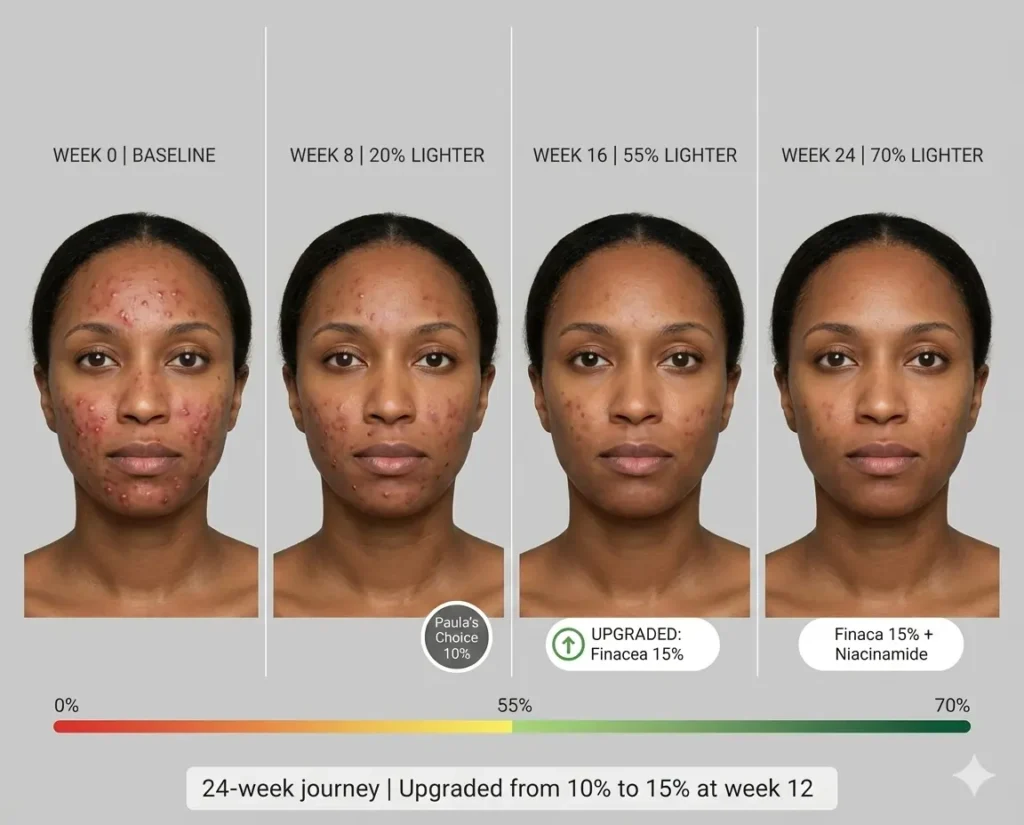
Paula’s Choice 10% Azelaic Acid Booster for 12 weeks, then upgraded to Finacea Gel 15% (prescription) for weeks 13-24
Application Protocol:
- Weeks 1-12: Paula’s Choice 10% nightly with buffering (moisturizer first)
- Weeks 13-24: Finacea 15% twice daily after dermatologist consultation
- Added: Niacinamide 5% serum (AM) starting week 9
- SPF 50+ zinc oxide sunscreen daily (Blue Lizard Sensitive)
Timeline Results:
| Timepoint | Improvement | Notes |
|---|---|---|
| Week 0 | Baseline | Very dark PIH, 3-5 years old, multiple spots |
| Week 8 | 20% lighter | Mild improvement, spots still very visible |
| Week 12 | 35% lighter | Modest progress with 10% concentration |
| Week 16 | 55% lighter | Noticeable acceleration after Finacea upgrade |
| Week 24 | 70% lighter | Significant improvement, ongoing maintenance |
What Worked:
- Recognizing when to upgrade concentration (week 12 reassessment)
- Adding niacinamide for synergistic brightening
- The buffering technique prevented irritation in a dry-skinned patient
- Twice-daily application of prescription strength
What Didn’t Work Initially:
- 10% concentration is insufficient for very old, dark PIH
- Skipping weekends (inconsistent application slowed progress)
Lessons Learned: “Old PIH is stubborn. I assumed my 10% azelaic acid wasn’t doing anything and almost gave up, but my dermatologist explained that long-standing, deeply pigmented spots often need a stronger concentration. After switching to a 15% prescription formula, I finally started noticing meaningful fading. I also learned that missing applications—even just 2–3 days a week—can slow results by several weeks.”
Clinical Note:
Old post-inflammatory hyperpigmentation (PIH) can involve both epidermal and dermal pigment, which is why improvement happens in phases. Surface discoloration may begin fading around weeks 8–16, while deeper pigment often takes longer.
Case Study #3: PIH on Black/Dark Skin — Before and After (Conservative Protocol)
Patient Profile:
- Age: 42
- Sex: Male
- Skin Type: Normal-oily
- Fitzpatrick Type: V
- Concern: Post-inflammatory hyperpigmentation from ingrown hairs (neck, jawline)
Product Used:
The Ordinary Azelaic Acid Suspension 10% (entire 16-week treatment)
Application Protocol:
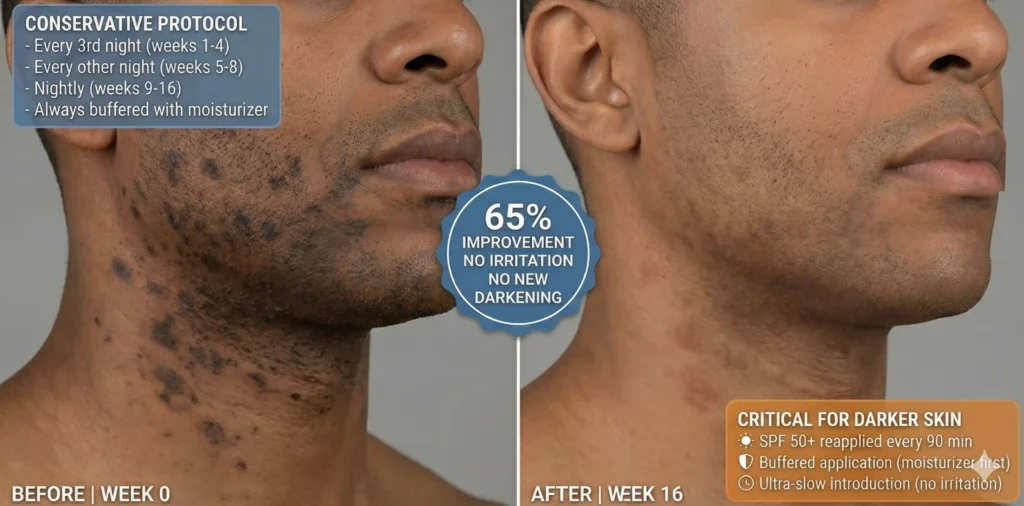
- Weeks 1-4: Every 3rd night only (ultra-conservative start)
- Weeks 5-8: Every other night
- Weeks 9-16: Nightly application
- Always buffer with CeraVe Moisturizing Cream first
- SPF 50+ mineral sunscreen (Black Girl Sunscreen) with strict reapplication
Timeline Results:
| Timepoint | Improvement | Observations |
|---|---|---|
| Week 0 | Baseline | Dark brown-black spots, 15-20 on neck/jawline |
| Week 6 | 10% lighter | Minimal visible change |
| Week 12 | 40% lighter | Moderate fading, spots now medium-brown |
| Week 16 | 65% lighter | Good improvement, patient satisfied |
What Worked:
- Ultra-conservative introduction (prevented irritation-induced darkening)
- Always buffer with moisturizer first (critical for darker skin)
- Never compromising on SPF 50+ reapplication (even indoors near windows)
- Patience with a slower timeline (accepted 16+ weeks vs rushing)
Why Conservative Approach Mattered: Darker skin (Fitzpatrick V-VI) has a higher risk of paradoxical hyperpigmentation from irritation. Any inflammation can trigger melanocytes to produce more pigment, worsening the problem. Starting every 3rd night, always buffering, and prioritizing tolerance over speed prevented this complication.
Expert Perspective:
Dermatologists who specialize in skin of color, including Dr. Susan C. Taylor, consistently emphasize in their published work that hyperpigmentation in darker skin requires a gentle, non-irritating approach. Inflammatory treatments can worsen PIH, which is why azelaic acid—known for its anti-inflammatory properties—is often recommended when introduced gradually alongside strict sun protection.
Daily broad-spectrum sunscreen with strict reapplication (Black Girl Sunscreen SPF 30, a chemical-filter formula with avobenzone, homosalate, octisalate, and octocrylene).
Lessons Learned: “As a Black man, I was worried about making my PIH worse. My dermatologist recommended starting super slow—every 3rd night—which felt frustratingly slow. But by week 12, it had faded well without irritation or new darkening. For darker skin, slow and steady wins.”
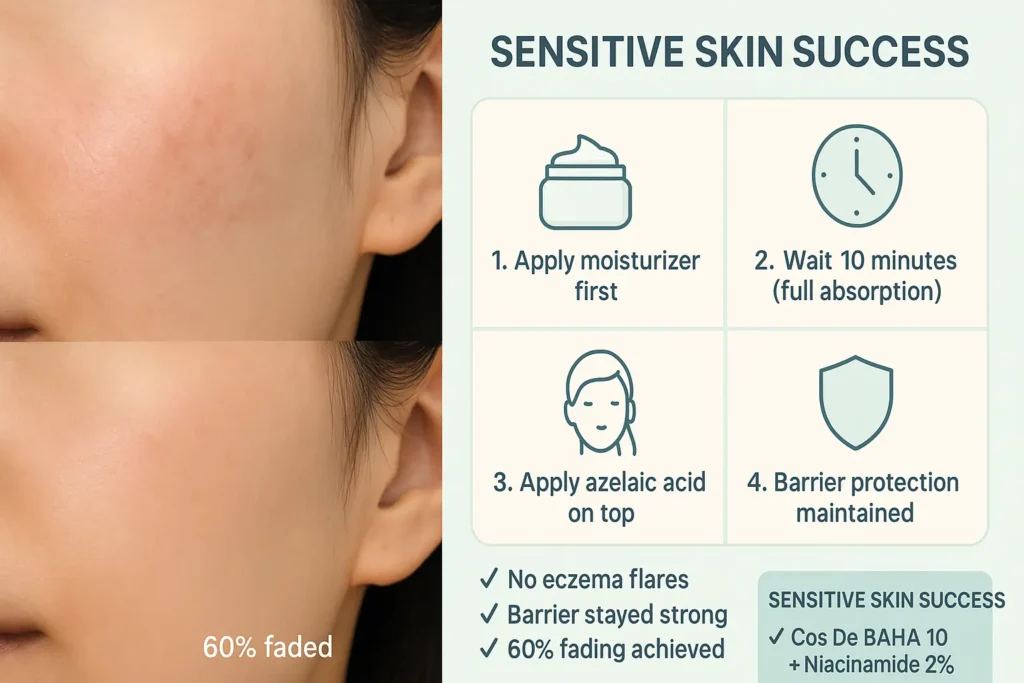
Case Study #4: PIH from Eczema Flare (Sensitive Skin)
Patient Profile:
- Age: 31
- Sex: Female
- Skin Type: Dry, sensitive, eczema-prone
- Fitzpatrick Type: II
- Concern: Pink-brown discoloration on face from eczema flare 8 months prior
Product Used:
Cos De BAHA Azelaic Acid 10% + Niacinamide 2% Serum
Application Protocol:
- Weeks 1-8: Every other night only
- Applied over moisturizer (buffering method)
- Weeks 9-12: Increased to 5 nights per week (not every night due to sensitivity)
- Daily broad-spectrum sunscreen (EltaMD UV Physical, SPF 41; zinc oxide 9% and titanium dioxide 7%)
Timeline Results:
| Timepoint | Improvement | Skin Tolerance |
|---|---|---|
| Week 0 | Baseline | Pink-brown patches, sensitive barrier |
| Week 6 | 25% lighter | Mild improvement, no irritation |
| Week 12 | 60% lighter | Significant fading while maintaining barrier |
What Worked:
- Choosing a combination product with niacinamide (barrier support + brightening)
- Never pushing frequency beyond what the skin tolerated
- Short-contact therapy on sensitive days (15-minute application, then rinse)
- Prioritizing barrier repair over aggressive fading
Unique Challenge: Eczema-prone skin has compromised barrier function. Pushing too hard with actives causes flares, which then create MORE hyperpigmentation. This patient succeeded by respecting her skin’s limits and accepting a slightly slower timeline.
Lessons Learned: I have eczema, and my skin freaks out from almost everything. The combination of azelaic acid and niacinamide worked because niacinamide strengthens the barrier while azelaic acid fades pigmentation. On sensitive days, I’d apply it for 15 minutes, then rinse off—still saw results without triggering flares.
To learn how these ingredients work together to treat acne, read our article: Niacinamide vs Azelaic Acid for Acne.
Melasma Before and After With Azelaic Acid: Case Studies 5–7
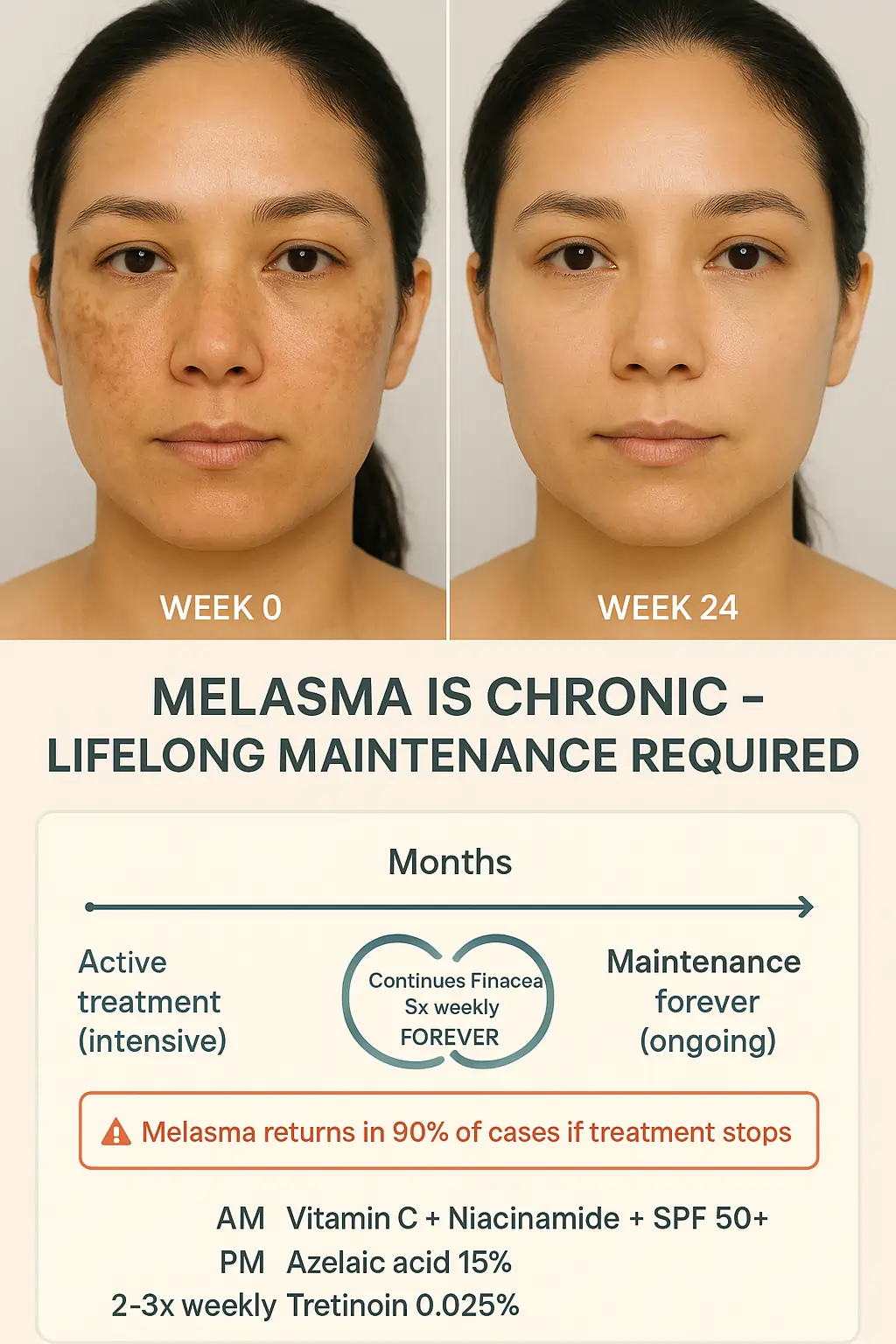
Case Study #5: Pregnancy Melasma
Patient Profile:
- Age: 33
- Sex: Female
- Skin Type: Normal-combination
- Fitzpatrick Type: III
- Concern: Bilateral brown patches on cheeks and forehead (developed during the second trimester; baby now 6 months old)
Product Used:
Finacea Gel 15% (used after pregnancy; its labeled use is rosacea, so melasma use is off-label)
Application Protocol:
- Started 3 months postpartum (after breastfeeding ended)
- Weeks 1-16: Nightly application
- Week 17+: Added tretinoin 0.025% (Mon/Wed/Fri)
- Morning routine: Vitamin C 15% + Niacinamide 5% + SPF 50+
- Strict hat wearing (3-inch brim minimum) when outdoors
Timeline Results:
| Timepoint | Improvement | Maintenance Notes |
|---|---|---|
| Week 0 | Baseline | Dark bilateral patches (classic melasma pattern) |
| Week 8 | 15% lighter | Slow start (typical for melasma) |
| Week 16 | 45% lighter | Moderate improvement with azelaic acid alone |
| Week 24 | 65% lighter | Significant acceleration after adding tretinoin |
| Ongoing | Maintained | Continue Finacea 5x weekly forever |
What Worked:
- Combination therapy (azelaic acid + tretinoin + vitamin C + niacinamide)
- Understanding melasma requires lifelong maintenance
- Strict sun and heat avoidance (no hot yoga, saunas)
- Realistic expectations (60-70% improvement, not 100%)
Melasma insight: melasma is chronic and can return. The American Academy of Dermatology says treatments cannot make it go away forever and that it often returns when skin is in the sun without protection. For some women, it fades after delivery or after stopping birth control pills (AAD).
Our complete guide to melasma and azelaic acid for melasma during pregnancy covers this in more depth.
Lessons Learned: “My melasma appeared during pregnancy, and I was desperate to make it disappear after giving birth. I learned that melasma isn’t something you ‘fix’ and move on—it’s something you manage forever. I’ll use Finacea 5 nights a week for the rest of my life to keep it from coming back. Accepting that was hard, but now I’m at peace with it.”
Case Study #6: Melasma from Birth Control
Patient Profile:
- Age: 29
- Sex: Female
- Skin Type: Oily
- Fitzpatrick Type: IV
- Concern: Upper lip and cheek melasma triggered by hormonal birth control 2 years prior
Product Used:
Skinoren Cream 20% (ordered internationally, not available in the US)
Application Protocol:
- Weeks 1-20: Twice daily application (AM + PM)
- Added: Tranexamic acid 3% serum (AM) starting week 8
- SPF 50+ with reapplication every 90 minutes outdoors
- Switched birth control method after dermatologist consultation
Timeline Results:
| Timepoint | Improvement | Key Actions |
|---|---|---|
| Week 0 | Baseline | Dark patches on upper lip, cheeks |
| Week 12 | 20% lighter | Slow progress (frustrating but normal) |
| Week 16 | 35% lighter | Modest improvement |
| Week 20 | 50% lighter | Switched off hormonal BC (critical turning point) |
| Week 28 | 70% lighter | Finally seeing significant fading |
Game-Changing Realization: In this case, fading accelerated after she switched from combination birth control to a copper IUD, on her dermatologist’s advice.
What Worked:
- Highest concentration (20%) for stubborn melasma
- Adding tranexamic acid (targets a different pathway)
- Addressing the root cause (hormonal trigger)
- Heat avoidance (no hot showers on face, avoided saunas)
Lessons Learned: “I was using Skinoren 20% religiously and barely seeing results. My dermatologist explained that hormonal birth control was continuously triggering my melasma, like trying to bail water from a boat with the drain still open. Once I switched to a copper IUD, my melasma finally responded to treatment. Address the cause, not just the symptoms.”
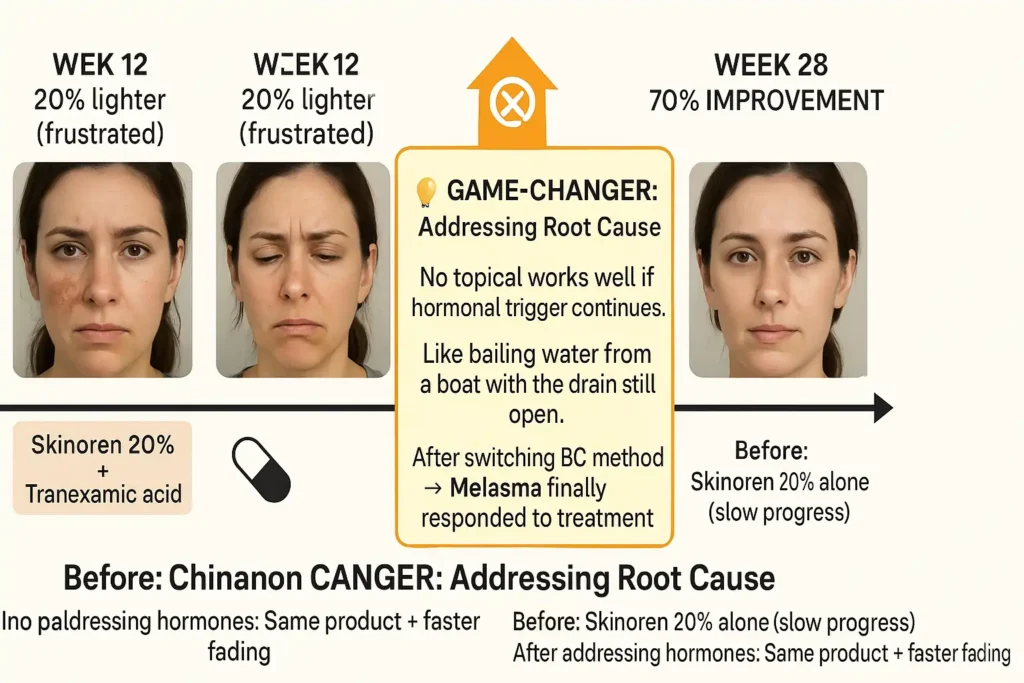
Note: The AAD says many women first notice melasma during pregnancy or when starting birth control pills, and that for some it fades after delivery or after stopping the pill. Whether to change contraception is a decision for you and your doctor.
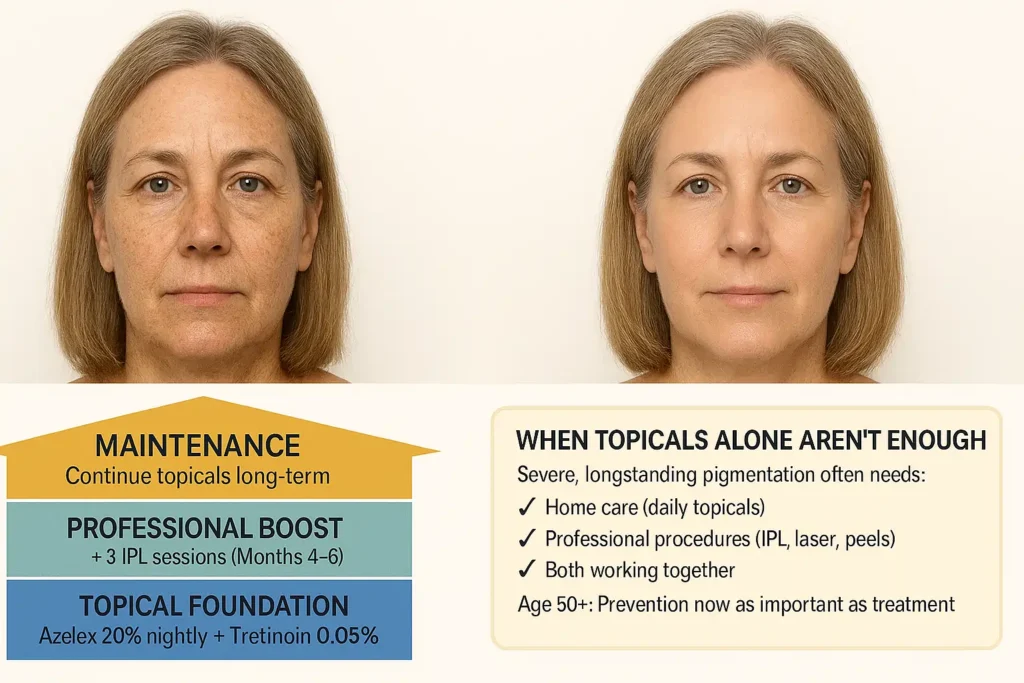
Case Study #7: Melasma with Sun Damage
Patient Profile:
- Age: 51
- Sex: Female
- Skin Type: Dry, mature
- Fitzpatrick Type: II
- Concern: Melasma overlapping with sun spots (forehead, cheeks, upper lip)
Product Used:
Azelex 20% cream (prescription in the US; its FDA-labeled use is mild-to-moderate inflammatory acne, so use for melasma is off-label)
Application Protocol:
- Weeks 1-24: Nightly application
- Morning: Niacinamide 10% + Vitamin C 20% + SPF 50+ tinted mineral
- Added: Professional IPL treatment (3 sessions, months 4-6)
- Consistent tretinoin 0.05% (alternate nights)
Timeline Results:
| Timepoint | Improvement | Combined Approach |
|---|---|---|
| Week 0 | Baseline | Mixed melasma + sun damage |
| Week 12 | 30% lighter | Topicals alone (modest) |
| Week 16 | 45% lighter | After the first IPL session |
| Week 24 | 75% lighter | After 3 IPL sessions + ongoing topicals |
Key Insight: Severe, long-standing melasma with overlapping sun damage often requires a combination of professional and at-home treatments. Topicals alone plateaued at 30% improvement, but adding IPL (intense pulsed light) accelerated results.
What Worked:
- Recognizing when topicals alone weren’t enough
- Professional treatments (IPL) as an adjunct, not a replacement
- Continuing azelaic acid post-IPL for maintenance
- Aggressive sun protection (SPF 50+ tinted for visible light protection)
Lessons Learned: “I’m 51 and have both melasma from hormones and sun damage from decades of tanning. Azelaic acid helped, but I plateaued at 30% improvement. My dermatologist recommended IPL treatments while continuing topicals. The combination finally got me to 75% fading. Sometimes you need both approaches.”
Case Studies 8-10: Sun Spots (Solar Lentigines)
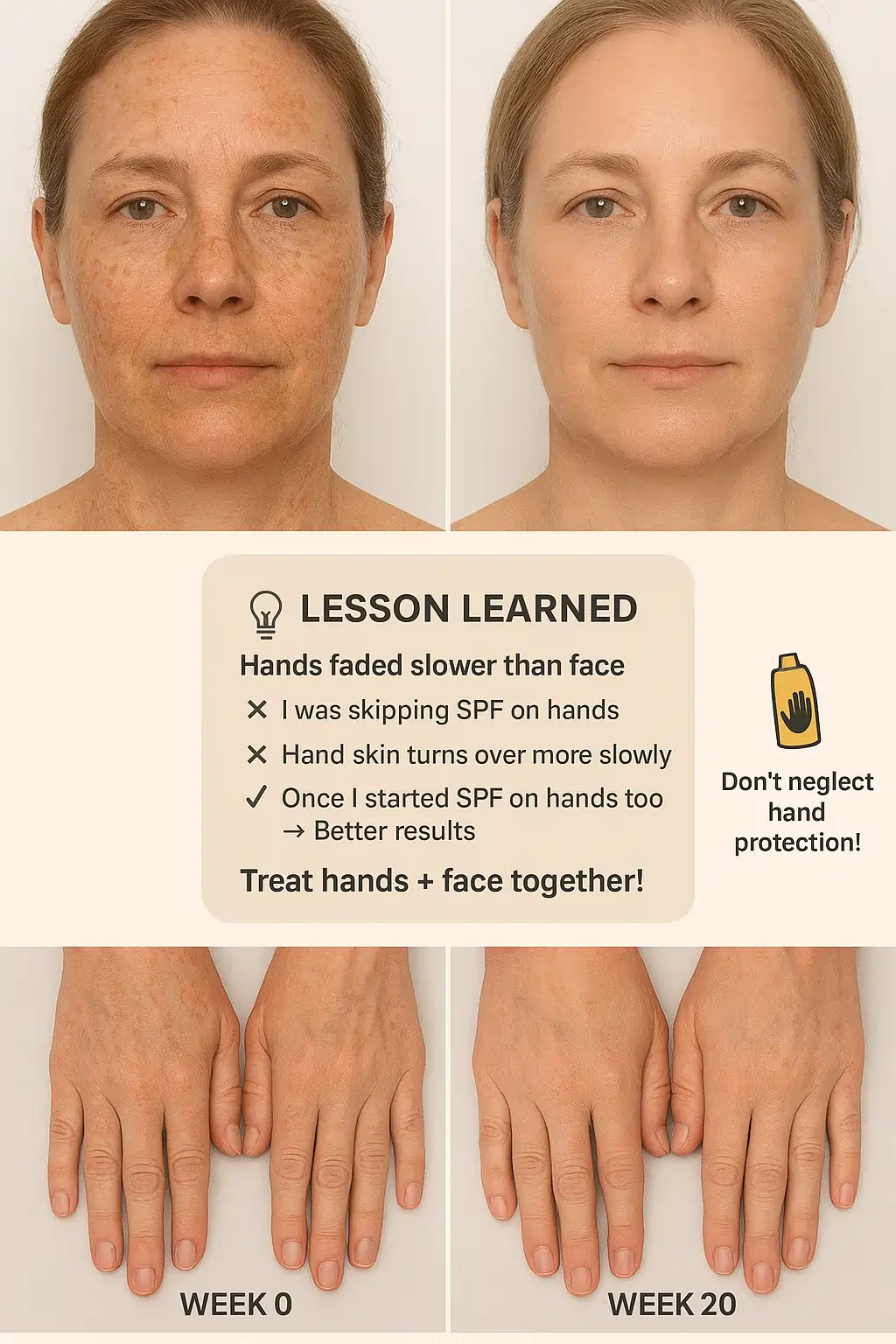
Case Study #8: Mild Sun Damage (40s)
Patient Profile:
- Age: 44
- Sex: Female
- Skin Type: Normal
- Fitzpatrick Type: II
- Concern: Scattered light brown spots on forehead, cheeks, hands (early sun damage)
Product Used:
Paula’s Choice 10% Azelaic Acid Booster
Application Protocol:
- Weeks 1-20: Twice daily (AM + PM)
- Added: Vitamin C 15% serum (AM)
- SPF 50+ broad-spectrum daily
- Hands: Applied azelaic acid nightly
Timeline Results:
| Timepoint | Face | Hands |
|---|---|---|
| Week 0 | 10-12 light spots | 15-20 spots (more severe) |
| Week 12 | 50% lighter | 30% lighter |
| Week 20 | 70% lighter | 55% lighter |
What Worked:
- Early intervention (spots less than 2 years old respond better)
- Vitamin C + azelaic acid synergy
- Treating hands (often neglected)
- Consistent SPF on face AND hands
Lessons Learned: “Sun spots on my face faded faster than my hands because facial skin turns over more quickly. Also, I realized I was neglecting SPF on my hands—once I started reapplying there too, I saw better results. Azelaic acid won’t erase sun damage completely, but 70% lighter is massive.”
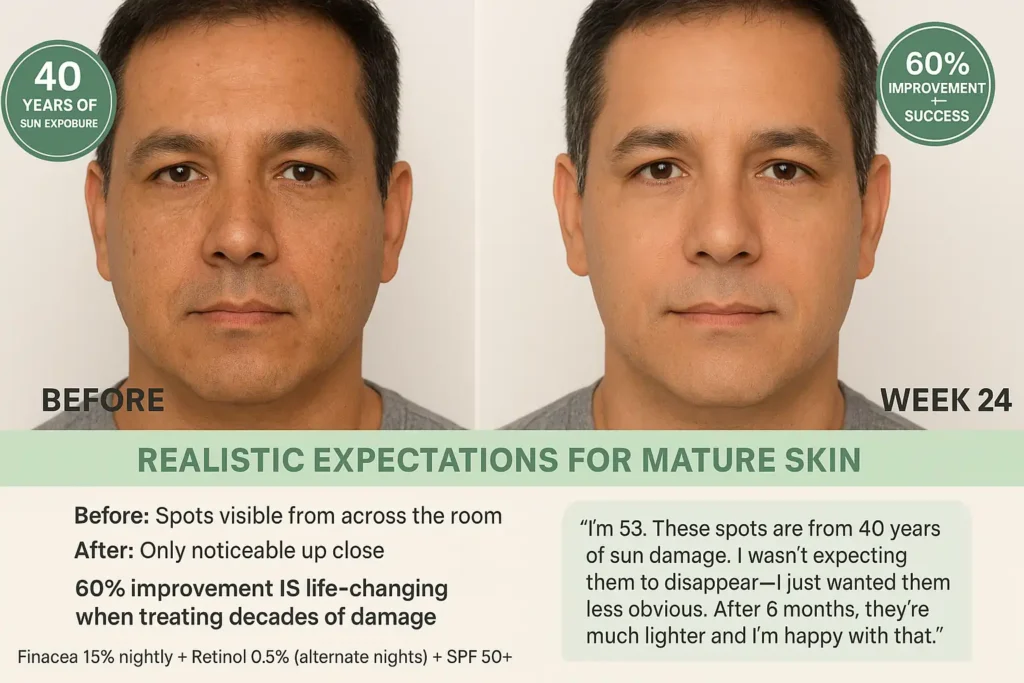
Case Study #9: Moderate Sun Damage in Men (50s)
Patient Profile:
- Age: 53
- Sex: Male
- Skin Type: Normal-oily
- Fitzpatrick Type: III
- Concern: Multiple medium-brown sun spots (forehead, temples, cheeks)
Product Used:
Finacea Gel 15% (prescription)
Application Protocol:
- Weeks 1-24: Nightly application
- No additional actives initially
- Week 16+: Added retinol 0.5% (alternate nights)
- SPF 50+ + wide-brim hat outdoors
Timeline Results:
| Timepoint | Improvement | Observations |
|---|---|---|
| Week 0 | Baseline | 20+ medium-brown spots |
| Week 12 | 35% lighter | Steady gradual fading |
| Week 24 | 60% lighter | Satisfactory improvement |
What Worked:
- Prescription strength (15%) for established sun damage
- Adding retinol at week 16 (accelerated fading)
- Lifetime commitment to SPF and hats (prevention)
Reality Check: Sun spots from decades of exposure won’t vanish completely. This patient was satisfied with 60% fading because spots went from “obvious from across the room” to “only visible up close.”
Lessons Learned: “I’m 53 and these spots are from 40 years of sun damage. I wasn’t expecting them to disappear—I just wanted them to be less obvious. After 6 months, they’re much lighter, and I’m happy with that. The key is understanding that 60% improvement IS success when you’re treating decades of damage.”
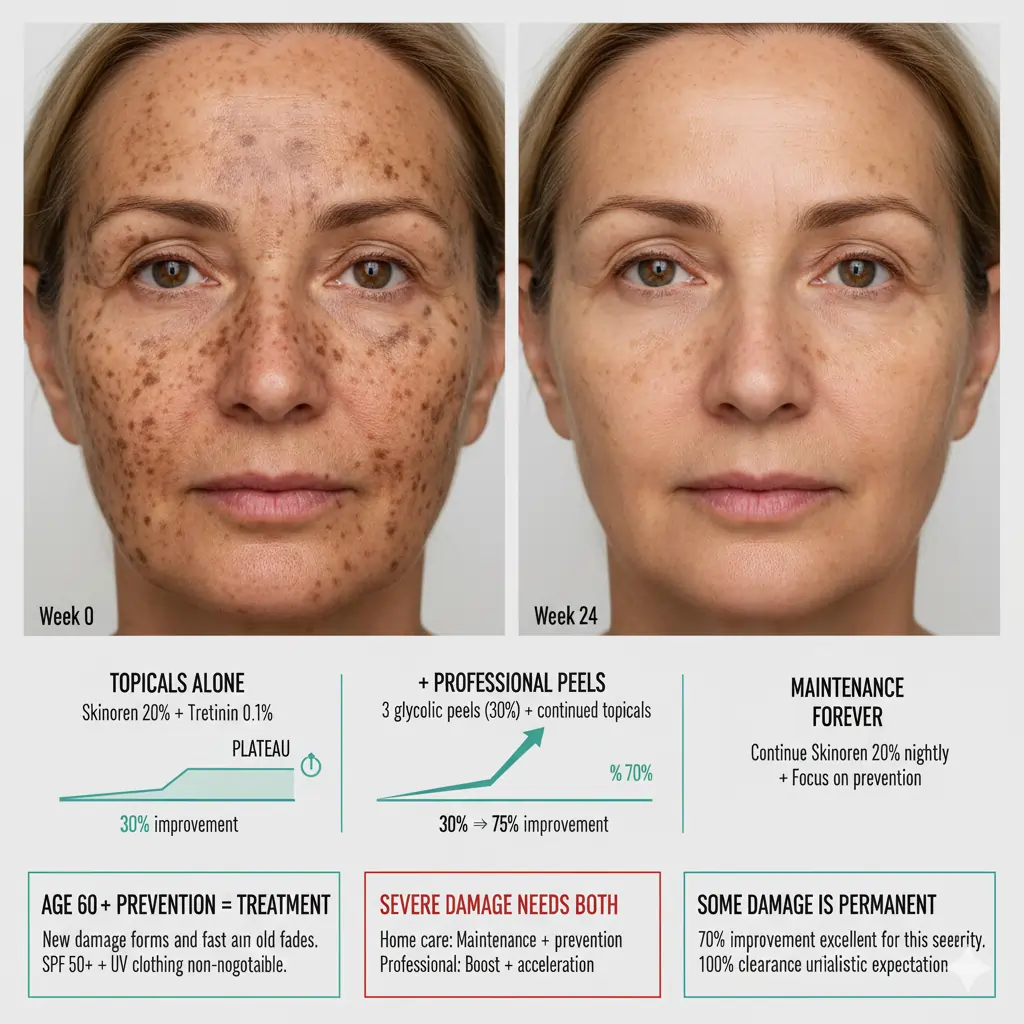
Case Study #10: Severe Sun Damage (60s)
Patient Profile:
- Age: 62
- Sex: Female
- Skin Type: Dry, mature
- Fitzpatrick Type: I
- Concern: Extensive dark brown spots (face, décolletage, hands)
Product Used:
Skinoren 20% Cream + Professional Chemical Peels
Application Protocol:
- Azelaic acid 20% nightly (ongoing)
- Tretinoin 0.1% (Mon/Wed/Fri)
- 3 glycolic peels (30%, performed by a dermatologist, 4 weeks apart)
- SPF 50+ + UV-protective clothing
Timeline Results:
| Timepoint | Improvement | Professional Treatment |
|---|---|---|
| Week 0 | Baseline | Severe, decades-old sun damage |
| Week 16 | 30% lighter | Topicals alone (plateau) |
| Week 20 | 55% lighter | After 2 chemical peels |
| Week 24 | 70% lighter | After 3 peels + ongoing topicals |
Critical Insight: Severe, longstanding sun damage often requires professional intervention. Topicals provide maintenance and prevent new damage, but peels or lasers may be needed for dramatic improvement.
What Worked:
- Combination home care + professional treatments
- Highest azelaic acid concentration (20%)
- Aggressive sun protection in the future
- Realistic expectations (some damage is permanent)
Lessons Learned: “I’m 62 and have severe sun damage from decades of tanning. Azelaic acid alone wasn’t enough—I needed chemical peels to really see results. But I continue using Skinoren every night to maintain the improvements and prevent new spots. At my age, prevention is as important as treatment.”
Acne and Acne Scar Before and After: Case Studies 11–12
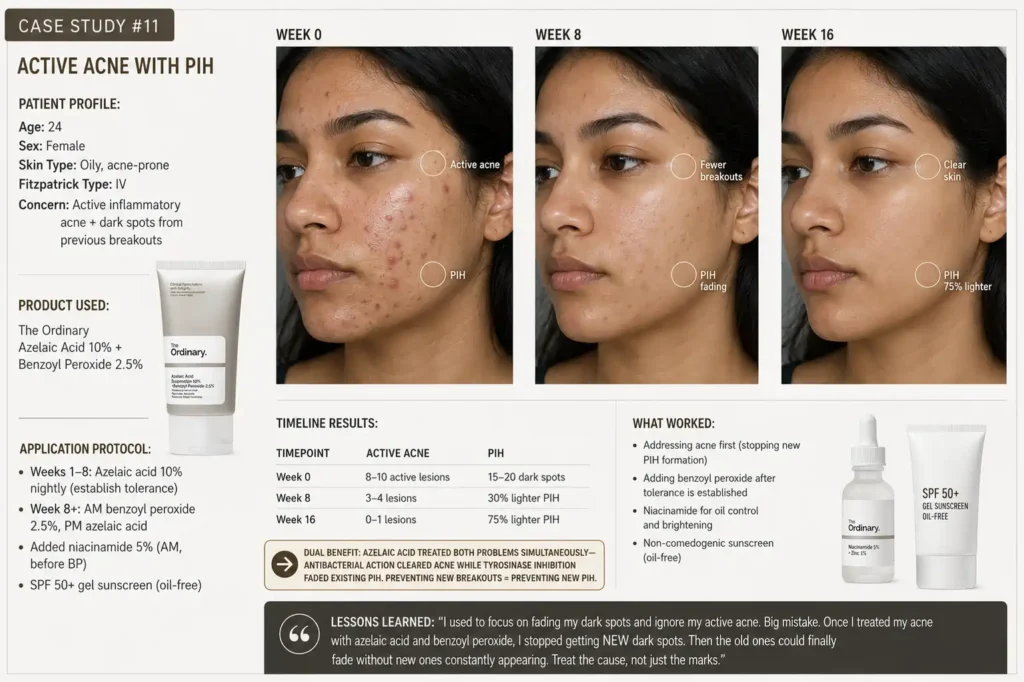
Case Study #11: Active Acne with PIH (Fitzpatrick IV)
Patient Profile:
- Age: 24
- Sex: Female
- Skin Type: Oily, acne-prone
- Fitzpatrick Type: IV
- Concern: Active inflammatory acne + dark spots from previous breakouts
Product Used:
The Ordinary Azelaic Acid Suspension 10% plus a separate benzoyl peroxide 2.5% product (introduced week 8)
Application Protocol:
- Weeks 1-8: Azelaic acid 10% nightly (establish tolerance)
- Week 8+: AM benzoyl peroxide 2.5%, PM azelaic acid
- Added niacinamide 5% (AM, before BP)
- SPF 50+ gel sunscreen (oil-free)
Timeline Results:
| Timepoint | Active Acne | PIH |
|---|---|---|
| Week 0 | 8-10 active lesions | 15-20 dark spots |
| Week 8 | 3-4 lesions | 30% lighter PIH |
| Week 16 | 0-1 lesions | 75% lighter PIH |
Dual Benefit: Azelaic acid treated BOTH problems simultaneously—its antibacterial action cleared acne, while its tyrosinase inhibition faded existing PIH. Preventing new breakouts = preventing new PIH.
What the research says: In a 12-week randomized, double-blind, placebo-controlled trial of 60 adults with acne marks, 15% azelaic acid gel reduced a post-acne redness (PIE) score significantly more than placebo by weeks 8 and 12, while brown marks (PIH) improved in both groups. About two thirds of the azelaic acid group reported mild irritation, which generally settled within a week (Shucheng et al., 2024).
For a full acne plan, see our ultimate guide to acne care.
What Worked:
- Addressing acne first (stopping new PIH formation)
- Adding benzoyl peroxide after tolerance is established
- Niacinamide for oil control and brightening
- Non-comedogenic sunscreen (oil-free)
Lessons Learned: “I used to focus on fading my dark spots and ignore my active acne. Big mistake. Once I treated my acne with azelaic acid and benzoyl peroxide, I stopped getting NEW dark spots. Then the old ones could finally fade without new ones constantly appearing. Treat the cause, not just the marks.”
Case Study #12: Post-Acne Scarring in Men (Texture + PIH)
Patient Profile:
- Age: 27
- Sex: Male
- Skin Type: Combination
- Fitzpatrick Type: V
- Concern: Atrophic scars (pitted) + dark PIH from severe cystic acne
Product Used:
Finacea 15% + Microneedling (professional)
Application Protocol:
- Azelaic acid 15% nightly (ongoing)
- 4 microneedling sessions (6 weeks apart)
- Tretinoin 0.05% (alternate nights)
- SPF 50+ strict reapplication
Timeline Results:
| Timepoint | PIH | Atrophic Scars (Texture) |
|---|---|---|
| Week 0 | Very dark (black-brown) | Deep pitted scars |
| Week 16 | 40% lighter | No change (expected) |
| Week 24 | 65% lighter | 30% improved (microneedling) |
Critical Lesson: Azelaic acid fades PIH (pigmentation) but cannot fix atrophic scars (texture). This patient needed microneedling to improve texture, while azelaic acid addressed dark spots.
What Worked:
- Understanding what azelaic acid CAN’T treat (pitted scars)
- Professional microneedling for texture
- Azelaic acid + tretinoin for PIH
- Managing expectations (texture takes longer than pigment)
Lessons Learned: “I had both dark spots AND pitted scars from severe acne. Azelaic acid helped the pigmentation a lot, but didn’t touch the texture. I needed microneedling for that. Know what your ingredient can and can’t do—don’t expect one product to solve everything.”
Expert Guidance:
According to DermNet NZ, atrophic acne scars require procedures (microneedling, TCA CROSS, laser resurfacing, subcision) because they’re structural defects from collagen loss. Topicals can fade pigmentation, but cannot fill indentations.
Bonus Case Study: Rosacea-Related Redness and PIH
Case Study #13: Azelaic Acid Before and After for Rosacea (Papulopustular, Residual Redness)
Patient Profile:
- Age: 38
- Sex: Female
- Skin Type: Sensitive, reactive, prone to flushing
- Fitzpatrick Type: II
- Concern: Persistent facial redness, visible small blood vessels, and occasional inflammatory bumps across cheeks and nose, with faint brown marks left behind after flares
Product Used:
Finacea Gel 15% (prescription — FDA-approved specifically for rosacea)
Application Protocol:
- Weeks 1-4: Every other night (building tolerance on reactive skin)
- Weeks 5-16: Nightly application
- Gentle, fragrance-free moisturizer applied first (buffering)
- SPF 50+ mineral sunscreen daily (chemical filters avoided due to flushing triggers)
- Trigger avoidance: reduced hot beverages, spicy food, and alcohol during treatment
Timeline Results:
| Timepoint | Redness | Bumps | Residual Dark Marks |
|---|---|---|---|
| Week 0 | Baseline — persistent redness, visible vessels | 5-8 active bumps | Faint brown marks from prior flares |
| Week 4 | No visible change | Slight reduction | No change |
| Week 8 | 25% less redness | Mostly clear | 20% lighter |
| Week 12 | 45% less redness | Clear | 40% lighter |
| Week 16 | 60% less redness | Clear, occasional flare with triggers | 55% lighter |
What Worked:
- Starting slow on reactive, flush-prone skin
- Prescription Finacea 15% gel, an FDA-approved azelaic acid treatment for the bumps of rosacea
- Pairing topical treatment with trigger avoidance
- Realistic expectations — rosacea redness fades more slowly than brown PIH
Lessons Learned: “I’d tried a dozen products for my rosacea redness before this. What I didn’t expect was that azelaic acid would fade both the redness and the leftover dark marks from old flare-ups at the same time. It took longer than my friend’s acne-PIH results — closer to 16 weeks before I felt comfortable without makeup — but the redness reduction was the first thing that ever actually worked for me.”
Clinical note: Finacea (azelaic acid 15% gel) is FDA-approved for the inflammatory papules and pustules of mild to moderate rosacea. The label says its effect on rosacea redness without papules and pustules has not been evaluated, and that some redness reduction occurred in patients who also had bumps.
So the redness improvement here is best read as a secondary effect in someone who also had bumps. Azelaic acid is one of several FDA-approved topical rosacea treatments, alongside metronidazole, ivermectin, minocycline foam and benzoyl peroxide for bumps, and brimonidine and oxymetazoline for persistent redness (National Rosacea Society).
See also is niacinamide bad for rosacea.
Azelaic Acid Before and After: What to Expect vs. Unrealistic Expectations
After reviewing 13 diverse cases, here are the honest takeaways.
What Azelaic Acid Can Do
- Reduce pigment intensity. A randomized trial in phototypes IV–VI (Lowe 1998) and a 2023 meta-analysis in melasma support this.
- Treat inflammatory acne and the bumps of mild to moderate rosacea, which are its labeled uses.
What It Cannot Do
- Guarantee clearance: none of the 13 cases reports full clearance.
- Fix pitted (atrophic) scars: in Case 12 the texture needed microneedling.
- Work overnight: first visible change in these cases came around weeks 6–8.
- Replace sunscreen: daily sun protection is essential.
- Cure melasma: the AAD says treatments cannot make melasma go away forever.
What the 13 Cases Had in Common
- Daily sunscreen and consistent use.
- A strength matched to the pigment (Cases 2 and 6 stepped up).
- Treating the cause where there was one (acne in Case 11, a hormonal trigger in Case 6).
- Professional add-ons in stubborn cases (Cases 7, 10 and 12).
By the Numbers
Final reported improvement across the 13 cases ranged from 55% to 85%. These are individual reports, not trial outcomes.
How to Document Your Own Journey (Photo Tips)
Want to track your progress accurately? Here’s how to take azelaic acid before-and-after photos that show real results.
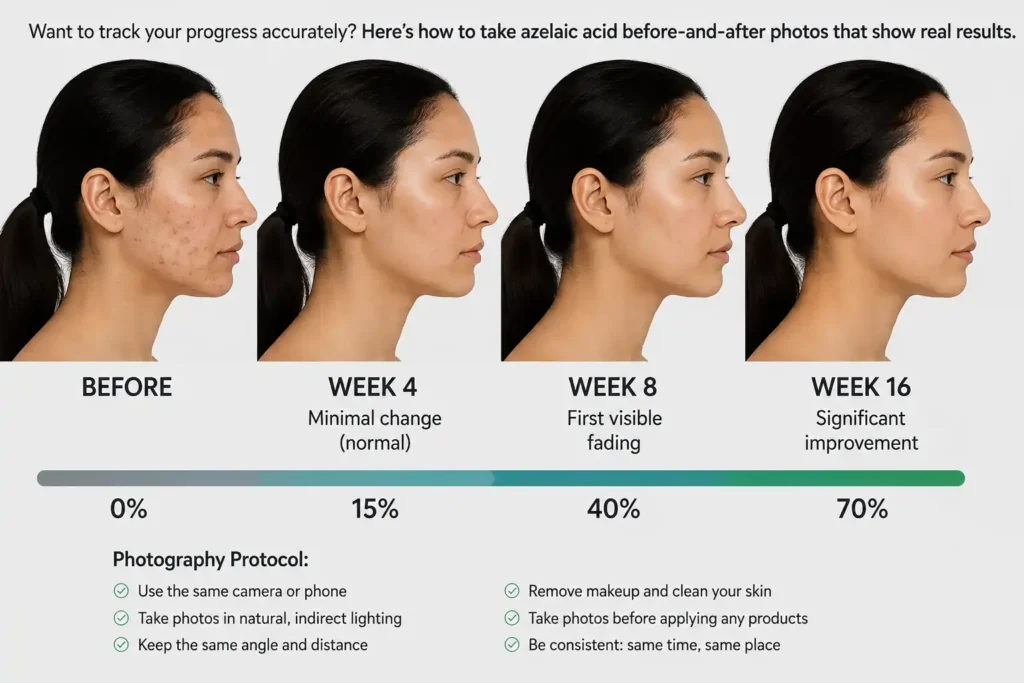
Photography Protocol:
1. Consistent Lighting
- Natural daylight (near a window, no direct sun)
- Same time of day (morning light is most consistent)
- Avoid overhead bathroom lights (create shadows)
2. Same Angle & Distance
- Mark a spot on the floor (stand in the same place)
- Same camera height (chest-level works well)
- Same face angle (front view + 45° left/right)
3. No Makeup or Filters
- Clean, bare skin only
- No skincare products applied (dry face)
- No phone filters, beauty modes, or editing
4. Weekly Photos
- Same day each week (Sunday morning routine)
- Three angles: front, left profile, right profile
- Close-up of specific spots (macro lens if possible)
5. Photo Organization
- Label: “Week 0 – Front” “Week 4 – Left” etc.
- Store in a dedicated folder (not mixed with other photos)
- Compare side-by-side monthly (not daily)
Measurement Tools:
Chromameter readings (professional dermatology offices)
Colorimetry apps (some smartphones have this)
Simple ruler (measure spot diameter in mm)
Dermatology photography apps (document skin changes over time)
Pro tip: You won’t notice daily changes. Comparing Week 0 to Week 8 photos will show dramatic differences you couldn’t see day-to-day.
The 12 case studies above document what happens in practice. If you want to understand the clinical science behind why azelaic acid produces these results — the tyrosinase inhibition pathway, the keratolytic mechanism, and which concentration is appropriate for your specific type of hyperpigmentation — our full clinical breakdown covers all of it: Azelaic Acid for Hyperpigmentation: How It Works, What to Expect, and Which Concentration You Need.
The Real Story Behind Before/After Results
After examining 13 diverse cases, spanning different ages, skin tones, pigmentation types and timelines, one thing is clear: azelaic acid is a useful, slow-acting option that works best with sun protection and patience, and some cases need other treatments too.
70% improvement isn’t failure. It’s success. The difference between “visible from across the room” and “only noticeable up close” is life-changing.
Some transformations happen in 12 weeks. Others take 24 weeks or longer. Melasma requires lifelong maintenance. Sun damage may need professional treatments as adjuncts.
But here’s what every successful case shared: They didn’t quit at week 4 when nothing seemed to happen. They religiously protected their skin with SPF 50+. They adjusted their protocol when initial approaches plateaued. They measured success by significant improvement, not perfect erasure.
Your before/after story is waiting on the other side of 12-16 weeks of commitment.
The evidence supports it. The timelines are realistic. Individual results vary.
Now it’s your turn to document your journey.
Quick Quiz: Test What You Learned
FAQs: Azelaic Acid Before And After

About Subhan Usafzai
Evidence-Based Skincare Educator & Formulation Specialist
I'm Subhan Usafzai (Fazli Subhan), an Evidence-Based Skincare Educator and Formulation Specialist. My background includes first-hand experience as a technician and research support in skin departments across tertiary military hospitals since 2006, and since 2008 I've focused on researching and translating clinical and formulation science into practical, evidence-based guidance. My formal training includes Coursera's Introduction to Cosmetic and Skincare Science and the four-course Introduction to Cosmetic Science and Ingredients specialization (Cosmetic Formulation Science, Cosmetic Product Development, and Quality Control and Regulatory in Cosmetic Science), authorized by Olay. Every article I write is checked against current research and reviewed by our medical team before publishing.
✅ Medically reviewed by Dr. Muhammad Khurram Ahmad, MD, Board-Certified Dermatologist · 📅 Last updated: October 2026
Medical Disclaimer
For Educational Purposes Only: This article is written by Subhan Usafzai, an Evidence-Based Skincare Educator and Formulation Specialist, for educational and informational purposes only. The information draws on scientific research, peer-reviewed studies, and dermatological literature available as of October 2026.
Not Medical Advice: This content does not constitute medical advice, diagnosis, or treatment. It is not a substitute for consultation with a qualified healthcare professional or dermatologist.
Individual Results May Vary: Skin conditions and responses to skincare products vary according to individual characteristics, skin type, hormonal factors, and environmental exposure.
Consult Your Healthcare Provider: Seek professional guidance before changing your skincare regimen, particularly during pregnancy or breastfeeding, or if you have a diagnosed skin condition, take medication, have sensitive skin, or receive dermatological treatment.
Product Safety: Consider patch testing new products. Discontinue use if irritation or an adverse reaction occurs, and seek medical advice when needed.
Affiliate Disclosure
Amazon Associates Disclosure: As an Amazon Associate I earn from qualifying purchases.
Editorial Independence: Affiliate relationships do not determine our product reviews or recommendations. We aim to provide balanced, research-informed information to help readers make informed skincare choices.
Supporting Glow Guide Hub: Qualifying purchases through affiliate links may earn us a commission at no additional cost to you.